




NTSB Determines Human Error Led to Waymo’s Illegal School Bus Passing
Investigators reported a remote assistance error allowed a Waymo driverless vehicle to illegally pass a stopped school bus in Austin.

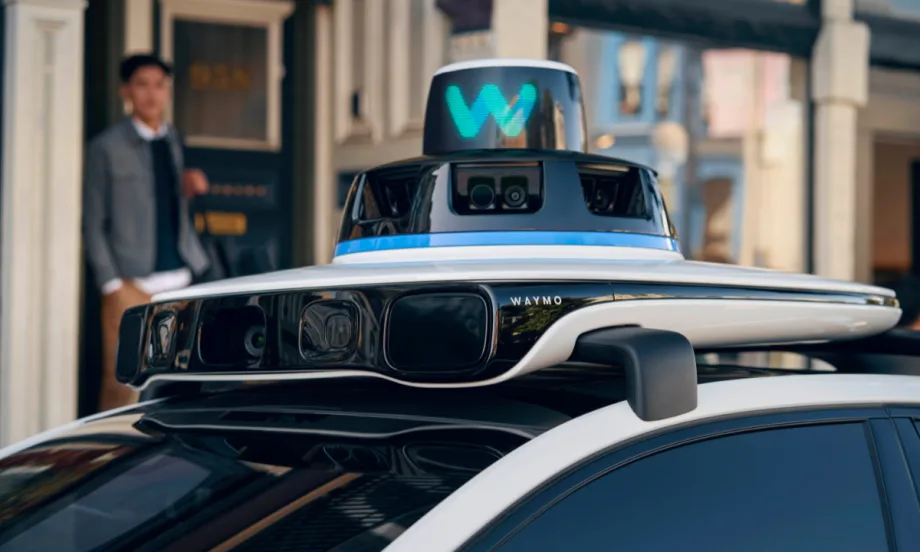
A 2024 Jaguar I-Pace sport utility vehicle equipped with an automated driving system and operated by Waymo LLC passed a 2025 Thomas Built school bus in Austin this school year, adding to an ongoing federal investigation.
Waymo
The National Transportation Safety Board (NTSB) is investigating vehicles equipped with automated driving systems, such as those operated by Waymo, for safety oversight and for illegal passing of school buses. One incident of note occurred in January 2026, when an autonomous vehicle passed a stopped school bus loading students in Austin, Texas, in violation of state law.
According to the NTSB, the incident occurred on Jan. 12, 2026, at approximately 7:55 a.m. CST on East Oltorf Street in Austin. A 2024 Jaguar I-Pace sport utility vehicle equipped with an automated driving system and operated by Waymo LLC passed a 2025 Thomas Built school bus operated by Austin Independent School District while the bus was stopped with its red warning lights flashing and stop arms extended as students were boarding. No injuries or crashes were reported.
The school bus had stopped in the right westbound lane of the 1700 block of East Oltorf Street, a non-divided roadway with two lanes in each direction. The posted speed limit is 35 mph. Weather conditions were clear, and the roadway was dry at the time of the incident.
Video evidence reviewed by investigators shows the autonomous vehicle initially stopped for the bus while traveling eastbound. However, after several other vehicles illegally passed the bus, the vehicle’s automated driving system contacted a remote assistance agent with the prompt: “Is this a school bus with active signals?”
According to the NTSB, a remote operator located in Novi, Michigan, responded “No,” after which the vehicle resumed travel and passed the bus while its stop arms remained extended. A passenger vehicle behind it also proceeded past the bus. In total, six vehicles passed the stopped bus during the incident.
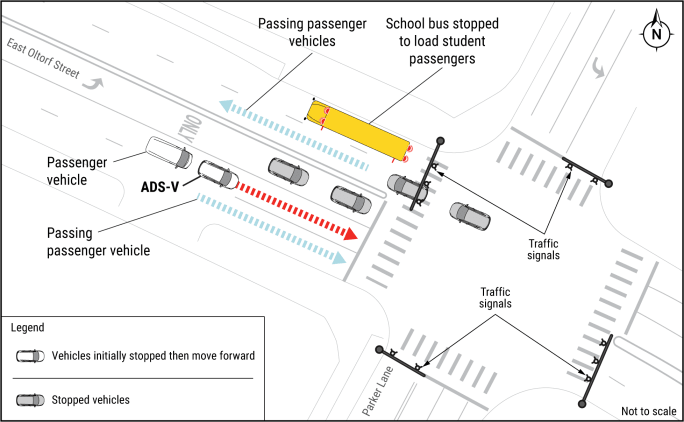
Map of the incident showing the actions of the ADS-equipped vehicle (ADS-V) and other vehicles in the area of the stopped school bus.
National Transportation Safety Board
Repeated Stop-Arm Violations Trigger Ongoing Federal Investigation
The NTSB said it has been monitoring incidents involving automated driving systems and school buses in Texas. Since the start of the 2025–2026 school year, Austin ISD has reported multiple incidents in which Waymo vehicles passed stopped school buses, including the Jan. 12 event and another on Jan. 14 involving a 2023 International school bus operating a special-needs route.
The NTSB opened its investigation in January after reports that Waymo driverless vehicles had passed stopped school buses more than 20 times during the school year in Austin. The agency will determine the probable cause of the incidents and may issue safety recommendations to prevent similar violations in the future.
Waymo is a party to the investigation along with the Austin Independent School District. According to KXAN Austin, the company said it is cooperating with investigators and working with the school district to conduct tests with school buses to better understand stop-arm lighting patterns and conditions.
“We appreciate the work of the NTSB and will remain a committed and collaborative party to the investigation,” a Waymo spokesperson said to KXAN Austin.
The National Highway Traffic Safety Administration is also examining the issue. The Office of Defects Investigation opened a preliminary evaluation in October 2025 into Waymo vehicles near school buses. In December 2025, Waymo announced a safety recall affecting 3,067 vehicles equipped with its fifth-generation automated driving system to update the vehicles’ software.
Austin ISD has reported thousands of stop-arm violations this school year, KXAN Austin reported, though officials say the vast majority involve human drivers rather than automated vehicles.
The NTSB said its investigation into the January incident and similar cases involving Austin ISD school buses remains ongoing.
More Safety

How to Build a Better School Bus Driver Training Program
Is it time to strengthen your driver training? Here’s how to pick the right talent and improve recruitment, retention, and safety. This video is brought to you by IC Bus.
Read More →
Recent School Bus Accidents Leave 2 Dead, 2 Injured
Four school bus crashes in Florida, Illinois, and Georgia highlight risks in transportation lots, at bus stops, and during student loading and unloading.
Read More →
When Every Second Matters, Clarity Keeps Routes Moving
From routine delays to urgent incidents, strong communication practices help drivers, dispatchers, schools, and families respond with confidence.
Read More →

What Happens When a School Bus Catches Fire — and What Can Help
School bus fires are rare but can be devastating. Learn how advances in fire suppression and asset protection help fleets detect fires earlier, reduce damage, and improve safety.
Read More →
Geotab Launches Tool to Help Fleets Investigate Road Incidents
Geotab Investigations combines telematics data, video, documents, and other evidence to help fleets reconstruct incidents, resolve claims, and determine what happened.
Read More →
Texas Sixth Grader Wins 2026 National School Bus Safety Poster Contest
Sai Darshana Yekolu of Moseley Middle School in Prosper, Texas, was named the newest winner for her artwork, bringing the theme of “Safe Rides, Everyday Heroes” to life.
Read More →
Doing More With Less: How Transportation Directors Can Prioritize Safety Amid Budget Uncertainty
With diesel prices soaring and nearly one-third of transportation directors expecting budget cuts, maintaining student safety has never been more challenging. Download this guide to learn how leading districts are prioritizing risk, funding critical safety technology, and building stronger budget cases with data.
Read More →
Walton County Schools Adds Gatekeeper Stop-Arm Enforcement System
The Florida district will deploy Gatekeeper’s updated Student Protector technology, which now incorporates AI to improve video evidence.
Read More →
How To Build a More Secure School Bus Yard During and After Hours
As thefts and overnight security threats continue, school transportation leaders are combining stronger operational practices with AI-enabled surveillance to better protect buses, facilities, and staff.
Read More →
FMCSA Names New Chief Safety Officer: What School Bus Operators Should Know
Steve Dowling is set to lead the federal agency's efforts to advance commercial motor vehicle safety and reduce crashes, fatalities, and injuries on the nation's roadways.
Read More →