





The National Conference of State Legislatures reports that as of July 2025, at least 26 states have enacted school bus stop-arm camera laws.
The Illegal Passing Problem: Reducing School Bus Stop-Arm Violations
About 40 million illegal school bus passings occur yearly. Learn how smart routing, technology, education, and enforcement can save lives in this deep dive.
September 4, 2025
Experts recommend a layered approach to curbing stop-arm violations. Combining enforcement with education, advocacy, policy, and good engineering, are ways to move the needle closer to zero infractions.
Photo: NHTSA/School Bus Fleet
19 min to read
Ask anyone in the industry what their biggest concern is regarding school bus safety, and chances are they’ll cite illegal school bus passings.
Every year, some 40 million times, someone drives by a school bus with its lights on and stop-arm out, endangering students and communities with too many close calls and tragically, multiple deaths per year.
Some say that illegal passing is more than a problem; it’s an epidemic, and a public safety issue.
As distracted driving increased with the use of cell phones, attitudes and busyness also shifted. Technology is partially to blame, but it is also here to help.
While illegal passing has always occurred, we now have more data on it than ever. Let’s dig into this persistent problem and what solutions will help turn the tide.
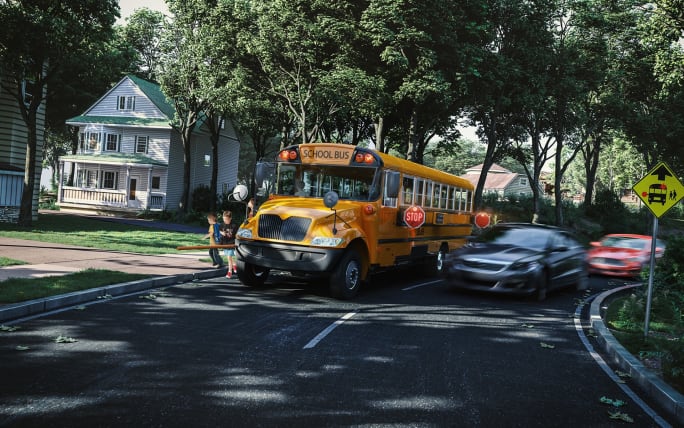
No matter whether the total number of violations is up or down, we all know that it is still happening far too often. Even one is too many, since it only takes one accident to lead to tragedy.
Photo: BusPatrol
Illegal Passing by the Numbers
Let’s start with the facts.
NASDPTS Stats
The National Association of State Directors of Pupil Transportation Services (NASDPTS) started tracking illegal passings in 2011. Its first-ever count reported an average of 0.69 passings per bus per day. This rose through 2019. Post-pandemic, the average has been 0.65.
The 13th annual survey this year estimated 0.59 passings per bus per day and a projected total of 39.3 million violations per year.
It’s the first year with a decline since the pandemic; last year, there were 45.2 million, a 4% increase over the prior year. It rose 4% the year before that, too.
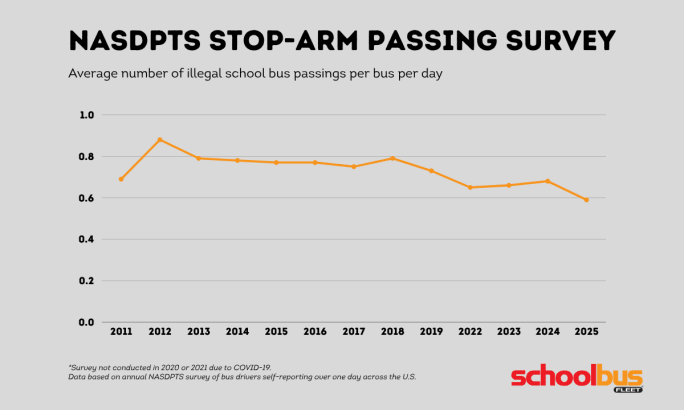
While NASDPTS survey results show that stop-arm passing is finally trending downward, many in the industry say the problem feels worse as distracted driving is on the rise, as are enforcement efforts. It’s worth noting these results are not scientific and vary widely from region to region.
Source: NASDPTS
“We recognize for the first time we have seen a reduction in illegal passings, but we also note the problem is far from resolved,” NASDPTS wrote in a statement. Due to the non-scientific nature of the survey, the association is unable to determine the exact reason for the reduction.
We also know that the vast majority — well over 90% — of passings occur on the left side of the bus. But, one concerning trend is that right-hand passings are increasing. Pre-pandemic, there was an average of 2.15% passings on the right; post-pandemic, it averages 3.02%.
BusPatrol also analyzed the data, noticing an average of 0.7 violations per driver across all states in the survey. However, several states far exceeded that, indicating a greater risk in those communities, as well as opportunity for more education and/or infrastructure improvement.
- Alabama: 5.3 violations per driver
- Arkansas: 2.0 violations per driver
- Arizona: 1.4 violations per driver
- California: 1.2 violations per driver
- Colorado: 1.2 violations per driver
NHTSA Stats
A recent national survey asked over 3,500 people why they think people illegally pass a stopped school bus. The top four reported reasons were that violators:
- Didn’t care: 30.5%
- Were in a hurry: 25.5%
- Didn’t know the law: 24.3%
- Were distracted: 12.2%
Local Stats
Student Transportation of America uses stop-arm cameras at many of its locations, and the information received is troubling. “In my region alone, the data showed that any given school bus was being illegally passed, on average, approximately five times per day,” said Denis Gallagher, Jr., senior VP of operations. “That number is astounding and should raise a red flag immediately for anyone in this industry concerned about safety.”
Clark County School District in Las Vegas recently did a pilot with BusPatrol, catching more than 11,000 violations over five months. It’s an average of 5.6 illegal passings per bus per day.
In Florida, Gatekeeper Systems’ pilot with Walton County School District captured 170 near-miss violations over 28 weeks with just one bus. “That’s six close calls per week where a child could have been hit,” said Jason Harris, VP of student protector programs.
Allentown, Pennsylvania, reported 56.2 violations per weekday, compared to Pittsburgh, where over 9,000 citations were reportedly issued over nine months, averaging 38.6 violations per weekday.
Anecdotally, a bus driver in rural Indiana shared with SBF that 90% of their violations occur on state roads as opposed to in-town. In the first three months of the 2024-25 school year, they saw about 100 violations on 41 routes, though less than 20 were reportable due to blurry video footage and no front license plates.
Meanwhile, Massachusetts Rep. Seth Moulton said that Peabody Public Schools found over 3,400 instances of vehicles failing to stop last year, adding up to 2.3 illegal passes per bus per day.
“Illegal passing isn’t just a problem, it’s an epidemic.” — Denis Gallagher, Jr., senior VP of operations, Student Transportation of America
Distracted Driving’s Role
It’s no surprise that distracted driving was one of the top factors named in the NHTSA survey results.
Drivers can easily miss a stop-arm or react too late when their eyes are on something other than the road, Gallagher, Jr. pointed out.
An NTSB investigation in Excelsior, Wisconsin, also points to distracted driving as the reason a 13-year-old died. There in 2023, a teenage driver failed to stop in time, swerving and side-swiping the bus, striking the student waiting to board. The reason for his slow reaction? Texting while driving.
As a result of the investigation, NTSB reissued its recommendation that cell phone manufacturers install lock-out mechanisms that disable certain features while driving. It also asked NHTSA to create new driver distraction guidelines.
“One of the largest contributing factors [to illegal passing] is the use of mobile devices behind the wheel,” said AngelTrax President and CEO Richie Howard. “Smartphones have made distracted driving worse, and although there’s more media attention and community concern, driver behavior hasn’t improved much. ... But ultimately, real change only happens when drivers face actual consequences — like citations and the fines that accompany them.”
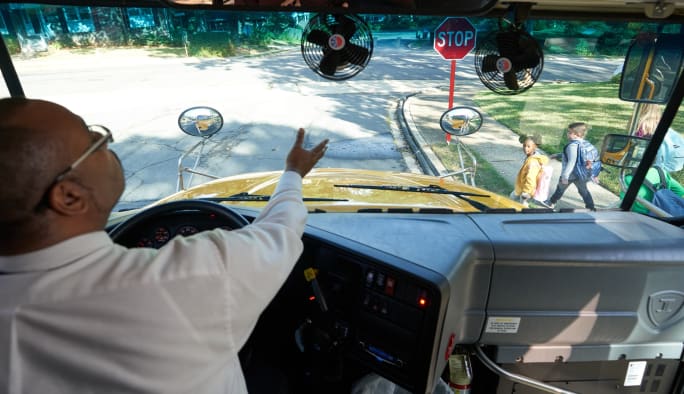
Experts also recommend educating students on protecting themselves by realizing that not all cars may stop when they should. Encourage them to look at the road and wait for a cue from the bus driver that it is safe before crossing.
Photo: NHTSA
Legislation & Enforcement
Currently, there is no federal legislation enforcing school bus passing requirements.
In 2021, the Stop for School Buses Act was signed, requiring a review of illegal passing laws, penalties, enforcement in all states, technologies, and driver education materials. It also called for it to implement a public safety messaging campaign. Led by the National School Transportation Association (NSTA), the PSA would be similar to “Click It or Ticket” to raise awareness, highlighting the dangers of illegal school bus passing.
Now, the proposed Brake for Kids Act seeks to do the same. “NSTA believes this bill will finally move the needle in the direction of safety for kids embarking and disembarking their school buses,” said Curt Macysyn, NSTA executive director. “A national public safety messaging campaign, including television and radio ads, will serve to educate and remind all drivers that it is illegal and dangerous to pass a stopped school bus with its lights flashing and stop arm extended.”
While there is federal oversight, passing is illegal in all 50 states (and in the District of Columbia, Guam, Puerto Rico, and the U.S. Virgin Islands), though specifics and enforcement efforts vary.
Many states and cities are implementing stricter fines and penalties for infractions. New York and other states add points to drivers’ licenses, with steeper consequences for multiple infractions. Drivers in Virginia can face $2,500 in fines and a suspended license, even up to a year in jail if they’re also charged with reckless driving. And this summer, Ohio passed a bill to increase the penalty from $250 to $1,000; there, repeated offenses could lead to a license suspension, a required safety course, and a $2,000 fine.
These efforts work: Both AngelTrax and Verra Mobility report that 98% of stop-arm violators who receive citations don’t repeat the offense. And for those NHTSA survey respondents who “don’t care,” a message about child safety may not stop the behavior, but personal consequences might.
Just last July, Rhode Island’s governor signed a law requiring outward-facing video systems to be added to all school buses in the state.
States are also adopting new ways to fund stop-arm safety programs. In Pennsylvania, a grant collects a portion of the violators’ fine to promote and increase school bus safety, education, and training, or pay for education, training, and other costs related to CDL issuance or endorsement for school bus drivers.
In 2022 with HB 267, Montana mandated that all school buses have an extended stop-arm on any route where a child must cross a road to board.
Thanks to evidence from a BusPatrol pilot in Carson City and Clark County, policymakers and stakeholders came together to help pass Assembly Bill 527. This legislation authorizes the use of automated enforcement cameras on school buses across Nevada.
In Minnesota, a recent bill (which failed last session) sought to remove the $500 mandatory fine for violations. “This would give the courts discretion to set the fine upon conviction,” explained Lieutenant Brian Reu, Minnesota State Patrol. “We have expressed concerns that reducing the fine or removing the ‘mandatory minimum’ fine gives the appearance that stopping for school buses isn’t that important.”
It’s hard for one person to know 50 different laws, pointing to a concern with the law being up to each jurisdiction. When people travel, they can easily find themselves unaware of the local law.
“Streamlining these [enforcement laws] frameworks would reduce confusion and create a stronger nationwide deterrent against illegal passing,” David Dorfman, senior VP of commercial at Verra Mobility, said.
For these efforts to work even more effectively, law enforcement and the judicial system must be fully committed, too. It’s worth the time to get in the ear of your local officials and collaborate on education and enforcement.
NHTSA launched a high-visibility enforcement project last January and is working with five states to test it. It supports law enforcement’s time on the roads to focus specifically on illegal school bus passing. “I don't have results to share [yet], but I will say that they are trending very positive, and we're getting a lot of great feedback,” agency chief Michelle Atwell said. The project is set to be completed in September 2027, and the agency hopes to continue it.
Safe Fleet has also been working directly with law enforcement on a solution to streamline detection, capture data, and process violations with its SAVES system.
“We hope to see legislators continue strengthening and expanding laws that put the safety and security of children first,” said Malinda Sandhu, director of business development, violation detection, at Safe Fleet. “Our automated enforcement systems have detected violations in nearly every scenario — including on the right-hand side of the bus, where students are most vulnerable.”
Kids getting off a school bus are often distracted, Sandhu added. “With naturally short attention spans, their focus is on what’s next — heading to school or what they’re going to do at home — not on the traffic around them. ... That’s why we hope every state continues to pass clear, effective legislation that holds drivers accountable and treats this issue with the urgency it deserves.”
Technology & Hardware Solutions
From making the school bus itself more visible, creating physical barriers to protect children from traffic, or catching violators, many solutions can help deter stop-arm passing. While some are designed to prevent a violation proactively, others ensure that if it has happened, it is documented.
NHTSA has been working on a comprehensive review of the technologies that address illegal passing. The report is not yet available, but as of late July, Atwell said, it is “closer than ever.”
Lights
Stop arms originally had incandescent lights, later evolving to LEDs for added brightness. Now, the entire sign and the word STOP is fully illuminated.
These new illuminated technologies on the stop signs and stop arms have proven to be effective at proactively helping drivers recognize the school bus and stop in time, said Doug Campbell, First Light Safety Products' director of sales.
To determine the effectiveness of such products, First Light studied data from 15 districts with a record of problematic routes or proven passings. All but one showed a significant decrease once illuminated arms were installed. One district — Texas’ New Braunfels ISD — even saw a 100% reduction in violations.
“Additionally, based on our illuminated product’s overall 88% effectiveness on two-lane roads in low-light conditions, it is clear our products make a substantial difference in reducing illegal pass-bys,” Campbell said.
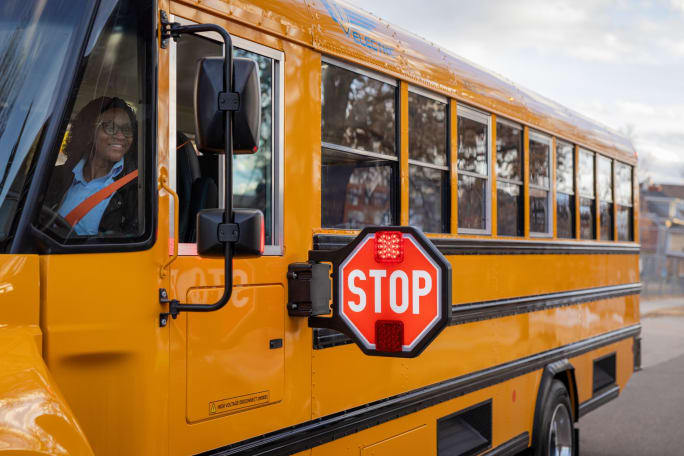
First Light’s fully illuminated stop arms and signage now come standard on IC Buses.
Photo: IC Bus
Campbell also points out that only one OEM has made this new safety tech standard. “If the industry truly wants to address this issue, more OEMs, contractors, and school districts need to take the lead and adopt the use of proven technologies,” he said.
Enhanced & Extended Arms
“Stop arm extensions have only been around for a couple of years, and they are the only proactive safety equipment designed to stop violations before they are committed and a tragedy happens,” said BusGates Co-Founder Dan Thompson.
It works by extending further into the street, making drive-arounds much harder. An aluminum barrier attaches to the stop sign, extending 5 feet from the side of the bus, with bright red flashing LEDs. It weighs less than 3 pounds and takes less than 15 minutes to install.
BusGates cites 95% effectiveness in its product stopping stop-arm runners.
Bus Safety Solutions offers a similar product that reaches 6.5 feet from the driver’s side of the bus and comes with strobing LED lights.
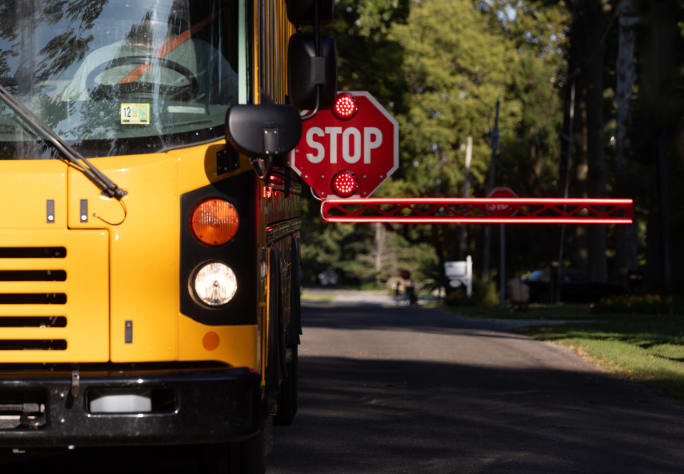
Many solutions are available to proactively prevent school bus passing violations. Here, an extended stop-arm is shown, which sticks out into the oncoming traffic lane to deter someone from driving by.
Photo: BusGates
Driver Alerts
Safe Fleet has evolved its offerings beyond cameras to include the Illegal Passing Suite with three strategic approaches to improve safety, including increased visibility, proactive alerts, and automated enforcement.
One product generating growing interest is its driver alert system — an LED sign mounted on the back of the bus and emergency exit door that helps increase driver awareness and student safety.
When the ambers are engaged, it flashes “stop” or “caution.” When the reds come on, it reads “stop, do not pass.” Both messages help reduce passings by up to 70%, Chris Fox, senior product manager, said.
Student Warning Systems
Safe Fleet also has a predictive stop arm that uses radar and advanced analytics to monitor oncoming traffic and assess danger. “If a driver is distracted and looking down at a phone, flashing lights only do so much,” Fox said. “So we thought, if we can't get the driver's attention, how do we keep the student out of harm’s way?
The company combined its sensors with AI to determine if an approaching vehicle will stop. If the system determines that a vehicle is unlikely to stop, it issues an audible warning through a speaker on the bus, saying “Stop, do not cross,” giving students three seconds to react. There is also a red, amber, and green light visible to the bus driver, indicating if it’s safe for students to cross the street.
“This has truly been a game-changer,” Fox said. “By approaching the issue from a different angle — rethinking how we identify and respond to risk — we’ve developed a solution that’s transforming student safety. Most people are trying to make the bus brighter, make it more visible, so this is a different approach to the problem.”
Cameras
External stop-arm cameras may not deter passing. Still, these systems remain one of the most effective tools for capturing evidence of vehicles illegally passing a stopped school bus — especially when law enforcement isn’t present to witness it. Plus, it’s one less thing the driver has to keep track of.
Not only has camera tech evolved leaps and bounds even in just the past few years, but the price has also decreased, making the investment less prohibitive than it used to be.
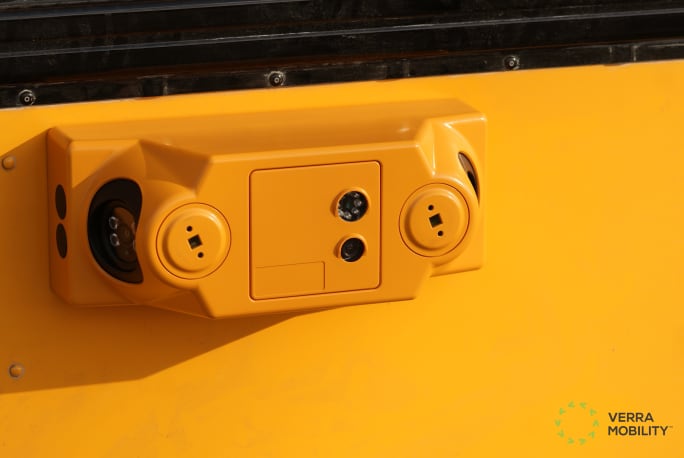
Gone are the days of blurry license plate photos. Camera tech is now better than it's ever been.
Photo: Verra Mobility
Camera technology has evolved from simple video capture to intelligent systems with high-resolution 4K video, AI detection of vehicles entering the violation zone, dual license plate detection that can capture 5MP images from multiple directions across several lanes, automatic violation processing, GPS timestamping, and more.
Videos should also demonstrate that the bus driver approached the stop with warning lights on and applied the stop arm correctly, preventing a motorist from passing.
Make sure to check your state and local law, and work with your camera provider if they will be used for automated enforcement, which requires legislation.
“Stop-arm cameras provide real accountability, capturing and then physically seeing violations in action, issuing citations, and ultimately changing behavior,” Dorfman said.
Dorfman calls out that Verra Mobility has each violation reviewed by two separate experts to ensure that only enforceable and fully compliant evidence packages are submitted to law enforcement. “When programs skip this kind of rigor, it can backfire fast,” he warned, “flooding police and courts with many events where violations didn’t actually occur, which can lead to programs being shut down and result in a lack of trust from the community.”
AngelTrax’s Child Safety Program is a fully automated, end-to-end stop arm violation enforcement solution designed to change driver behavior and keep kids safer. This system automatically uploads video and snapshots to AngelTrax’s secure portal for Child Safety Program reviewers, who begin the multi-tier administrative process, which includes initial review and verification before supervisory review, Howard explained. “A Child Safety Program supervisor will then verify the vehicle owner’s registration data, using DMV and Nlets databases, before elevating the evidence to law enforcement. Authorized law enforcement officers then access a secure web portal, developed by AngelTrax, to review the evidence package, determine whether a violation has occurred, based on state law, and approve or reject the citation request.”
Photo enforcement systems often also come with a district revenue share or violator-funded model to ease the financial burden on school bus operators. Gatekeeper’s Student Protector enables districts to receive nearly 100% of citation revenue, enabling them to reinvest into safety initiatives or operations.
AngelTrax’s Child Safety Program also provides support, appeals, judicial system integration, and revenue distribution and reporting with no third parties. What sets us apart even more,” Howard said, “is how seamless and hands-off the Child Safety Program is for the schools and school bus drivers.”
In Minnesota, a $15 million grant was launched in 2022, with eight rounds of awards to fund stop-arm cameras on 8,000 buses across the state and ask for reporting. Results show 2,105 citations issued in 2024. According to Reu, the number of charges filed or tickets written has doubled after the grant was released.
When both school bus cameras and red light cameras are used, we see even more success. BusPatrol estimates there is anywhere between 20% to 40% reduction in violations year over year, and a recidivism rate around 10%.
In one district, a camera deployment captured hundreds of violations in under six months, Harris said. “With consistent enforcement, violations dropped by over 20% the following school year, proving that technology-backed accountability changes behavior.”
Verra Mobility also reports that beyond its 98% success rate in preventing second offenses, in the 2024-25 school year, there was a 67% reduction in citations from the beginning of the school year to the end.
“Ultimately, issuing a citation also serves as an educational tool, alerting drivers to a violation they may not have even realized they committed,” said Julian Jimenez, senior product manager at Safe Fleet. “When we present a compelling evidence package containing images and video of both traffic and children entering or leaving the bus … it adds a level of realism and awareness that aims to curb future behavior.”
Jimenez adds that with these connected devices, we also gain critical information that can help school officials identify areas of concern and make more informed decisions on routing or collaborate with their city to implement barriers or speed enforcement. These tools can effectively act as an extension of law enforcement, capturing critical evidence without the time and administrative burden.
“What I like about civil fines being levied through automated stop arm camera enforcement programs is that the number of violations means more citations and more members of the public are touched,” said Derek Graham, industry consultant. “If (someone is) angry that they received a citation, they will likely complain about it to friends, thus increasing the overall chatter in the community. More chatter means more awareness and maybe, just maybe, improved motorist behavior.”
Low-Cost, Easy Solutions
No one solution is the silver bullet; there is room for multiple technologies to assist schools with their efforts to reduce violations. Some can even happen with no financial investment.
Routing & Safe Stops
One of NTSB’s formal recommendations to combat the dangers of illegal passing is to reduce the number of routes that require students to cross the street.
NHTSA has an illegal passing social media playbook available with sample social media content in English and Spanish. Try posting it to your district’s or company’s pages. Also, check out their tips for planning safer bus stops.
Safe stop planning includes:
- Right-side pickups and drop-offs when possible.
- Walkable infrastructure with paths separated from the road.
- Knowledge of threats to physical safety, including construction, water, and crime.
- Avoiding stops located at intersections, especially on roads with speeds over 35 mph, or on curves or hills.
- Locating stops in areas with good visibility, free of obstructions, and away from railroads.
- Teaching children to stay out of the danger zone, 10 feet on each side of a stopped bus.
Consider coordinating with your local or state DOT to install signage informing drivers of school bus stops ahead.
Education
A recent survey found that the majority of drivers know the requirements of the law on undivided roads, but their knowledge decreases substantially when approaching a bus from the front on a four-lane road with or without a physical median. This suggests a starting point for community education.
“I think we’re still underutilizing the power of local accountability,” Gallagher Jr. said. “The vast majority of illegal passings aren’t committed by strangers; they’re neighbors, coworkers, parents at the same schools. That proximity gives us an opportunity, and a responsibility, to take this personally. We need more community-driven visibility: local leaders, principals, coaches, even students speaking out and making it clear that this behavior isn’t just dangerous; it’s unacceptable here. Nothing changes culture like looking someone in the eye and saying, ‘We don’t do that here.’”
Connie Grisim, co-owner of Grisim School Bus, offers the idea of setting up presentations at organizations like the Lions Club or Boosters to educate the community. She also said driver training is important, for example, making sure drivers always deploy their lights and stop-arm with enough time and give a visual cue to students that it’s safe to cross.
It's time to start reviewing on back-to-school safety with our kids! 🍎#wetransport#schoolbussafety#backtoschool#driverawareness#generationsofsafety#safetyfirst#bussafetypic.twitter.com/ytgdIsQ4kY
— WE Transport Inc. (@WeTransportInc) August 11, 2025
Don’t forget to educate and train the students on board, too. Reu suggests reminding students to stop, look both ways, and wait for the bus driver’s signal that it is safe to exit or approach the bus before entering or crossing the roadway. Students must be aware that motorists may make mistakes, and they should not assume that cars will stop when they are supposed to.
A Multi-Pronged Approach
Gallagher Jr. warns against only treating the symptom and not the cause. “The real problem is reckless or distracted driving around school buses, and that requires a culture shift. We need to make it socially and legally unacceptable to pass a stopped school bus.”
This will take a village.
All the experts agreed that a multi-pronged approach combining technology with education, enforcement, and community involvement is what will ultimately solve the problem. Basically, redundancy is essential.
NHTSA recommends that stop-arm compliance programs include four basic components:
- Enforcement
- Engineering (road design, construction, signage, tech)
- Education and awareness
- Policy/legislation
Aside from the Safe System Approach, NHTSA also recommends incorporating the following three layers based on specific factors and groups:
- Factor: The law is not obeyed. Target: Motorists. More education is needed to make sure people understand their legal duties when encountering a stopped school bus, why it is so crucial they obey the law., and what penalties exist for breaking the law.
- Factor: Violations are not reported or are underreported. Target: School bus drivers and law enforcement. A driver’s main focus should always be on safe driving and student monitoring; therefore, any reporting, if permitted, should aim to reduce that burden (i.e., through technology).
- Factor: The law is not enforced. Target: Law enforcement, prosecutors, and judiciary. Due to concerns around accuracy of civilian-reported claims, cameras can provide objective evidence. In states where law enforcement must witness the violation, drivers should be empowered and trained to report them. In cases where a judge foregoes prosecution due to lack of evidence, consider how cameras could assist.
“The best approach to tackling the issues will have multiple levels,” Reu said. “It starts with education… We need to remind the public of the law and what’s at risk, the possibility of taking a child’s life.”
Referring to the 2018 Rochester incident that killed three siblings, “Let's not wait for another tragedy like we had in Indiana before we collectively do something meaningful,” Campbell said.
Subscribe to Our Newsletter
More Safety

How to Build a Better School Bus Driver Training Program
Is it time to strengthen your driver training? Here’s how to pick the right talent and improve recruitment, retention, and safety. This video is brought to you by IC Bus.
Read More →
Recent School Bus Accidents Leave 2 Dead, 2 Injured
Four school bus crashes in Florida, Illinois, and Georgia highlight risks in transportation lots, at bus stops, and during student loading and unloading.
Read More →
Sponsored•September 8, 2026
When Every Second Matters, Clarity Keeps Routes Moving
From routine delays to urgent incidents, strong communication practices help drivers, dispatchers, schools, and families respond with confidence.
Read More →

What Happens When a School Bus Catches Fire — and What Can Help
School bus fires are rare but can be devastating. Learn how advances in fire suppression and asset protection help fleets detect fires earlier, reduce damage, and improve safety.
Read More →
Geotab Launches Tool to Help Fleets Investigate Road Incidents
Geotab Investigations combines telematics data, video, documents, and other evidence to help fleets reconstruct incidents, resolve claims, and determine what happened.
Read More →
Texas Sixth Grader Wins 2026 National School Bus Safety Poster Contest
Sai Darshana Yekolu of Moseley Middle School in Prosper, Texas, was named the newest winner for her artwork, bringing the theme of “Safe Rides, Everyday Heroes” to life.
Read More →
Sponsored•August 27, 2026
Doing More With Less: How Transportation Directors Can Prioritize Safety Amid Budget Uncertainty
With diesel prices soaring and nearly one-third of transportation directors expecting budget cuts, maintaining student safety has never been more challenging. Download this guide to learn how leading districts are prioritizing risk, funding critical safety technology, and building stronger budget cases with data.
Read More →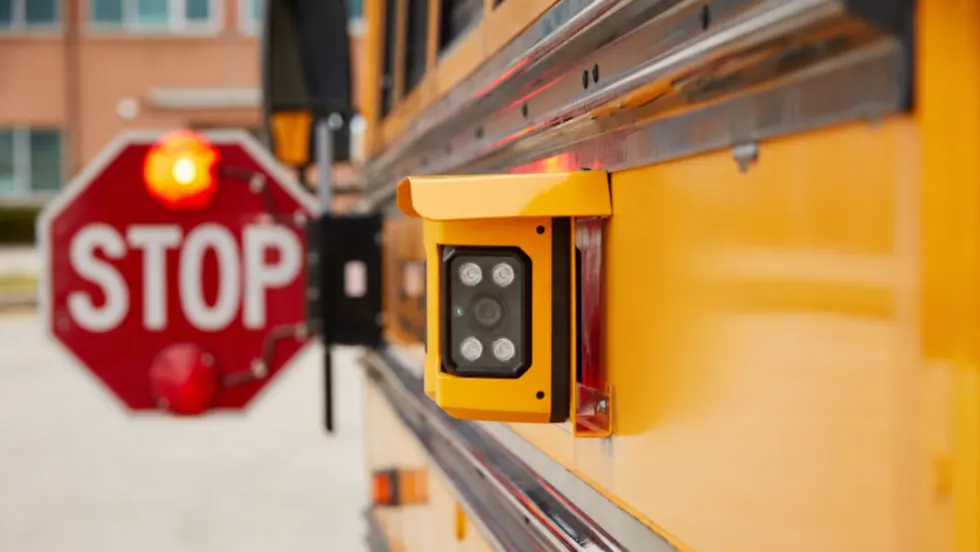
Walton County Schools Adds Gatekeeper Stop-Arm Enforcement System
The Florida district will deploy Gatekeeper’s updated Student Protector technology, which now incorporates AI to improve video evidence.
Read More →
How To Build a More Secure School Bus Yard During and After Hours
As thefts and overnight security threats continue, school transportation leaders are combining stronger operational practices with AI-enabled surveillance to better protect buses, facilities, and staff.
Read More →
FMCSA Names New Chief Safety Officer: What School Bus Operators Should Know
Steve Dowling is set to lead the federal agency's efforts to advance commercial motor vehicle safety and reduce crashes, fatalities, and injuries on the nation's roadways.
Read More →