





Need advice on implementing electric buses from those who’ve been there? CALSTART’s Electric School Bus Network facilitates bi-monthly discussion forums, highlighting success stories and solutions to common challenges by connecting school districts, fleet operators, manufacturers, utilities, and policy leaders through peer-based forums and resources. Sign up for future forums or watch past recordings online.
The State of Electric School Buses: Where We Are and Where We're Going
Electric school buses face hurdles in funding, supply, and infrastructure, but adoption continues to grow. Here’s where the segment stands.
September 26, 2025
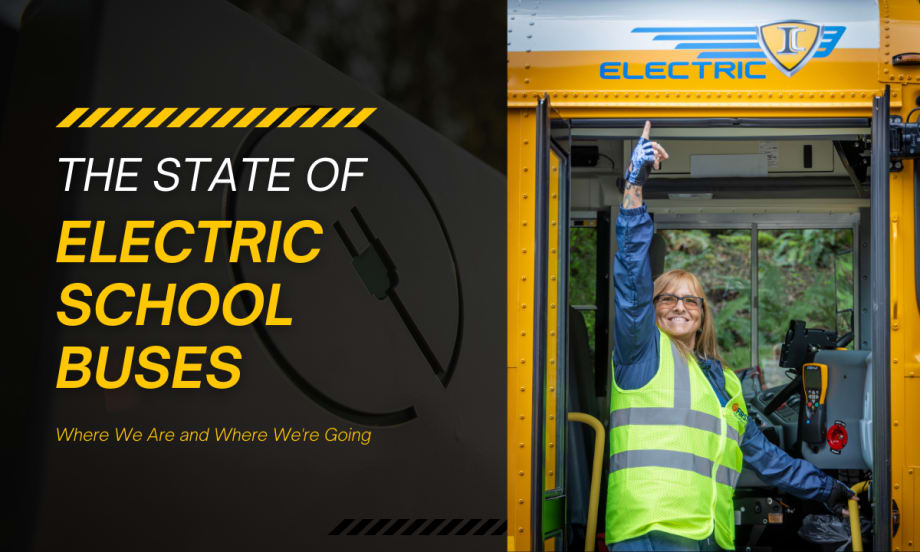
A First Student bus driver for Tacoma Public Schools celebrates its new electric buses.
Photo: First Student/School Bus Fleet
23 min to read
With a new federal administration, changing regulations, price concerns, not to mention funding uncertainty, one might think that electric school buses are in decline. However, those directly involved in the industry’s electrification say recent events are merely a hiccup. Electric bus projects are still very much powering forward in North America.
So, where do we stand with electric school bus adoption, technology, inventory, funding, and more? School Bus Fleet talked to a range of experts to find out.
Electric School Bus Adoption to Date
The biggest recent shift to electrification for school buses took off about five years ago, around when the EPA’s Clean School Bus Program was launched.
In 2020, just over 400 ESBs were on the road, and 1,226 were on their way. Three hundred school districts had at least one committed electric school bus, according to WRI’s Electric School Bus Initiative.
Now in 2025, over 5,000 ESBs are in operation, and almost 14,000 are committed. Over 800 districts have at least one ESB now, and 1,500 are committed. Electric school buses (ESBs) are on the road in 49 states, D.C., four U.S. territories, and more than 20 tribal nations.
“These figures make it clear: the electric school bus moment has arrived, and it isn’t going anywhere,” said Sue Gander, director of the Electric School Bus Initiative.
WRI estimates that electric bus commitments now account for 2.9% of the total U.S. school buses, transporting approximately 265,000 students. About 6% of U.S. school bus registrations are now BEVs, according to Polk registration data as of June 2025.
What has also changed is where ESBs are deployed. No longer a phenomenon limited to the coasts, adoption has spread everywhere (pending Wyoming). WRI data shows the Midwest accounts for 15% of all electric school bus commitments, the Northeast for 21%, the South for 31% and the West for 33%. And, the split between politically red and blue states has evened out too, with rural areas also coming on board.
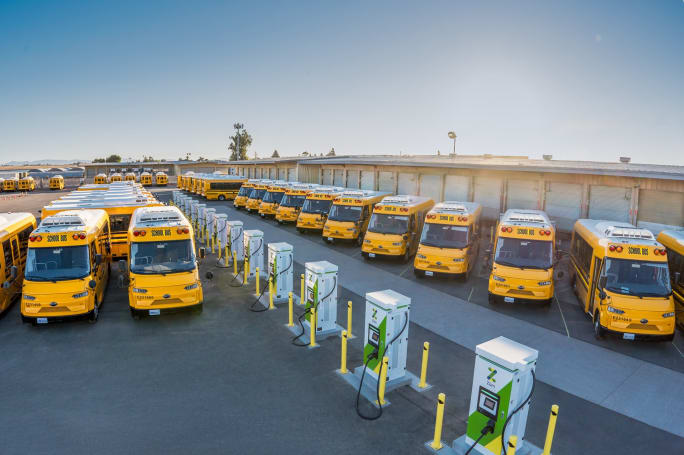
RIDE and Zum supplied Oakland Unified School District with 74 all-electric school buses and charging technology in 2024.
Photo: Zum
School districts with the highest number of electric bus commitments are:
- Montgomery County Public Schools, Maryland: 540
- Los Angeles Unified: 440
- Boston: 241
- Miami-Dade, Florida: 150
- New York City: 125
- Fairfax County Public Schools, Virginia: 106
- Beaverton ISD, Oregon: 101
- Clayton County, Georgia: 100
- Milwaukee School District, Wisconsin: 100
- Broward, Florida: 85
In Canada, the number of electric school buses has doubled from 900 in 2023 to 1,930 now, according to the Canadian Electric School Bus Alliance (CESBA). Quebec has the most, followed by British Columbia, Prince Edward Island, and Ontario. Five provinces have no electric school buses.
Currently, 70% of Canada’s school buses are powered by diesel; 3.9% are electric.
A Changing Regulatory Environment
Currently, seven U.S. states have enacted zero-emission school bus transition requirements, two plus D.C. have non-binding transition goals, and 11 states have adopted California’s Advanced Clean Trucks rule. The latter, currently in a legal battle, requires manufacturers to sell ZEVs as an increasing proportion of sales over time.
In New York, all new school bus purchases must be electric by 2027, with full fleet conversion by 2035.
States that have adopted CARB’s Advanced Clean Truck rules are:
- California
- Colorado
- Maryland
- Massachusetts
- New Jersey
- New Mexico
- New York
- Oregon
- Rhode Island
- Vermont
- Washington
The above list accounts for 34% of school districts and 35% of all school bus riders nationwide in states with some form of zero-emission requirement.
Nationally, in 2024, the U.S. EPA announced its final rule, phase 3 of the Greenhouse Gas Emissions Standards for Heavy-Duty Vehicles, which set stronger standards for new model-year 2027 and 2032 vehicles under the previous Biden administration.
Since, the Trump administration has rolled back many of the national electric vehicle (EV) credits, incentives, and rules, and is seeking to end EV mandates and GHG emissions rules. It has filed lawsuits against CARB’s Clean Air Act, calling it a “power grab,” prompting California to reaffirm its commitment to clean transportation. Other U.S. states came together to file lawsuits challenging the federal rollback. However, in response to challenges from 17 states, CARB has agreed to fully repeal portions of its rule and clarified it will not enforce the 100% zero-emission sales mandate for model year 2036 “until and unless CARB obtains a waiver from U.S. EPA.”
One segment most affected by the rapidly changing environment is the manufacturers, most of which were racing to meet federal electrification targets set by the Biden administration.
Some EV-only manufacturers are feeling the tug-of-war most. On the consumer automotive side, Rivian said that the rollback of fuel economy standards is holding up $100 million of its expected revenue. But what about school buses?
While it remains to be seen exactly how green mandates will play out in the new federal environment, Blue Bird said that it has not lost one EV order, and this year has maintained the biggest backlog since the product launched.
In Canada, the federal government has asked for 35% of new medium- and heavy-duty vehicle sales to be electric by 2030 and 100% by 2040. Some provinces have set their own targets: B.C. following California’s standards for a goal of all-electric by 2036, P.E.I. aiming to electrify half of its buses by 2027, and Quebec mandating all new bus purchases be electric as of November 2021. However, despite Quebec’s early standard, it has since reversed course. Earlier this year, its provincial government no longer required new purchases to be electric in the wake of the shakeup at Lion Electric.
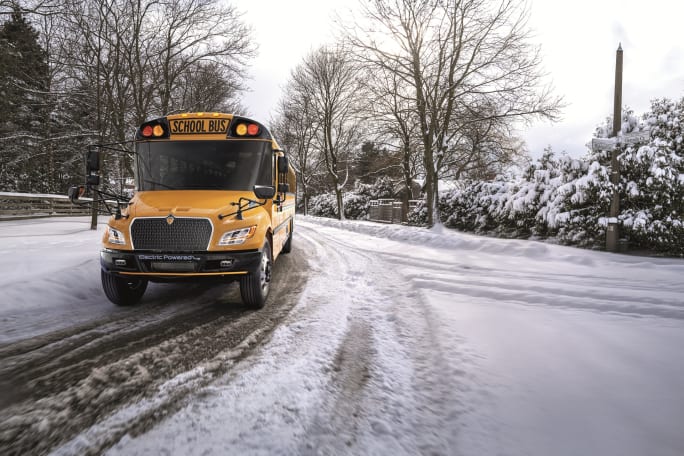
IC Bus’ next-gen electric CE Series now allows drivers to adjust regenerative braking levels.
Photo: IC Bus
Where the Tech Stands
While electric school buses aren’t new, they’ve had a wave of resurgence thanks to the battery innovation for passenger vehicles. The early electrics ran their course in the early 2000s, Brad Beauchamp, EV product segment leader, recalled. He credits industry work on fuel cells and batteries for the next wave, which started with electrifying utility trucks, and school buses following.
“In just a decade, electric school buses have grown from cobbled-together science fair projects into hard-working applications that showcase real innovation while constantly improving in range, technology, and total cost of ownership,” said Frank Girardot, RIDE’s senior director of communications.
New technologies like e-axles (an electrified version of the vehicle’s powertrain) and improved high-voltage components are benefiting the landscape, too. Battery technology has continued to improve, with up to a 300-mile range with the largest pack option. Cell technology has also increased energy density and improved kWh storage.
Thomas Built Buses notes that customers are experiencing tangible cost savings, including reduced brake replacements through the use of regenerative braking.
Range anxiety was a concern from the get go — and arguably still is — with early estimates around 40 to 100 miles. Smart charging, route rotation, and driver training all help extend both battery range and life and reduce operational costs now.
RIDE has recently increased the range on its Type A bus, incorporating customer operation data after two years in service, upping it from 105 to 120 miles. It also comes in an activity bus version and has a new hydraulic brake system that was tested in Minnesota winter and Arizona summer. Its Type C bus has a range of 170 miles, Blade battery technology, and its structure test was just completed.
According to IC Bus, Putnam County School System in Tennessee reports that its two electric buses operate at approximately one-third the energy cost of diesel alternatives. Its monthly average to power both has been $350. Ron Chaffin, transportation department supervisor, calculated that the average cost for the diesel for both buses would be around $1,000 for the same period.
IC Bus’s next-generation electric CE Series features an enhanced design with notable updates for customers, including a redesigned driver's area for improved accessibility, comfort, visibility, and safety. It also includes a stalk shifter that allows drivers to adjust regenerative braking levels, enhancing energy recovery and helping them focus on the road.
Other industries have seen more advanced electrification efforts compared to school buses. Alison Wiley, founder of the Electric School Bus Newsletter and a consultant, estimates the electrification of school buses is about seven years behind the electrification of public transit. “China has well over 300,000 electric public transit buses on the road and has for many years,” she said. “The technology has been well-proven elsewhere. It's easy for me, maybe for all of us, to be U.S.-centric.”
Many say that the yellow bus is actually a near-perfect candidate for the technology. This is due to predictable routes, consistent schedules, and centralized charging depots (at least compared to long-haul trucking and other working vehicles).
CESBA says that the total lifetime cost of an electric bus, without incentives, by 2030 is almost that of a diesel.
One plus to running electric buses is their potential to strengthen grid reliability and support emergency preparedness, Highland Electric Fleets adds. These buses are essentially mobile energy storage units with consistent schedules, making them capable of supporting technologies like vehicle-to-grid (V2G), vehicle-to-building (V2B), and vehicle-to-everything (V2X).
School Bus Manufacturer Updates
All of the major manufacturers remain committed to ESB production.
The biggest news of late in ESB manufacturing comes from LION (formerly Lion Electric). Earlier this year, the Canadian-based OEM founded in 2008 had significant revenue drops prior to seeking bankruptcy protection, reported faulty buses, layoffs, manufacturing suspension and a plant closure, and investigations for federal securities fraud. After failing to find creditor protection in December, it went into liquidation. But last May, local investors acquired the company.
LION’s new owners intend to refocus solely on the Quebec market, and all U.S. warranties were voided. This affects about 1,600 buses placed in U.S. operation and even more orders on the books. Fortunately, other U.S. OEMs and dealers stepped up to help districts with Lion buses repair or replace them.
“LION is now seen as a black eye in the industry,” Wiley said. “It's a very bad experience for a school bus fleet to have warranties be voided. That said, LION really moved electric school buses forward in developing the technology.”
Another purpose-built electric school bus manufacturer is RIDE, the U.S. counterpart to BYD. The parent company has been around since 1994; RIDE since 2023. Wiley says RIDE has the most powerful batteries she’s seen, likely attributed to its parent company’s 30-year history in battery production.
Girardot says RIDE is just getting its toes wet in the ESB market. “As our footprint continues to grow across the United States, we love to tell folks that we're proudest of our motto — Real Innovation Delivered with Excellence — and what it stands for in our products,” he said.
Last year, RIDE delivered more than 60 battery electric school buses equipped with vehicle-to-grid technology in Oakland, California. It has delivered more than 180 ESBs to over 18 districts and plans to deliver 100 more by the end of this year.
In a recent GreenPower investor webinar, the manufacturer stated that it can make one ESB every two weeks, and is aiming for a production goal of eight per month.
Thomas Built Buses’ EV is the Saf-T-Liner Jouley. It was originally introduced in 2017, with the second-gen release earlier this year. It includes many of the same safety features found on its traditional buses and has an 800-volt Proterra battery with Accelera 14Xe axle and a digital instrument cluster.
Thomas Built has now delivered 1,500 of its EV buses across North America, including all ESBs in place at Montgomery County. The OEM claims 36% of the U.S. Type C market for both EV and ICE as of June 2025.
IC Bus, which has nearly 1,500 ESBs on the road, has launched new complete service contracts for its zero-emission buses. “What that does is gives you a flat line for all your maintenance costs, so you can actually pick and choose different buckets and programs for maintenance,” Shane Cauble, sales director at IC Bus, said. “If you take a bus to a dealer, they fix the bus…. and it's already paid for, included in the price of your bus, so you know exactly your maintenance cost.”
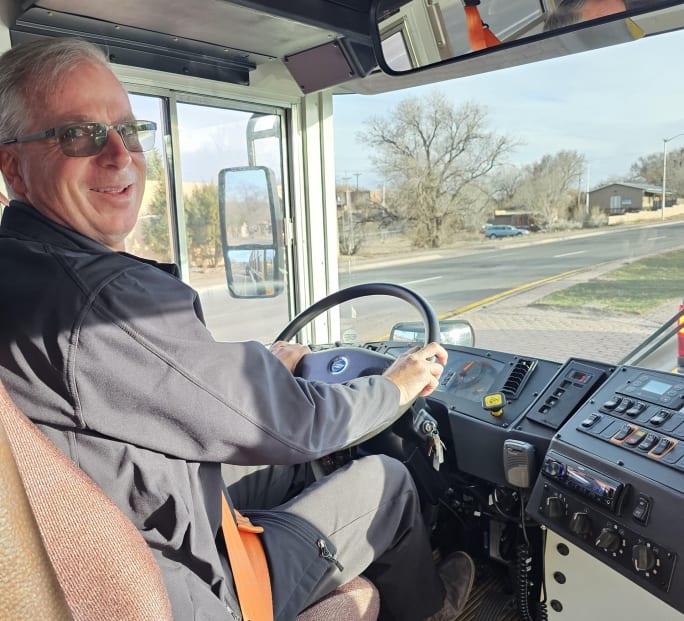
Brad Beauchamp gets behind the wheel of one of Blue Bird’s electric school buses.
Photo: Brad Beauchamp
Blue Bird claims first to market with a fully electric school bus in the U.S. Its early ESBs were a joint venture with Westinghouse and used in the 1996 Olympics in Atlanta. Now, the manufacturer has more than 2,500 electric school buses in operation covering 5 million miles and counting.
A record order of 180 (more) EV Blue Birds was placed by Los Angeles Unified School District (LAUSD) in 2024 to meet its goal of a 100% electric bus fleet — the company’s single largest EV deployment to date.
“What I was impressed with there is the attitude that the people that we trained — the maintenance technicians, the safety people, the leadership at the yards — these people are dedicated, and they really love student transportation,” Beauchamp said. “Every interaction we had was positive, and it's hugely refreshing because of the challenges of being such a large organization, where it's not always easy to make things work. But they found a solution.”
Sales, Pricing, Delivery & Inventory Trends
Diesel continues to dominate school bus orders, but electric buses are making gains.
In 2020, there were just 459 electric school bus orders placed nationwide, according to WRI. By 2024, that surged to 2,698, representing an estimated 7.5% of all new school bus sales. This is up from just 1% in 2020 — a milestone on par with the electric vehicle market for passenger cars, Gander points out.
How is market uncertainty affecting this segment, though?
Years ago, the hope was that EV bus pricing would fall off as the product scaled. That hasn’t happened yet due to a still-small pool of manufacturers and the fact that batteries are the most expensive parts of a bus. “I think we'll see a little bit of price concession after we get through 2025 when we know how the tariff situation is going to work out,” Cauble said.
Jason Yan, on behalf of RIDE, agreed, noting that the cost of oil and lithium production will also balance the high demand and should lead to lower pricing next year.
Jenna Van Harpen, VP of national fleet sales, added that Blue Bird is trying every day to challenge its suppliers to reduce prices. The challenge happens when the price of the bus isn't changing, though. “It's a tariff, but we are trying to get there,” she said at NSTA’s 2025 annual meeting.
“Tariffs are impacting the supply chain, and we are working closely with suppliers to understand the full impact,” said Mark Childers, powertrain and technology sales manager for Thomas Built Buses. “Because tariff rules remain fluid and uncertain, we have implemented tariff pricing on future orders and will continue to adjust as more details are finalized.”S
Thomas Built Buses states that its lead times have improved, with BEV order-to-delivery times in the eight- to 12-month range.
Cauble referenced the overall downturn in production from 2020 to 2022 at NSTA’s meeting, calling 2023 a comeback year. “We see a pretty steep climb into 2027, depending on what the industry can handle capacity-wise,” he said. “The lines are very dependent on production capacity and improvement, as well as any component supply issues. But we know the demand is high and it's pent up based on some of the replacements that did not happen.” IC Bus said its overall current backlog is down 7,000 units versus early 2024.
Blue Bird had a near 50/50 split between diesel and alternative-fuel sales from about 2016 to 2020, when the scale tipped in favor of the latter. In 2022, the OEM experienced its first year of decline in diesel purchases. Now, 60% of its sales are for alt-fueled, non-diesel vehicles. Beauchamp said a new electric Blue Bird order would take about five to eight months for delivery right now, shorter than a new ICE order.
As of July, RIDE said its lead time is still up to 10 months. The company believes that prices will remain stable this school year and says it doesn’t anticipate any disruption in delivery schedules.
In Canada, the upfront new vehicle cost for an ESB is anywhere between 1.5 to 2.5 times higher compared to a comparable diesel (CESBA cited $400,750 for a Type C electric; $150,000 for diesel). There, available funding does not yet meet (most) operators' needs.
Nearly 20 ESB models are currently available from more than 10 manufacturers for Type A, C, and D buses, including repowers.
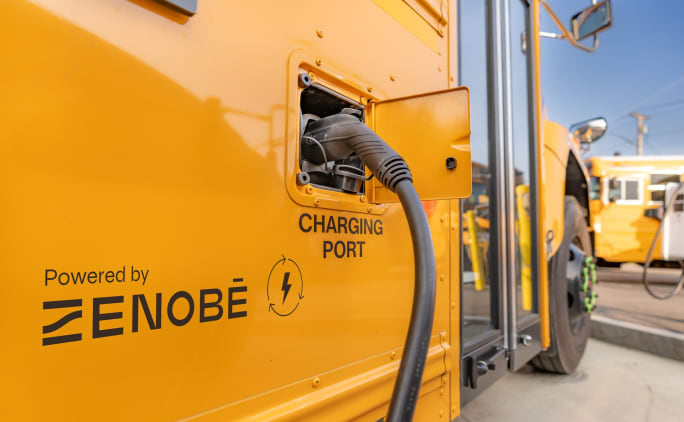
Zenobe encourages considering shifting the cost of batteries to a third-party under a “battery-as-a-service” program.
Photo: Zenobe
Current ESB Challenges
As with any new technology, there are challenges.
Funding & Costs
Funding is always hard for operators’ strapped budgets, and many states have yet to develop clear incentive programs.
Aside from the cost of the bus itself, charging costs, too. “We have started to see routine (EV) maintenance cost savings, which is an encouraging sign for long-term operational savings, but the cost of electricity versus diesel varies from location to location,” Rachel Laughlin Lane, VP electrification, Student Transportation of America (STA) said. She adds that timelines for receiving switchgear and transformers have improved from a couple years ago.
STA did experience one more surprise expense: “We did not expect to get an increase to our property tax after we installed EV chargers at one of our terminals,” Lane told SBF.
“Concerns about the upfront cost of electric school buses are understandable and valid,” Gander said. “Elected officials have a responsibility to support districts’ ability to provide clean transportation to their students until the electric school bus market matures to the point where electric models reach total cost of ownership parity with their fossil-fuel burning counterparts.”
One alternative to buying new is considering a repower, a retrofit system that converts a diesel bus to electric. Although brand-new buses typically cost more than $300,000, repowered buses can cost between $110,000 and $180,000, according to WRI.
Electrifying a fleet involves more than buying buses, though. And according to Wiley, learning charging technology is way harder than learning about the buses.
To be successful, planning and coordination must happen across multiple vendors. “An electric school bus fleet needs detailed route modeling, planned charging schedules, and adequate grid capacity,” Brian Buccella, chief commercial officer, Highland Electric Fleets, added.
Without a trusted partner, navigating this process alone can be intimidating and poses an administrative and educational burden.
Infrastructure
It’s no secret that infrastructure lags behind ESB production, making charging questionable in some places. And while public charges are even harder, experts advise planning on-site depots and coordinating with utilities at least one year in advance.
“Until there are reliable community charging hubs, like those … in the trucking space, school bus electrification will continue to be a challenge for field trip and extracurricular routes,” Lane said.
Beauchamp references some electric bus orders that have already been completed that are still not delivered because of a charging holdup. “I certainly don't want to build you a bus if you're not ready for it on the infrastructure side,” he said.
One barrier to getting reliable infrastructure is that the utilities in our country are dealing with aging power lines and higher energy use (especially as AI ramps up), Wiley said. “Once in a while, electric school buses show up in a schoolyard and there's no chargers yet for them,” she said. “So we always advise districts to start on their charging before they look at bus models. And it's hard to do that because you feel out of your depth having a conversation with a utility.”
For instances in which there might be interconnection delays or grid constraints, the industry is responding with innovative solutions, Rachel Chard, deputy director, electric school bus projects, CALSTART, said, mentioning First Student’s trenchless charging solution, First Charge, and the Fast & Flexible Interconnection program from Itron and The Mobility House.
Antelope Valley, California, where the first fully electric public transit fleet is in the U.S., found a smart solution in sharing its infrastructure. There, its transit agency operating BYD buses coordinated with its school district to use the same chargers. The district’s buses were made by RIDE, and that success is what inspired them to seek an all-electric fleet, Girardot said.
Of note: Public EV chargers are growing steadily in the U.S., according to a Canary Media report. Where 60,000 could be found in 2018, there were 200,000 as of 2024. Growth has been slower than Europe and China, but continues to build.
Supply
Then there’s that darn supply chain that is still recovering — now with higher prices from tariffs and inflation. While other aspects are closer to normal now, Kevin Matthews, head of electrification at First Student, says the supply chain for charging infrastructure is the biggest challenge.
“Not only are we competing against other medium and heavy-duty entities that are electrifying their fleet, we also compete against the commercial building sector because they use several of the same components we have,” Matthews wrote.
In Canada, it’s similar. CESBA says to meet its own federal emissions targets, battery and manufacturing capacity must increase.
Education & Training
The workforce must also be ready to maintain and operate ESBs. Electric vehicle critics often point to broken-down electric buses as proof that they don’t work. But, others say those claims are exaggerated, and that ESBs are still widely misunderstood with a learning curve for mechanics and drivers, not to mention warranty issues. The good news is that more information and education are available for high-voltage maintenance.
Many of the early adopters have helped work out the “kinks” too. “For the most part, suburban, urban, rural, doesn't matter what state you're in, what temperature or climate,” Beauchamp said. “We've all had a lot of learnings from this. And yeah, there's challenges, but we've been working through them. Which is a cool thing.”
Many drivers are doubtful of driving electric when they’ve become accustomed to diesel. IC Bus said it has recognized the importance of training and ride-alongs in overcoming initial hesitation. “We see many drivers who express a desire to never go back to diesel once they get comfortable with zero-emission,” a company rep said. “Be wary of misinformation in the marketplace. Do not believe the negative comments without driving a bus for yourself.”
While battery range and performance is increasing, it’s still not yet enough for all areas of the country. Some rural, remote, mountainous regions can prove incompatible, as can some areas in extreme climates.
There is still work to be done in this area, according to Maggie Clancy, EVP fleet business development at Zenobē. “Some fleets have been burned by partners that overpromised and underdelivered,” she said. “Every depot, district, and daily route schedule is different and deserves a bespoke upfront assessment and a collaborative approach to electrification.”
WRI notes, however, that ESBs are performing successfully in various climates, altitudes, and terrains. From the mountain winters of Salt Lake City and Vermont to the harsh cold of Michigan, Minnesota, and South Dakota, electric school buses are handling winter weather well, Gander writes. And in the desert heat of Arizonaand humid summers of Miami, electric school buses are making the grade across all types of climates. The Eastern Band of Cherokee Indians in North Carolina leverages regenerative braking to help cover their mountainous electric school bus routes.
The Future of Funding
The U.S. EPA’s Clean School Bus Program (CSBP) is largely responsible for the rapid rise of electric bus projects. This same program, not surprisingly, funded most ESBs, with two-thirds of all purchases coming from CSBP money. WRI says 114 total sources have funded ESBs. And, California-specific sources comprise five of the 10 most frequent ones.
To date, CSBP has awarded nearly $3 billion to fund 8,600 electric school buses to 1,200 school districts. As of July 2025, it was unclear if the remaining $2 billion would be made available.
Through January 2025, WRI said federal funding went toward 8,917 buses; state funds 2,629; VW settlement 739; regional 200; and the rest unknown or utility, private, or other.
“We've had some boom and bust with funding,” Wiley said. “The EPA represented a huge boom, and now I think that it’s going to be a slower growth curve for some time. But it’s clear that it still has traction. I see commitment everywhere I look.”
Beauchamp agrees. “The growth rate will be more like it was before,” he said. “The one thing that supercharged (ESB adoption) was the EPA money. So, take that as if it didn't happen, and that's what it feels like right now. You're still seeing growth, but you're not seeing the frenzy of people going, ‘hey, there's free money, and we gotta take advantage of it.’ When you get to this point, people are discerning. They're going to be in it for the long haul.”
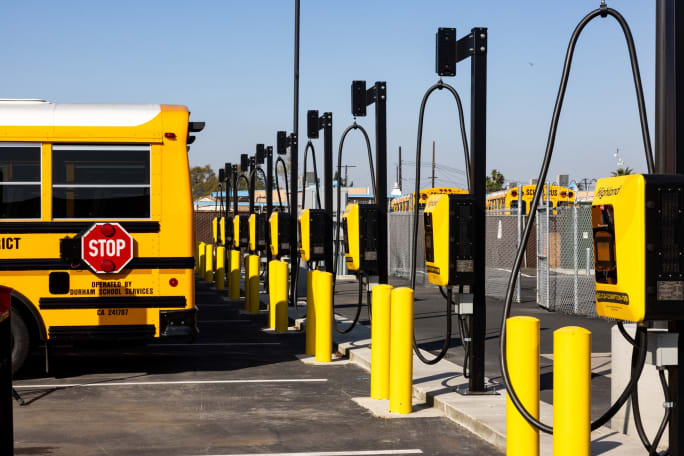
Last February, Compton Unified School District and Durham School Services launched 25 electric school buses and 25 Tellus chargers.
Photo: Durham School Services/Highland Electric
Regardless of federal funding status, states are poised to step up. State-level funding for ESBs has grown from $268 million in 2020 to $2.47 billion in 2025, according to WRI.
In fact, states have been at the forefront of the ESB transition even before the CSBP, WRI maintains. Continued momentum at the state level is a strong indicator that they’ll continue, even when gaps are created by disruptions to federal funding, Gander said.
In August, Maryland committed $12 million to find electric school buses for seven districts, and New York added $200 million more to fund ESB adoption. Yet in the latter, some districts say it’s still not enough and unrealistic. Greece Central School District told Audacy it was "a drop in the bucket," and that the estimated cost for an all-electric fleet would range from $120 million to $150 million.
“I foresee financing solutions becoming more available or more interesting to fleets that hadn’t considered them in the past,” Chard said. For example, the Connecticut Green Bank launched a Fleet Electrification Accelerator Program that provides free plans and financing assessments to school bus fleets in Connecticut’s distressed municipalities.
“The amount of technical assistance and resources available for school bus fleets is unrivaled by most other vehicle sectors,” Chard added. “This is something the school bus industry is doing really well!”
Zenobē also mentioned that new financing approaches can make a real difference, especially Battery-as-a-Service and Electric Vehicle-as-a-Service models. These offer flexible, lower-risk paths to electrification, allowing operators to avoid large upfront capital investments by turning battery and vehicle costs into predictable, monthly expenses, Clancy explained.
The former allows operators to lease the battery, covering around one-third of the bus cost, while receiving monitoring, replacement, and performance guarantees. The latter bundles the bus, charger, software, and support into a single, managed package.
“Understanding battery value is key to unlocking private investment,” Clancy said. “Most batteries still retain significant capacity after their first use and can be repurposed for energy storage. This second-life value turns batteries into strategic, bankable assets, and opens the door to private financing. When paired with public funding, this can create strong public-private partnerships and deliver tangible benefits.”
Several industry vendors offer customized grant support, including Zonar, A-Z Bus Sales, Sonny Merryman, and Blue Bird’s Clean Bus Solutions, not to mention services available direct from OEMs and charging and infrastructure providers.
Beauchamp noted that there are a number of people who know that even without funding, they're going to continue on the EV path because going zero-emissions is the right plan for them.
Are EVs Right for Your Fleet?
Even EV advocates acknowledge that electric isn’t for everyone, so some skepticism is warranted — and electrification should never be portrayed as a silver bullet.
“They may not be the right fit everywhere, but where routes, schedules, infrastructure, and a vision for cleaner transportation exists, they can be a win-win solution,” Childers said.
Kicking the tires on something new takes time, Highland Electric Fleets said. “This isn’t about rushing into a big change. It’s about having the right support while you explore what might work for your district.”
If and when you are ready to go electric, don’t go it alone. Plan carefully based on your routes, energy needs, and depot options. Modular approaches enable you to scale gradually and spread costs over time. Find a proven expert or trusted peer to help set you off on the right foot, even if you take baby steps to test the EV waters.
“The people who are good at this generally make themselves available for conversation,” Wiley said. “Craig Beaver at Beaverton School District is a prime example. You'll succeed and have a better experience if you tap into their knowledge base.”
Where We’re Headed
As electrification projects slow — but certainly not stop — fleets all over the country will figure out their plan. We may see more repowers or adoption of other alternative fuels for a more varied landscape. Wind, solar, and hydrogen fuel cells may step in alongside V2G and V2X to alleviate the burden on the grid.
Beauchamp noted one area of opportunity is creating a secondary market for electric school buses. In cases where an operator tests the technology but finds it’s not the right fit, there can be a pathway to transfer those buses to districts or contractors with more expertise. This would help preserve the value of the vehicles and ensure they are not underutilized. “We don’t want those buses to just disappear,” he said.
We should also be aware that the impacts of diesel buses are not felt equally. “Some students are more likely to face air pollution,” Gander said. Typically, Black students, students with disabilities, and low-income students rely on diesel-burning school buses more than others. “Efforts to expand the benefits of electric school buses should begin where the benefits have the greatest impact — in communities most affected by diesel pollution. Leaders in those communities should have the resources and decision-making power to guide their transition.”
Remember that change is always hard. “I'm old enough to remember when we went from gasoline to diesel back in the late ‘70s,” Beauchamp said. “It was painful. This EV transition is no different. Like all those (shifts) in history, we're making it work.”
We’re entering a new normal, where technology will continue to be refined, and reliability and efficiencies realized as the market sorts itself out.
“One thing that is for sure,” Beauchamp added, “is this EV wave is global. The whole support system around EVs continues to get better for commercial vehicles. We’ve got a chance that over the next decade, this will become the most easily adopted technology for school buses.”
Stay tuned to School Bus Fleet for more updates on the status of electric school buses and other alternative fuels. Want something on a specific topic? Let us know what you want covered! Email amanda.huggett@bobit.com.
Subscribe to Our Newsletter
More Alternative Fuels

CALSTART and Forth Combine to Form Catalyst Mobility
The new name represents a renewed vision for the nonprofit focused on advancing clean, equitable, and affordable transportation solutions that move people and goods.
Read More →
Alt-Fuel Moves: New Buses, Charging Hubs & Real-World EV Testing
Propane and electric school bus deployments continue to grow as districts add new vehicles, expand charging infrastructure, and gather more real-world operating data.
Read More →
Fewer Electric School Bus Models Reshape the U.S. Market
WRI’s latest buyer’s guide points to a consolidating electric school bus market, but fewer options may reflect a maturing industry rather than fewer meaningful choices for school bus operators.
Read More →
The Fuel Budget You Can Actually Predict: How Propane Autogas Keeps Money in the Classroom
Learn how propane autogas helps school districts manage fuel costs with predictable pricing, lower maintenance, and reduced emissions from former transportation director Joel Stutheit.
Read More →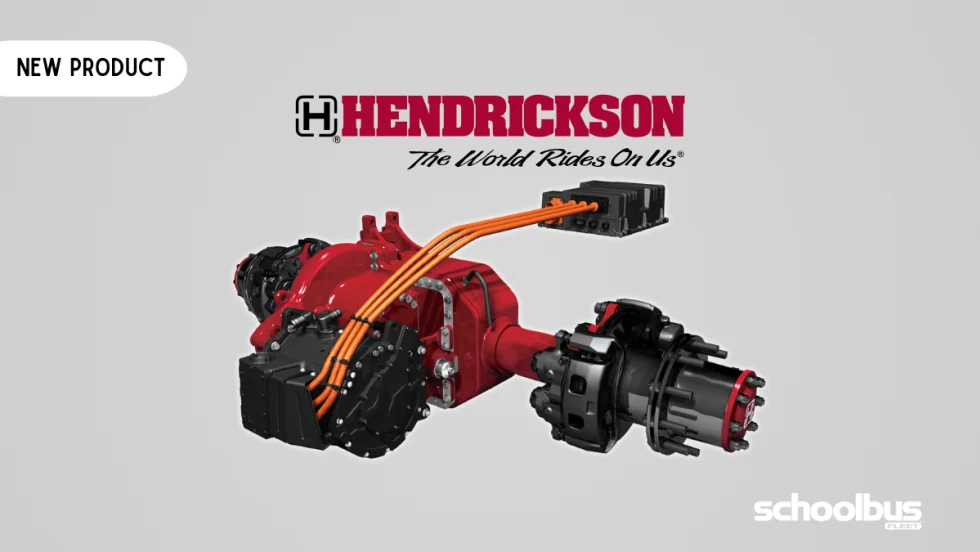
Hendrickson, Driventic Introduce New Electric Powertrain for School Buses
ELECTRAAX, the electrified, lightweight drive axle offers integrated ePowertrain efficiency and modular flexibility for Class 6–7 school bus use.
Read More →
The Mobility House Joins PowerFlex in Fleet Electrification Deal
The acquisition combines intelligent charging software, bidirectional charging expertise, and fleet electrification services to support the growing adoption of electric school buses across North America.
Read More →
Alt-Fuel Moves: Electric School Bus Investments Hit the Road
See which districts across the U.S. are putting electric school buses into service, expanding charging infrastructure, and planning the next phase of fleet electrification.
Read More →
With Fuel Volatility Ahead, School Districts Turn to Propane
While diesel prices peaked above $5 this spring, districts with propane autogas-powered fleets paid under $2 per gallon, according to PERC.
Read More →
EPA Unveils Proposed Changes to 2027 Heavy-Duty Engine Rules
The federal agency has proposed changes to next year’s targets that would eliminate DEF derates, ease warranty requirements, and retain current NOx emissions standards.
Read More →
Alt-Fuel Moves: EV Charging & Infrastructure Projects Gain Momentum
The latest developments include new funding, charging infrastructure, utility investments, and fleet technologies designed to support the transition to electric school buses nationwide.
Read More →