





Keep Reading: How to Beef Up Bus Lot Security
How To Build a More Secure School Bus Yard During and After Hours
As thefts and overnight security threats continue, school transportation leaders are combining stronger operational practices with AI-enabled surveillance to better protect buses, facilities, and staff.
August 25, 2026
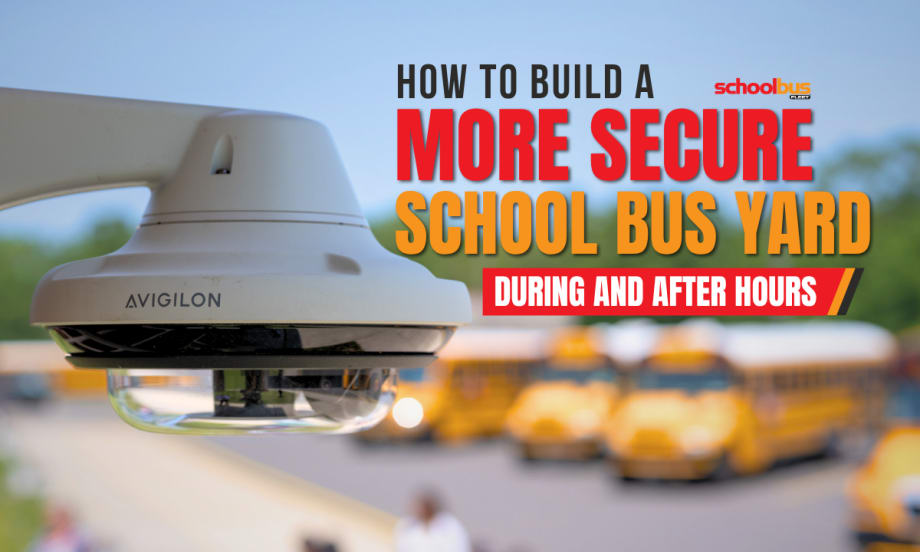
Surveillance cameras remain one of the most common security investments transportation departments make, but alone they don’t prevent crime. Pictured here: Avigilon camera installation at the Hamilton Township School District in New Jersey.
Credit:
Motorola Solutions/School Bus Fleet
10 min to read
- School transportation leaders are responding to security threats and thefts with enhanced operational strategies.
- Integration of AI-enabled surveillance plays a crucial role in protecting buses, facilities, and personnel.
- Stronger security measures aim to safeguard school bus yards both during operational hours and overnight.
*Summarized by AI
Every transportation director knows the feeling. The last bus pulls into the yard, drivers head home, and the facility sits largely empty until morning. But while student transportation has ended for the day, your security responsibilities haven't.
Overnight hours and weekends are when transportation departments become the most vulnerable. Whether it's catalytic converter theft, unauthorized access to maintenance shops, fuel theft, vandalism, or simply a bus left unlocked, seemingly small security gaps can quickly become operational disruptions that delay routes and create liability for the district.
The good news? Experts say improving bus yard security doesn't always require a six-figure technology investment. In many cases, strengthening policies, tightening physical security, and creating a culture where every employee views themselves as part of the security team can dramatically reduce risk.
The most effective security programs start with viewing the transportation department as critical infrastructure and building a culture where security becomes everyone’s responsibility, not just something cameras handle after the fact.
The interviews emphatically revealed that transportation facilities deserve the same level of attention as school buildings and, too often, they don’t receive it.
Bret Brooks, chief operating officer for Gray Ram Tactical, said transportation facilities are frequently viewed as maintenance sites rather than mission-critical operations. As a result, many districts invest heavily in classroom security while overlooking the very facilities responsible for getting students to and from school safely every day, which can leave transportation departments vulnerable to preventable incidents.
Brooks commonly encounters unlocked gates, inadequate perimeter fencing, poor lighting, unsecured maintenance buildings, inconsistent key management, buses left unlocked overnight, blind spots in camera coverage, and little formal security training for employees.
Rather than asking, “What new technology should we buy?” transportation directors should first ask, “Where are we most vulnerable today?”
Start With a Different Mindset, Fix the Fundamentals First
A simple exercise lies in walking the property after dark. The facility often looks very different at night than it does during business hours. Areas that appear well-lit during the day may become blind spots, and gates left open for convenience during operating hours may provide easy access after everyone leaves. Plus, maintenance doors that employees routinely prop open can unintentionally create opportunities for unauthorized entry.
“Our recommendations almost always begin with the basics before investing in expensive technology,” Brooks said. Walking the bus yard with fresh eyes can quickly reveal weaknesses that might otherwise go unnoticed.
Questions to consider include:
- Could someone enter the property without being seen?
- Are all gates consistently locked after hours?
- Are buses parked in a way that creates blind spots?
- Is fuel storage adequately protected?
- Are maintenance shops secured when employees leave?
- Would someone know immediately if an individual entered the lot overnight?
Answering those questions honestly provides a far better starting point than immediately shopping for new equipment. Experts like Brooks and Randy Welch, education business development director at Motorola Solutions, agree that sophisticated technology can't compensate for poor fundamentals.
Brooks recommends approaching facility security using a layered philosophy built around six principles: deter, detect, deny, delay, defend, and recover. That means creating multiple obstacles that discourage criminals long before they reach a bus or building.
For transportation directors, that often starts with basic operational practices:
- Secure perimeter fencing
- Controlled gates with limited access points
- Consistent locking procedures for buses and buildings
- Strictly enforced key control and access management
- Clearly defined visitor procedures
- Adequate lighting throughout the property
Many of these improvements require more discipline than budget. For example, assigning designated parking spaces may seem like a logistics decision rather than a security measure. Still, Welch said consistent parking layouts help maintain clear camera sightlines between buses and eliminate unnecessary blind spots.
If reimagining bus parking isn’t an option, focus on camera coverage at access points and open areas of the parking lot to record activity where it may be easily identified.
Likewise, simply requiring two employees to close together makes a world of difference in safety for your staff, and double-checking that all buses are locked every evening can reduce opportunities for theft or unauthorized access.
Don’t Let Cameras Become Passive Witnesses
Surveillance cameras remain one of the most common security investments transportation departments make, but alone they don’t prevent crime. In fact, several interviewees warned that districts often install cameras without considering whether they'll actually produce usable evidence.
Welch said one of the most common mistakes is overlooking nighttime conditions. Low-resolution cameras combined with poor lighting frequently result in blurry footage or dark areas where important activity goes undetected. Even worse, improperly placed lighting can create glare that actually reduces image quality instead of improving it.
Instead of viewing lighting and cameras as separate projects, transportation directors should treat them as one integrated system. Good lighting supports camera performance, while strategic camera placement supports better investigations. Consistent bus parking also ensures that neither component is compromised.
Brooks added that cameras should support a broader security strategy. Perimeter fencing, controlled access, motion detection, lighting, intrusion alarms, and strong employee procedures all work together to make facilities harder to target.
With that, it’s no surprise that technology is changing how school transportation departments approach surveillance. It’s not uncommon to use cameras as investigative tools. When something happens, or someone reports an incident, transportation staff or law enforcement can spend hours reviewing footage, but today’s systems increasingly focus on identifying suspicious activity while it's happening.
Welch explained that artificial intelligence can establish a baseline for normal activity and immediately flag unusual events, like someone entering the bus yard overnight or moving through restricted areas when no one should be present. Those alerts can be delivered through text messages, email, or two-way radios, allowing transportation leaders to respond much sooner than they could with traditional surveillance systems.
Pete Pacent, director of product management at Verkada, said the biggest advantage isn't necessarily capturing better video, but reducing response time.
He pointed to Beech Grove City Schools in Indiana, which experienced the theft of 20 catalytic converters during an unmanned period in May 2026, and again in July 2026. While fencing and some lighting existed, there was no proactive system capable of alerting staff or authorities while the theft was occurring overnight.
“The opportunity is to be proactive about that, identify situations as they're happening, and add deterrence to lower the actual amount of theft or incidents that happen,” Pacent said.
Instead of functioning as passive recording devices, newer security platforms can detect fence jumping, unauthorized entry, line crossing into restricted areas, or unusual after-hours activity and automatically notify transportation personnel or even law enforcement, depending on how districts configure their response procedures. The addition of talk-down deterrence can also warn or turn away trespassers in real time.
A shift from reactive investigations to proactive response may be one of the biggest opportunities for transportation departments looking to strengthen facility security without dramatically increasing staffing.
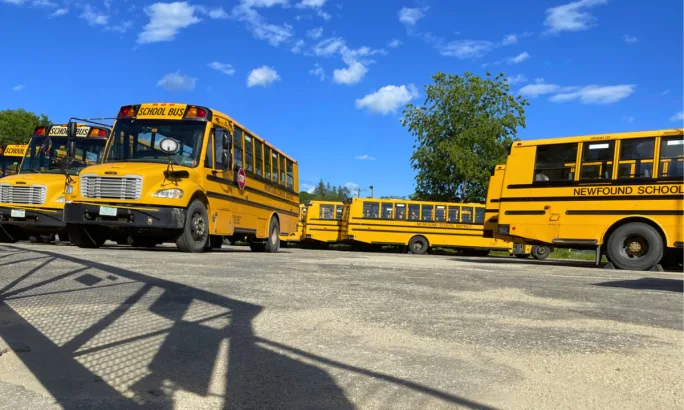
School transportation facilities face their greatest security risks after hours, when unlocked gates, poor lighting and unsecured buses can create opportunities for theft, vandalism and unauthorized access, according to security experts.
Credit:
Amy Coleman
Make Security Part of Everyday Operations and Inspection Routines
Many smaller transportation departments don’t have any security infrastructure for their school buses, especially in rural communities where offenders know these locations receive less attention. So, what should they do? The most effective and affordable way to improve facility security is to build it into existing workflows, which starts with employees.
Brooks recommended establishing clear expectations through written security checklists, end-of-shift inspections, supervisor spot checks, random audits, designated parking locations, annual refresher training, and strong key management procedures. More importantly, supervisors should explain why those procedures matter rather than treating them as another box to check.
“The most secure transportation operations don't simply purchase more equipment — they create an organizational culture where every driver, mechanic, dispatcher, technician, supervisor, and administrator understands their role,” Brooks said. Everyone needs to be vigilant and do their part.
Before rolling out in the morning, transportation departments already rely on pre-trip and post-trip inspections to keep buses safe. Why not use those same routines to strengthen security? Denny Coughlin, owner of School Bus Training, LLC, an industry consultant, believes many transportation departments miss an easy opportunity during inspections.
“Most drivers are lucky to do a pre-trip of some form, but few, if any, include a security check,” he said.
Coughlin recommended adding a quick security inspection whenever a bus has been left unattended, particularly during athletic events, field trips, or other activities where the vehicle sits outside a controlled environment before students return.
Plus, the inspection doesn’t need to be lengthy. Drivers can quickly verify that:
- Doors and emergency exits haven't been tampered with
- No suspicious items have been left on or around the bus
- Compartments remain secure
- No obvious damage occurred while the bus was unattended
Make it a point to train drivers to look for “out of the ordinary” markers every morning that are not the way they were left the previous afternoon, such as door openings, new footprints, foreign debris, or items in the driver’s area that are moved.
“Anything out of place from the way you left it should be a red flag,” Coughlin said.
At the facility level, directors should encourage employees to report anything that “just doesn't look right,” whether that's an unfamiliar vehicle, someone lingering near buses, or an unlocked gate that should have been secured.
Respond Quickly and Learn From Every Incident
How a school transportation department responds after a security incident often determines whether it becomes a one-time event or a recurring problem.
Brooks recommended treating every incident as both an investigation and a learning opportunity. After law enforcement has been notified and evidence preserved, transportation leaders should review exactly how the incident occurred.
Internal questions worth asking include:
- How did the individual access the property?
- Were cameras positioned correctly?
- Did lighting contribute to the problem?
- Were gates or doors left unsecured?
- Did employees follow established procedures?
- What changes would prevent this from happening again?
While it’s important to replace stolen equipment or repair damages, transportation departments should use a security breach to strengthen policies and eliminate vulnerabilities before the next one occurs. However, there are some platforms and tools, if funding allows, that can streamline the process.
Welch said AI can automatically reconstruct an individual's path across multiple cameras, allowing investigators to quickly identify where someone entered the property, where they traveled, and how they exited.
Appearance-based search tools can also reduce hours of video review to minutes. Pacent noted newer technology, like Verkada’s Command platform, allows investigators to search using plain language instead of timestamps. Rather than scrolling through footage manually, transportation leaders can search for a “person wearing a blue jacket,” a gray SUV, fence jumping, or another specific activity across every camera on the property. AI can then build a timeline showing where that individual or vehicle appeared.
Make the Case to District Leadership
School transportation directors often recognize security needs long before funding becomes available, simply because they work in the environment every day. If more security infrastructure is needed, the challenge is making the case to district administrators.
Brooks said transportation leaders should focus on operational risk over emotion. Truly explain the consequences of doing nothing. Use other district examples whose operations mimic your own if you have to. For example, Beech Grove City Schools didn’t just suffer from the financial impact of catalytic converter thefts. All school transportation operations were impacted during the last week of the school year, with students relying primarily on parent drop-offs to make it to school. Otherwise, absences were unavoidable.
So, a vandalized school bus isn’t just a damaged vehicle because these buses are essential to daily operations. It may delay routes, create driver shortages, require substitute buses, increase maintenance costs, and affect hundreds of thousands of students who rely on the service to get to school.
Transportation directors should advocate for security solutions that integrate with district-wide systems while addressing the unique needs of off-site bus yards and maintenance facilities. For districts working with school bus contractors, those expectations should also be clearly defined in contracts, including requirements for lighting, camera coverage, and access control.
Technology certainly has a role to play, particularly as AI helps transportation leaders move from reacting to incidents toward preventing them. But technology works best when it's paired with strong operational practices.
“One of the biggest lessons from school transportation security is that preparedness consistently outperforms reaction,” Brooks said.
Subscribe to Our Newsletter
More Safety

2 Killed, Dozens Injured in Florida School Bus Crash
A multi-vehicle collision caused a Polk County school bus carrying 37 students to overturn on its way to Winter Haven High School.
Read More →
Illegal School Bus Passing Drops 24% in New York Districts
With fewer than 5% of citations involving repeat offenders, Westchester County officials said enforcement, education, and community partnerships are helping change driver behavior.
Read More →
School's Back. Here's What Happened to Traffic, Speeding & Distraction
What happens to traffic when school resumes? New data analysis examines changes in distracted driving, congestion, and speeding around schools.
Read More →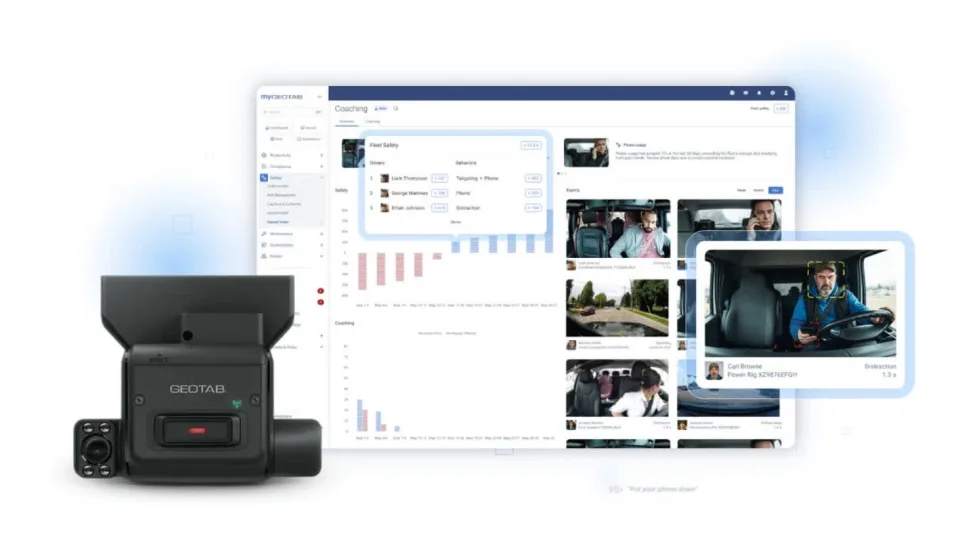
Geotab Expands Fleet Safety Tools With Video Coaching, Risk Insights
New safety and video capabilities aim to help fleet managers assess risk, support drivers, and take targeted action through video coaching, red-light violation detection, and more.
Read More →
How to Build a Better School Bus Driver Training Program
Is it time to strengthen your driver training? Here’s how to pick the right talent and improve recruitment, retention, and safety. This video is brought to you by IC Bus.
Read More →
Recent School Bus Accidents Leave 2 Dead, 2 Injured
Four school bus crashes in Florida, Illinois, and Georgia highlight risks in transportation lots, at bus stops, and during student loading and unloading.
Read More →
When Every Second Matters, Clarity Keeps Routes Moving
From routine delays to urgent incidents, strong communication practices help drivers, dispatchers, schools, and families respond with confidence.
Read More →
What Happens When a School Bus Catches Fire — and What Can Help
School bus fires are rare but can be devastating. Learn how advances in fire suppression and asset protection help fleets detect fires earlier, reduce damage, and improve safety.
Read More →
Geotab Launches Tool to Help Fleets Investigate Road Incidents
Geotab Investigations combines telematics data, video, documents, and other evidence to help fleets reconstruct incidents, resolve claims, and determine what happened.
Read More →
Texas Sixth Grader Wins 2026 National School Bus Safety Poster Contest
Sai Darshana Yekolu of Moseley Middle School in Prosper, Texas, was named the newest winner for her artwork, bringing the theme of “Safe Rides, Everyday Heroes” to life.
Read More →