





IdleLock Theft Prevention Tool Expands to Type C School Buses
How to Beef Up Bus Lot Security
After finding that many school bus yards are lacking preventive measures, a security expert details ways to deter would-be vandals and terrorists, from barbed-wired fencing to automated lighting to surveillance systems.
April 9, 2010
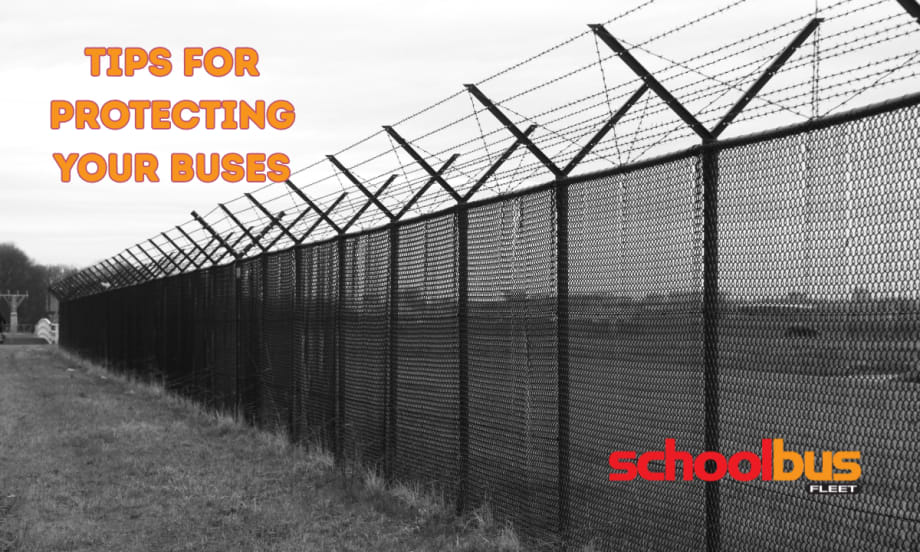
Implementing physical security measures can end up saving tens of thousands of dollars in repairs and replacements.
Photo: School Bus Fleet
5 min to read
The physical security of the school bus lot is a sometimes-overlooked but essential part of the security program for any school district or contractor. There are many ways to improve existing security features, and there are simple ways to begin a physical security program.
Having a well-established and well-maintained physical security program will lessen the chances of theft, tampering and vandalism for any school bus operation. This in turn saves money and lowers operating costs.
Prior to the start of this school year, I visited numerous school bus lots in the Midwest while performing independent research. I discovered that approximately 60 percent of those lots had implemented no physical security measures at all to protect their school buses.
This should be a concern not only for those districts, but all districts. Should, for example, terrorists attempt to use school buses in an attack, it would not be difficult for them to gain access to one. U.S. intelligence knows some terrorist organizations have already conducted planning and scouting for this very purpose.
The districts that had no physical security of their buses were also opening themselves up to theft and vandalism. Those acts can cost a district or contractor thousands of dollars in repairs and replacements. It is better, and cheaper, to implement good physical security. Here are some cost-effective and simple ways to either begin a physical security program or upgrade an existing program.
Restrict access
The most important aspect of a physical security program is access control. If people are able to walk directly up to a school bus, there is no physical security. The easiest way to avoid improper access is to position all of the school buses in one central location. Keeping the buses together allows them to be protected without having to create physical security at numerous locations.
Once all buses are located together on one lot, a fence must surround them. A typical eight-foot chain-link fence will be sufficient. If your operation cannot afford an eight-foot fence, one that is shorter will have to work. It is better to have some type of fence than no fence at all.
Triple-strand barbed wire toppers placed at a 45-degree angle at the top of the fence will keep all but the most determined out of the area. Additionally, vision-reducing material can be placed in chain-link fence to prevent people from looking into the secure area.
Gates in the fence must be kept locked, and the keys to those locks must be controlled. One way to ensure that locks and keys are not lost, and to ensure that improper key copying does not take place, is to have a signout roster. The bus lot manager will have access to the keys and sign them out only when needed, only as long as needed, and to only those who must have them. This will be recorded and logged, so if something were to happen, there is a record as to who had the keys and when. If keys are lost or stolen, all the locks should be replaced.
Lights, cameras ...
Security lighting is another cost-effective way to reduce the chances of intrusion from unauthorized persons. Lights must turn on automatically at dusk and also during low-visibility times, such as storms. Standard dusk-to-dawn lights will generally be sufficient, but there are many other options on the market.
Do not rely on a person to turn on and off the lights. Humans are prone to forgetfulness, and if the lights are not on, they don't do any good.
Surveillance cameras work both as a deterrent and as a way to identify individuals who enter the bus lot. When selecting a camera system, ensure the camera is designed to work outdoors and in various light conditions. Some cameras will not work at night or when the sun is directly pointed at the lens. Some cameras are motion activated, and others record activity nonstop.
Whichever camera system is used, it must have the capability to record and keep the recording for an extended period of time. Digital recorders work well.
Also, make sure the system is able to record the numerous cameras you might be using. Tamper-resistant cameras and mounts are preferred so people do not turn off or manipulate the camera video feed.
Cops and consultants
Another effective way to protect school buses is to coordinate with local law enforcement. Local police departments, sheriff departments or state police agencies will generally provide extra patrol around school bus lots if requested. However, this method should not be used alone. Having some physical security measures in place is still important.
There are many commercially manufactured products available to enhance the physical security of a bus lot. Each company will advertise its product as the most effective. Hiring an independent and unbiased security consultant is the best approach to making sure your physical security program is both effective and efficient.
When security professionals are tied to a specific product or products, they will attempt to sell these products and, in turn, are not completely unbiased. A good security consultant does not attempt to sell any specific product or service. He or she will suggest various methods and products that best suit your own community.
Additionally, hiring a professional physical security consultant allows you to truly find out your current level of protection.
There are many other physical security options available for school bus lots. Beyond what I've covered above, a few items to consider are passive and active electronic detection systems, angled lighting and different fence materials.
Whichever systems or products a school bus operation decides to use, it is vital that a solid physical security program is established and enhanced often. Routine maintenance and checks are also needed.
Spending money on preventive measures can help thwart vandals and others with ill intentions, enhancing the security of the community and potentially saving tens of thousands of dollars in repairs and replacements.
Implement the systems that work best for you, and use them consistently. Don't be one of those lots that have no physical security program. Take pride in your service, and protect your buses.
Subscribe to Our Newsletter
More Management

How to Build a Better Driver Training Program
Ready to boost up your school bus instructor training? Here’s how to pick the right talent and improve recruitment, retention, and safety.
Read More →
CALSTART and Forth Combine to Form Catalyst Mobility
The new name represents a renewed vision for the nonprofit focused on advancing clean, equitable, and affordable transportation solutions that move people and goods.
Read More →
What Makes a Great School Bus Driver Trainer?
Choosing the right school bus driver trainer takes more than experience. Learn six keys to selecting and developing trainers and evaluating program effectiveness.
Read More →

School Bus Contractors Expand Through New Deals, Acquisitions & Partnerships
STA's Canadian division acquires Ontario-based G&L Stevenson Transport while Durham School Services adds a new district contract in California, First Student adds a New Jersey contract, and Minnesota Coaches acquires Halo Transportation.
Read More →
Logan Bus Company Rolls Out AI Phone System for NYC School Bus Families
A summer pilot found that AI agents could handle most routine calls, freeing up time for customer service staff to focus on emergencies and complex family concerns.
Read More →
From Intent to Impact: What I Learned About Leadership from TAPT
A Texas transportation supervisor shares lessons on self-awareness, accountability, managing stress and building trust — and why investing in leadership development matters at every stage of your career.
Read More →
NAPT Names 2026 Award Recipients, Hall of Fame Inductee
Who earned national recognition for their work in student transportation? This year, NAPT named five recipients of its 2026 awards for service, safety, and leadership, plus its newest Hall of Famer.
Read More →
Sponsored•September 2, 2026
2026 State of Student Transportation Report
Driver shortages. Rising costs. Growing safety expectations. More data, but not enough time to act on it. The 2026 State of Student Transportation Report reveals what transportation leaders say is putting the most pressure on their operations—and where they’re investing next. See how your priorities compare.
Read More →
How to De-Escalate an Angry Person: 5 Steps for Handling Workplace Conflict
What makes emotions run high, and how should you handle an angry colleague or parent? Follow these steps for staying calm, listening, showing empathy, and resolving conflict.
Read More →
Sponsored•September 1, 2026
What Readiness Looks Like This School Year
Learn about the challenges shaping the 2026–2027 school year, from persistent driver shortages and budget pressure to technology and readiness gaps. See how school districts are responding and adapting in Zonar’s 2026 Back-to-School Readiness Report.
Read More →