





More News: New NTSB Investigation Report Highlights Driver Impairment and Medical Requirements
Should School Buses Have AEDs? OEM’s New Safety Investment Sparks Discussion
A growing push to expand AED access is raising a key question for the school bus industry.
March 24, 2026
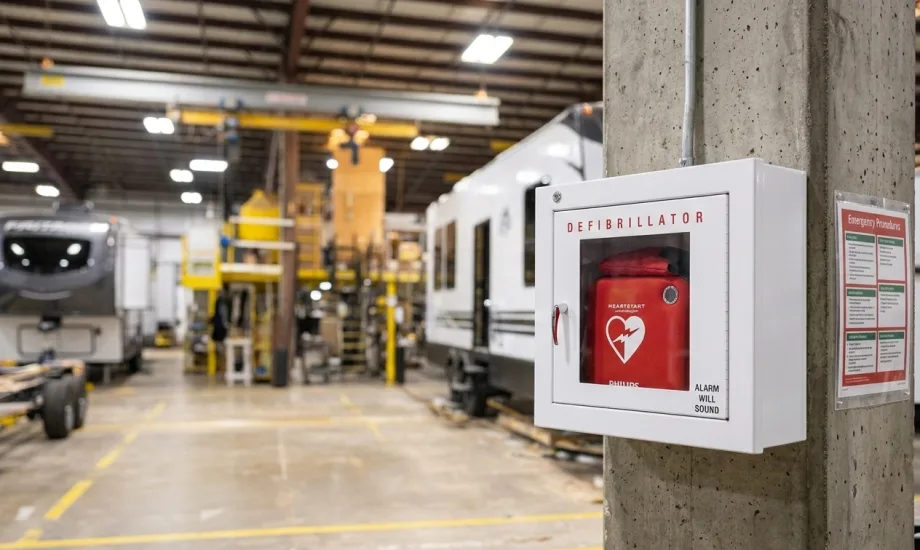
Forest River expands workplace safety efforts by installing AED devices across facilities, reinforcing rapid response preparedness for cardiac emergencies.
Credit:
Forest River
4 min to read
- Forest River is expanding AED access across 120 facilities, focusing on cardiac emergency preparedness.
- Each facility will have at least one employee trained in CPR and AED use, emphasizing hands-on training and equipment placement.
- The initiative highlights the company’s commitment to safety and quick response during cardiac events in the workplace.
*Summarized by AI
Forest River is expanding access to automated external defibrillators (AEDs) across its operations, a move that underscores growing attention to cardiac emergency preparedness and could have broader implications for pupil transportation.
The company announced it is installing AEDs in 120 facilities, with at least one employee at each location trained in CPR and AED use. The initiative, led by its safety and human resources teams, focuses on both equipment placement and hands-on training.
“At Forest River, people come first, and looking out for one another is more than a statement, it’s a responsibility,” said David Youman, chief compliance officer. “By strategically placing AEDs where our people work and training responders how to use them, we’re strengthening our ability to act quickly when every second matters in a cardiac event.”
Sudden cardiac arrest (SCA) remains a leading cause of death in the U.S., with about 10,000 cases occurring annually in workplaces, according to the American Heart Association. Survival rates drop significantly with each minute without defibrillation, while immediate AED use can dramatically improve outcomes.
Forest River’s rollout also emphasizes awareness, as research shows more than half of employees do not know where AEDs are located in their workplace.
The company said it plans to expand AED placement and training as the program continues.
OEM Perspectives on AED Preparedness
Forest River’s initiative raises broader questions about how school bus manufacturers and suppliers approach emergency preparedness within their own facilities—and whether similar measures could extend beyond the workplace.
To find out what other industry OEMs do, School Bus Fleet reached out to several manufacturers but did not receive comments in response in time for publishing.
AEDs on School Buses: Rare but Emerging
A small but growing number of districts have begun equipping school buses with AEDs as part of broader safety initiatives. In one example highlighted in local news coverage of Western New York, Allegany-Limestone Central Schools implemented on-board AEDs to address the reality that medical emergencies can occur during transport, when immediate access to first responders may be limited.
Officials emphasized that bus routes go through rural areas of the community, and that emergency services could take 10 to 20 minutes to respond. The devices, designed to guide users step-by-step, were paired with CPR and AED training for both staff and students to ensure all could act quickly and confidently. The effort reflects a preparedness-focused approach: while cardiac emergencies on school buses are rare, having life-saving equipment readily available can help bridge the gap until emergency personnel arrive.
A-1 Limousine, which offers charter and school bus trips and sport team overnights, also just announced it is installing AEDs across all company buses and will certify all its motorcoach drivers in CPR and AED usage. Jeffery Starr, owner & CEO, said that the move is “adding an extra layer of protection and peace of mind for our passengers and their families.”
A Growing Conversation Around Transit Safety
The discussion around AEDs on school buses mirrors a broader shift in public transportation.
Sudden cardiac arrest affects approximately 350,000 people annually in the U.S., and survival rates without treatment can be as low as 5%. However, when CPR and AED use are applied within three to five minutes, survival rates can increase to as high as 74%.
Transit agencies have already begun responding. Systems such as Boston’s MBTA, Chicago’s Metra, and NJ Transit have installed AEDs across trains, stations, and facilities. In some cases, these programs have directly contributed to lives saved.
With millions of passengers using public transportation daily, the presence of AEDs—and trained personnel—has become an increasingly important component of safety planning.
Industry Perspectives and Practical Challenges
Among school transportation professionals, opinions on AEDs aboard buses vary.
Some drivers and staff support the idea, pointing to real-world experiences where faster access to an AED could have changed outcomes. In one discussion among drivers, a participant noted that a student death on campus was later determined to be survivable with an AED.
Others emphasize logistical and practical concerns, including training requirements, device maintenance, liability, and the relatively low frequency of cardiac events on school buses.
Some suggest a middle-ground approach, such as placing AEDs at bus depots or transportation centers rather than on every vehicle. One driver noted that having devices available at the bus yard could still address emergencies involving staff, citing multiple incidents over time.
Looking Ahead
As AEDs become more common across workplaces and public transit systems, the school bus industry may face increasing pressure to evaluate their role in pupil transportation.
For manufacturers like Forest River, expanding AED access within facilities is one step. For school districts and contractors, the question remains whether similar investments should extend to the buses themselves.
With student safety as a core priority, the conversation is likely to continue: Should AEDs become another layer of protection on school buses—and if so, what would it take to make that a reality?
Quick Answers
Forest River is expanding access to automated external defibrillators across its operations, installing AEDs in 120 facilities and ensuring at least one employee in each location is trained in CPR and AED use.
*Summarized by AI
More Safety
Illegal School Bus Passing Drops 24% in New York Districts
With fewer than 5% of citations involving repeat offenders, Westchester County officials said enforcement, education, and community partnerships are helping change driver behavior.
Read More →
School's Back. Here's What Happened to Traffic, Speeding & Distraction
What happens to traffic when school resumes? New data analysis examines changes in distracted driving, congestion, and speeding around schools.
Read More →
Geotab Expands Fleet Safety Tools With Video Coaching, Risk Insights
New safety and video capabilities aim to help fleet managers assess risk, support drivers, and take targeted action through video coaching, red-light violation detection, and more.
Read More →
How to Build a Better School Bus Driver Training Program
Is it time to strengthen your driver training? Here’s how to pick the right talent and improve recruitment, retention, and safety. This video is brought to you by IC Bus.
Read More →
Recent School Bus Accidents Leave 2 Dead, 2 Injured
Four school bus crashes in Florida, Illinois, and Georgia highlight risks in transportation lots, at bus stops, and during student loading and unloading.
Read More →
When Every Second Matters, Clarity Keeps Routes Moving
From routine delays to urgent incidents, strong communication practices help drivers, dispatchers, schools, and families respond with confidence.
Read More →
What Happens When a School Bus Catches Fire — and What Can Help
School bus fires are rare but can be devastating. Learn how advances in fire suppression and asset protection help fleets detect fires earlier, reduce damage, and improve safety.
Read More →
Geotab Launches Tool to Help Fleets Investigate Road Incidents
Geotab Investigations combines telematics data, video, documents, and other evidence to help fleets reconstruct incidents, resolve claims, and determine what happened.
Read More →
Texas Sixth Grader Wins 2026 National School Bus Safety Poster Contest
Sai Darshana Yekolu of Moseley Middle School in Prosper, Texas, was named the newest winner for her artwork, bringing the theme of “Safe Rides, Everyday Heroes” to life.
Read More →
Sponsored•August 27, 2026
Doing More With Less: How Transportation Directors Can Prioritize Safety Amid Budget Uncertainty
With diesel prices soaring and nearly one-third of transportation directors expecting budget cuts, maintaining student safety has never been more challenging. Download this guide to learn how leading districts are prioritizing risk, funding critical safety technology, and building stronger budget cases with data.
Read More →