





National Action Plan Aims to End Illegal School Bus Passings Across the U.S.
The BUILD America 250 Act Has Big Implications for School Buses, Too [Updated]
Buried within a sweeping federal transportation bill are provisions that could affect school bus driver requirements, illegal passing enforcement, and even the future role of autonomous technology in pupil transportation.
June 1, 2026
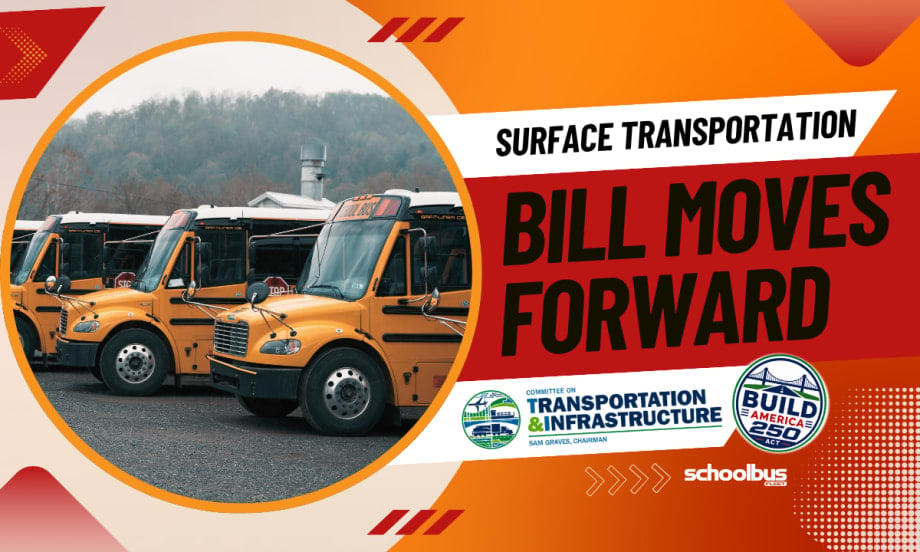
The BUILD America 250 Act is intended to replace the current federal surface transportation authorization, which expires September 30, 2026.
Credit:
Photographs with Riss/School Bus Fleet
4 min to read
- The BUILD America 250 Act includes provisions impacting school bus driver requirements.
- The legislation addresses enforcement measures for illegal passing of school buses.
- The bill explores the integration of autonomous technology in student transportation, and more.
*Summarized by AI
A sweeping federal transportation reauthorization bill advancing through Congress includes several provisions that could directly affect school bus operations, driver requirements, safety enforcement, and the future use of autonomous vehicle technology in pupil transportation.
On May 22, the House Transportation and Infrastructure Committee approved the bipartisan BUILD America 250 Act following a 14-hour legislative markup session, moving the five-year surface transportation package one step closer to a full House vote.
The legislation would reauthorize federal highway, transit, rail, and motor carrier safety programs through 2031 while investing in infrastructure, transportation innovation, and roadway safety initiatives. Committee leaders said the bill includes the largest federal investment in bridges in U.S. history, new Highway Trust Fund revenue measures, and the nation’s first federal framework for autonomous commercial vehicles.
For the school bus industry, the legislation includes a new national public safety messaging effort focused on illegal school bus passing and safe student loading and unloading procedures. The U.S. Department of Transportation would be required to consult with school bus industry representatives, state highway safety offices, and other stakeholders while developing the campaigns.
Plus, the Natural Resources Defense Council said the legislation “would place a new $130 annual fee on electric vehicles, eliminate key programs to cut emissions and trim overall transportation spending, including on EV chargers.”
The bill would also expand the federal High-Visibility Enforcement Program to include speeding reduction efforts and establish a new traffic safety enforcement Center of Excellence to provide technical assistance to state highway safety offices and law enforcement agencies focused on reducing roadway fatalities and injuries.
Another provision would allow states to waive the “under-the-hood” commercial driver’s license pre-trip inspection testing requirement for school bus and public transit bus drivers operating within certain geographic limits. Specifically, the requirement is waived for “school buses or public transit buses in intrastate commerce or interstate commerce within a 150 air-mile radius of the point of origination.”
States participating in the waiver program would still be required to maintain driver records and submit annual safety data to the federal government.
The legislation also addresses automated driving systems in commercial vehicles. Under the proposal, the U.S. Department of Transportation would have two years to establish safety standards for autonomous commercial motor vehicles operating in interstate commerce.
However, any autonomous commercial vehicle transporting primarily minors, especially school buses, or hazardous materials would still be required to have a human operator physically present inside the vehicle during operation.
Industry Groups Weigh In on BUILD America 250 Act
Industry reaction to the BUILD America 250 Act has been mixed, with safety organizations generally supporting the bill’s enforcement and grant provisions, while clean transportation advocates raised concerns about proposed changes to electric vehicle and emissions-related programs.
The Commercial Vehicle Safety Alliance voiced support for several commercial motor vehicle safety provisions in the bill, including continued funding through the Motor Carrier Safety Assistance Program, expanded eligibility for enforcement and training grants, improvements to the New Entrant Safety Assurance Program, and efforts to strengthen oversight of exemptions from federal regulations. CVSA Executive Director Collin Mooney said the legislation “lays the groundwork for long-term improvements in commercial motor vehicle safety by investing in enforcement, training, compliance and innovation.”
The Governors Highway Safety Association also praised the proposal, particularly its plan to combine federal highway safety grant programs into a single structure. GHSA said the change would give state highway safety offices more flexibility to make data-driven investments in areas such as speeding, impaired driving, distracted driving, occupant protection, motorcycle safety, and nonmotorized safety.
However, clean transportation groups expressed concern about portions of the bill affecting electric vehicles and charging infrastructure. CALSTART President and CEO Michael Berube criticized the proposal’s new annual fees on electric and plug-in hybrid vehicles, as well as the elimination of dedicated funding for zero-emission transit vehicles and charging infrastructure. He said the bill could create additional uncertainty for automakers, suppliers, charging companies, and fleets working to adopt cleaner transportation technologies.
The World Resource Institute's Electric School Bus Initiative called the bill "a step backwards," citing concern over the added federal fee on electric and hybrid vehicles and lack of funding on modernizing the grid. In a statement, Sue Gander, director of U.S. Transportation, World Resources Institute, said: "...Congress has an opportunity in this reauthorization to build on its recent investments in electric vehicles and other clean, affordable mobility options — or further cede our competitive advantage to other countries..."
CVSA also noted that while the bill includes several safety improvements, it remains concerned about exemptions from size, weight, and electronic logging device requirements for certain industry groups. As the legislation moves through Congress, industry organizations are expected to continue pressing lawmakers for changes before a final surface transportation package is enacted.
Editor's Note: This article was originally published May 22, 2026, and was updated on June 1, 2026, for continued relevancy on the BUILD America 250 Act and reactions from industry groups like CVSA, GHSA, and CALSTART. It was again updated on June 19, 2026, to add WRI's statement.
More Policy & Regulations
Ohio Transportation Workgroup Calls for End to 'Impractical to Transport' Payments
A final report from Ohio's Pupil Transportation Workgroup proposes ending "impractical to transport" payments and expanding transportation options through regional partnerships, but not all industry pros agree on the approach.
Read More →
School Bus Laws to Watch: New York Delays EV Mandate
Plus, federal lawmakers seek new funding for school bus safety as states weigh stop-arm enforcement, disability protections, and education spending.
Read More →
School Bus Laws To Watch: Seat Belt Bills, Funding Fights & EV Changes
From national bills on seat belts and driver oversight to driver awareness campaigns referencing “Finn’s Rule” and ongoing transportation funding debates in Alaska, here’s the latest in school bus legislation across the U.S.
Read More →
School Bus Laws To Watch: Driver Shortages, EV Debates & Safety Upgrades
From driver shortage solutions in Tennessee and rural connectivity debates in Utah to new safety laws in Wisconsin and ongoing electric bus mandate discussions in New York and Connecticut, here’s the latest in school bus legislation across the U.S.
Read More →
School Bus Laws To Watch: Stop-Arm Enforcement, EV Mandates & Seat Belts
From North Dakota public charter school regulations, tracking illegal school bus passing consequences in multiple states, and the continued debate on New York’s electric school bus mandate, here’s the latest in school bus legislation across the U.S.
Read More →
School Bus Laws To Watch: Anti-Trafficking Curriculum, Passing Loopholes & Tougher Penalties
From Nebraska CDL training add-ons, tackling stop arm passing loopholes in Minnesota, and increased penalties for school bus driver DUIs and firearm incidents, here’s the latest in school bus legislation across the U.S.
Read More →
School Bus Laws To Watch: Driver Penalties, Funding Fights & New Safety Initiatives
From New York driver penalty changes to stop-arm camera programs, reliable special education transportation, and a Kentucky budget shortfall, here’s the latest in school bus legislation across the U.S.
Read More →
School Bus Laws To Watch: Stop-Arm Cameras, Safety Retrofits & Driver Shortage Fixes
From Maine bus safety upgrades to stop-arm camera bills, electric bus funding, and an Alabama workforce solution, here’s the latest in school bus legislation across the U.S.
Read More →
State Grant Program Advances School Bus Safety Upgrades Across Ohio
$10 million in state grants will fund safety upgrades and new features on school buses serving students across the Buckeye State.
Read More →
Where EPA School Bus Funding Stands: CSBP, DERA, and Heavy-Duty Grants Update
One program ends, another looks to be reimagined, and the Clean School Bus Program is in a holding pattern — here’s where each EPA program stands and what to expect moving forward.
Read More →