




How to Find Funding for Alt-Fuel School Buses
Faced with scarce funding for your alternate fuel fleet plans? There is help! Here’s how to plan your transition to green school buses — and secure the finances and support to afford them.

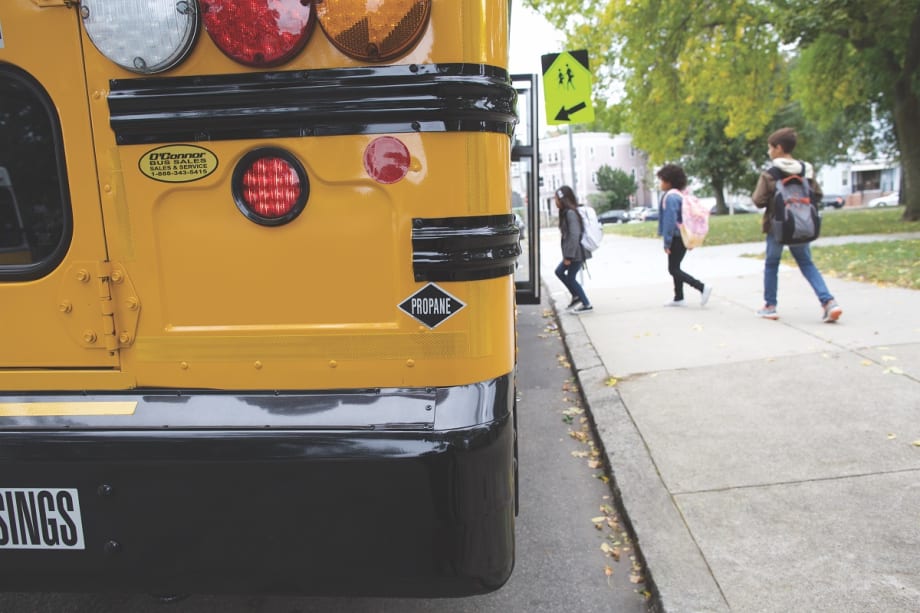
Whichever fuel you choose, do your research. While many fleets go electric, PERC is a proponent of propane autogas as an affordable option with range up to 400 miles on a single refuel with significantly lowered emissions.
Photo: PERC
Perhaps your school’s fleet has already received a few green buses and needs more, or maybe you’re ready to add new buses to break outside of the traditional gas-powered bus fleet. It can be daunting to navigate grants, rebates, and incentives, not to mention get the infrastructure in place to support it. The good news is there are plenty of programs and organizations out there to help.
Getting the (Green) Groundwork in Place
As with any major change, the sooner you can set goals, put plans into place, and get stakeholder buy-in, the better. Start with a needs analysis before looking into logistics, seeking out infrastructure, or calculating costs. The transition to zero or low emission buses is not as easy as purchasing the buses and hitting the road, said Kevin Matthews, head of electrification for First Student.
“Districts must talk to their electric utility to determine how to power the electric vehicles and prepare their electrical infrastructure for the increased load,” Matthews added. “An electric fleet will require charging stations and advanced electrical infrastructure to be installed at bus depots; an early and sustained coordination with the utility holds the key to a successful electrification project.”
“Federal and state incentives and mandates are going to increase demand for electric school buses, which will lead to longer bus delivery times and price increases,” said Duncan McIntyre, CEO at Highland Electric Fleets. “If you start planning an electric transition now, you can do it at a pace that works for you and give your drivers, mechanics, and leadership time to get comfortable with the upgraded technology.”
While propane, CNG, or other options certainly exist and provide a lower initial investment to deploy, many fleets choose to go electric because of the government mandates and incentives. But, electric buses can cost 3x as much as diesel buses, which doesn’t even include charging infrastructure.
Steve Whaley, director of autogas business development for Propane Education & Research Council (PERC), advises checking out the State of Sustainable Fleets report, which details each energy source available to school bus fleets and provides insights that can help transportation directors make a decision on the right fuel for their fleet.
He also recommends fleet directors ask these questions when putting their alt-fuel plan together:
Does the energy source provide an environmental benefit greater than what I’m currently experiencing? There needs to be a reduction in emissions over the lifecycle of the energy source, ideally without increasing cost or losing efficiency.
Does the energy source provide a financial benefit? There should be a reduction in the total cost-of-ownership or a return on investment long before the end of the vehicle’s lifecycle.
Does the energy source provide an operational benefit? The vehicle should perform as well or better than the original fuel without compromising range.
Is the new energy source abundant and readily available? There shouldn’t be barriers to obtain the energy source and refueling should be convenient.
Having a partner help you navigate all of this affords a significant leg up. One option: Highland Electric offers a fleet electrification-as-a-service model that removes the upfront cost and charges school districts a fixed, annual fee over a 10–15-year contract that includes everything from bus and equipment procurement, depot upgrades and charging installation, training, electricity and warranties, repair reimbursement, and managing charging.
“We use a public-private partnership model that combines public funding with efficiencies that only private capital can provide,” McIntyre said. “Our goal is to make upgrading to electric as simple and affordable as possible for schools around the country, and today, we can do that for the same price as, or less than, what they’d pay to own, operate, and maintain their diesel buses.”
Enel North America also can help school districts transition from diesel to electric. Its energy experts work to propose the right combination of solar panels, on-site battery storage, and efficiency solutions by working with the school’s facilities and sustainability manager. And, “For schools unable to make an upfront purchase of an electric bus, Enel will purchase the bus and keep that capital asset on our books,” Brianna Walsh, head of smart cities for Enel North America explained, “giving the use of that bus and the charging infrastructure to the school for a fixed annual fee across a multi-year contract.”

Martha’s Vineyard Transit Authority runs 32 buses and uses solar panels for charging, with goals for a 100% electric fleet by 2027.
Photo: Enel North America
“As more funding is dedicated to electrifying bus fleets, now is a great time to have exploratory conversations,” Walsh said. “Schools are historically underfunded, but the incentives available now to electrify can significantly reduce upfront costs and the operational cost of fuel and maintenance.”
Various bus manufacturers like IC Bus, as well as contractors like First Student, also offer support for the transition.
For those considering the propane route, Whaley pointed out that propane autogas school buses are affordable and provide the lowest total cost-of-ownership for school districts thanks to the low fuel and maintenance costs. “The nice thing about propane autogas is that while there are several funding opportunities available, even without the funding, these buses are affordable for any school district, allowing us to provide clean student transportation to more students at a quicker rate,” Whaley said.
Additionally, propane fueling infrastructure is completely scalable and often changed out as the fleet grows without having to alter the dispensing equipment. “Your local propane supplier can help identify the right refueling setup,” he said. Considerations include available space, expected growth, and traffic requirements. Fuel tank sizes range from 1,000 to 30,000 gallons. School districts can own or lease the infrastructure from the supplier and should ask about securing a fuel contract to lock in a set price per gallon for a duration beneficial to both parties.
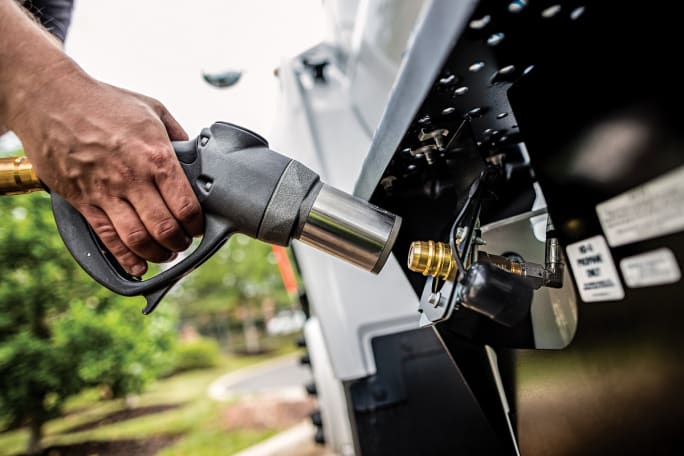
This past month, PERC encouraged propane fleets to take advantage of the Alternative Fuel Tax Credit. The bill extends credits through Dec. 31, 2024, and can be used retroactively for fuel purchases made in 2022.
Photo: PERC
Alt-Fuel Funding Programs
Probably the most-talked about financial support program for schools to upgrade their buses is the U.S. EPA’s Clean School Bus Program, which provides $5 billion from FY 2022-2026 to replace existing school buses with zero-emission and low-emission model through the Bipartisan Infrastructure Law. The current round of rebates is now closed, but the EPA just announced it is nearly doubling 2022 funds based on high demand.
The passage of the Inflation Reduction Act also includes clean energy and electric transportation measures, including a tax credit for commercial electric vehicles, a tax credit for charging infrastructure, and a new EPA grant program for replacing heavy-duty vehicles, which applies to electric school buses.
The EPA’s Diesel Emissions Reduction Act (DERA) also offers rebates and grants to reduce emissions from older diesel vehicles. The DERA national grants are currently closed, but 2022 Tribal and Insular Area applications are open through Oct. 26, 2022.
Michelle Levinson, senior manager for WRI, shared in an SBF webinar that about $2.8 billion in state and local funds are available across the country — most of which comes through the VW settlement agreement. “A number of states took the funds that they were awarded during that settlement and put them toward funds for electric school buses, but a number of states have subsequently dedicated additional funds,” she said.
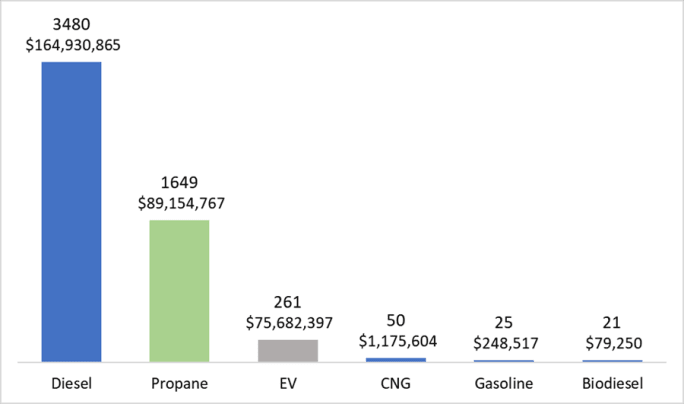
The VW funds are not just for EVs. This chart shows the number of buses and amount of VW funds spent by school bus fuel type through Q1 2022.
Source: PERC
There are multiple ways to save even more, Levinson said, whether through state tax exemptions, voucher programs like California’s HVIP, cap and trade funds, green banks, and energy community transition grants.
“A number of states, like the Clean Energy Fund in North Carolina and the Green Bank in Nevada, are looking to supplement pure public funds with low-cost financing,” Levinson said. “And those can have really favorable terms, and often come with technical assistance, which is really helpful. I think looking to local and regional partners, in addition to state pots of funds, can be a really great way to uncover the pieces that are elements to the recipe for getting an electric school bus deployed properly.”
Whaley also recommends checking with your local Clean Cities Coalition for additional information.
In Canada, the Canada Infrastructure Bank has established a C$2.75 billion Zero Emission Transit Fund to provide funding for similar projects.
Some utility companies also offer impactful incentives.
Many grant programs have a timeline of 3 to 18 months. “With all types of grant funding, whether it be public sector grants or utility program grants, the devil is in the details,” Matthews said. It is imperative to thoroughly understand the terms and conditions and financial implications.
Ryan Kauffman, vice president of sales at IC Bus, offers these suggestions for preparing for a future grant release:
Practice good records management. Grants often require data from the current fleet and may also require the scrappage of an older diesel unit. Accessible fleet records and data is extremely helpful when navigating the grant application process; specifically, copies of titles and registrations.
Identify administrative barriers. Grant applications often require the signature of an authorized representative. While with some fleets this role is straightforward, other districts can require school board approval. Grant timelines are inflexible, so it is helpful to know the internal process for approval in order to accommodate administrative barriers.
Identify minimum cost share required. Grant award amounts can vary widely and by knowing the amount of cost share needed, you can focus on only those opportunities that would result in a meaningful award. If an available grant does not offer the minimum cost share required, a fleet could explore stackable incentives from the local utility or other areas.
Kauffman also recommends considering if program rules dictate scrappage of an old bus. “Applications should review the timeline and conditions; some programs require the old bus to be scrapped at the outset of a program, long before the new bus is delivered,” he said. “This can create a gap in the number of units in a fleet.”
And, don’t forget compliance reporting. “When applying for funds, a fleet should review information regarding reporting and compliance to ensure they are able to meet these requirements,” Kauffman said. “In a worst-case scenario, a grant recipient who does not maintain proper vehicle use and provide reporting and compliance paperwork could find the funds repealed.”
Success Stories
Montgomery County (Md.) Public Schools runs 27 electric buses (of 1,268 total), with plans to increase to 88 by November this year, which they believe would make it the largest EV school bus fleet in the nation. The district began its transition in August 2020 by issuing an RFP, which ultimately was awarded to Highland Electric.
“Montgomery County Public Schools’ DOT expects to cover the cost of said contract over time with funds that otherwise would have been spent purchasing and operating diesel-equivalent school buses,” explained Chris Cram, director in the district's office of communications. “Budget neutrality is possible over time because Highland will invest in the otherwise high upfront costs of purchasing electric school buses with the plan to recoup that investment over time through decreasing vehicle prices, less expensive fuel, and maintenance savings. As far as MCPS and Highland know, this is the first budget-neutral, non-grant-dependent, school bus fleet electrification plan available.”
The current contract calls for 25 electric buses for fall 2021, 61 additional electric buses in fall 2022, and approximately 120 electric buses (one-twelfth of the fleet), each year thereafter. Cram encourages schools to include its community as interested partners from the beginning of your transition.
Highland Electric also worked with South Burlington School District in Vermont, which recently announced the addition of four electric buses to its fleet, which will also serve as V2G assets for Green Mountain Power.
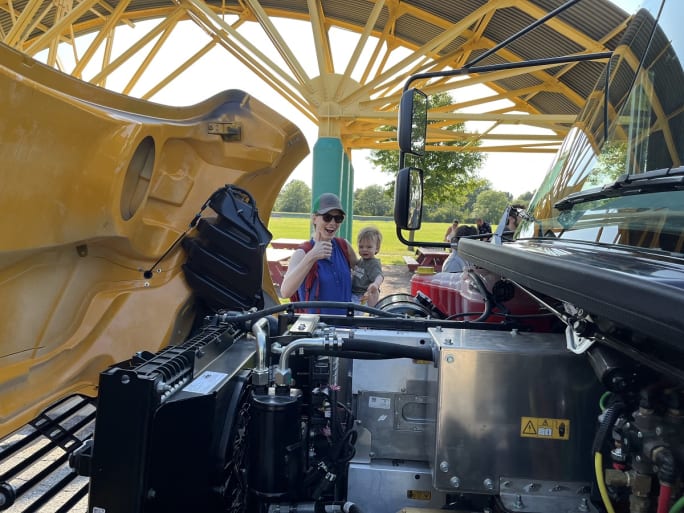
The South Burlington (Vt.) School District rolled out two new electric buses this fall from Thomas Built that charge at its own garage.
Photo: Green Mountain Power
In Tennessee, Washington County Schools currently runs 17 of its 92 buses on propane (one is electric, 23 are small gas-powered buses, and the rest are diesel). Jarrod Adams, chief operations officer, shared that he began the grant process in October 2019, modeling plans after other states’ use of electric buses and overall environmental impact.
There, funding for 11 propane buses came through East Tennessee Clean Schools’ “Reducing Diesel Emissions for a Healthier Tennessee” rebate program. For its one electric bus, half the cost and infrastructure ($100,000) was covered by the Volkswagen Settlement Grant, with $30,000 coming from the local electric company, BrightRidge. Adams said that all stakeholders involved love the new bus and report cost savings over the long-term as well.
In Vermont, the South Burlington School District just welcomed two electric buses, with two more coming later this year. “Last year, when we realized there was a funding opportunity that would support this initiative via Vermont’s Volkswagen Environmental Mitigation Trust Funds with additional support from the Vermont Agency of Natural Resources, Green Mountain Power and Highland Electric Fleets, the move to electric was a no brainer,” said Corey Burdick, the district’s communications coordinator.
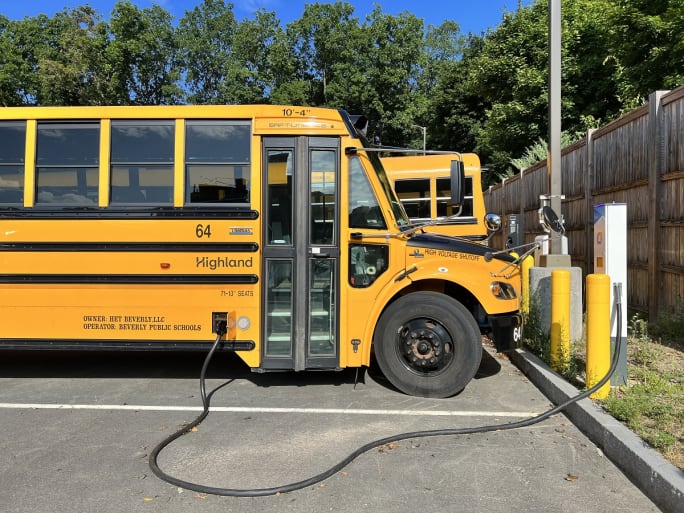
Highland has eight electric school bus deployments in progress across seven states, including a deployment of 326 buses for Montgomery County Public Schools.
Photo: Highland Electric
To help fund the project, the district received a $965,000 grant through the Vermont DOE Conservation with funding from the state’s VW settlement. GMP provided additional incentives and V2G chargers based on the amount of carbon emissions the project is expected to reduce. “Truly, it's a win win,” Burdick said.
First Student also reports a large electric school bus fleet deployment underway for several districts in Quebec. Out of a total proposed deployment of 300 buses, 176 are already transporting students to and from school. “This large-scale deployment represents a very successful cooperative effort between several diverse entities including First Student, the government, the school bus manufacturer, and the utility,” Matthews said. “From braving construction in Canadian winters to proudly removing underground fossil fuel tanks to enable electrification infrastructure installation, our experience, tips, and lessons learned could fill a book!”
“Many school districts don’t realize that electrifying their bus fleet can provide them with a new revenue source by participating in demand response and other market programs offered by local utilities and Independent System Operators,” Walsh added. “Electric school buses with vehicle-to-grid capabilities not only receive power when they are plugged in but can also pull power from the buses’ battery packs to supply it back to the energy grid in exchange for a monetary value.”
“Medium- and heavy-duty fleets have significant health and air quality impacts, and we need to accelerate their electrification. School buses are an ideal starting point for many reasons,” McIntyre said. “The more electric school buses we can deploy, the more we can protect our children's health and well-being, as well as that of drivers and community members.”
Whaley agrees, adding that the goal of any funding opportunity for clean bus options should be to provide a benefit to student health and the environment — and do it quickly. “Every child deserves to have a safe, clean, healthy ride to school. Propane autogas provides the energy equity we need to ensure that goal is met for any student in any district.”
More Alternative Fuels

CALSTART and Forth Combine to Form Catalyst Mobility
The new name represents a renewed vision for the nonprofit focused on advancing clean, equitable, and affordable transportation solutions that move people and goods.
Read More →
Alt-Fuel Moves: New Buses, Charging Hubs & Real-World EV Testing
Propane and electric school bus deployments continue to grow as districts add new vehicles, expand charging infrastructure, and gather more real-world operating data.
Read More →
Fewer Electric School Bus Models Reshape the U.S. Market
WRI’s latest buyer’s guide points to a consolidating electric school bus market, but fewer options may reflect a maturing industry rather than fewer meaningful choices for school bus operators.
Read More →
The Fuel Budget You Can Actually Predict: How Propane Autogas Keeps Money in the Classroom
Learn how propane autogas helps school districts manage fuel costs with predictable pricing, lower maintenance, and reduced emissions from former transportation director Joel Stutheit.
Read More →
Hendrickson, Driventic Introduce New Electric Powertrain for School Buses
ELECTRAAX, the electrified, lightweight drive axle offers integrated ePowertrain efficiency and modular flexibility for Class 6–7 school bus use.
Read More →
The Mobility House Joins PowerFlex in Fleet Electrification Deal
The acquisition combines intelligent charging software, bidirectional charging expertise, and fleet electrification services to support the growing adoption of electric school buses across North America.
Read More →
Alt-Fuel Moves: Electric School Bus Investments Hit the Road
See which districts across the U.S. are putting electric school buses into service, expanding charging infrastructure, and planning the next phase of fleet electrification.
Read More →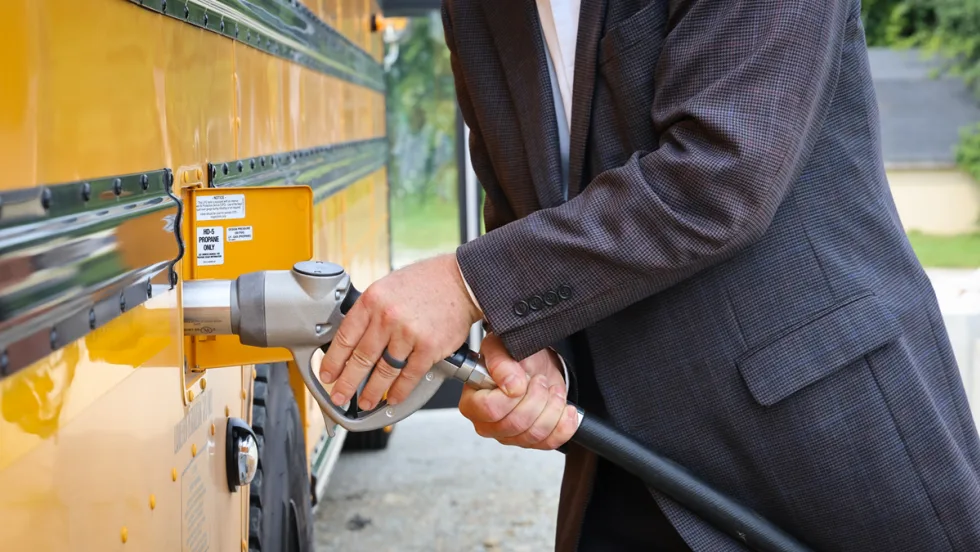
With Fuel Volatility Ahead, School Districts Turn to Propane
While diesel prices peaked above $5 this spring, districts with propane autogas-powered fleets paid under $2 per gallon, according to PERC.
Read More →
EPA Unveils Proposed Changes to 2027 Heavy-Duty Engine Rules
The federal agency has proposed changes to next year’s targets that would eliminate DEF derates, ease warranty requirements, and retain current NOx emissions standards.
Read More →
Alt-Fuel Moves: EV Charging & Infrastructure Projects Gain Momentum
The latest developments include new funding, charging infrastructure, utility investments, and fleet technologies designed to support the transition to electric school buses nationwide.
Read More →