





WATCH: Propane vs. EV School Buses: Blue Bird Execs Talk Alt-Fuel Progress
With Fuel Volatility Ahead, School Districts Turn to Propane
While diesel prices peaked above $5 this spring, districts with propane autogas-powered fleets paid under $2 per gallon, according to PERC.
July 30, 2026
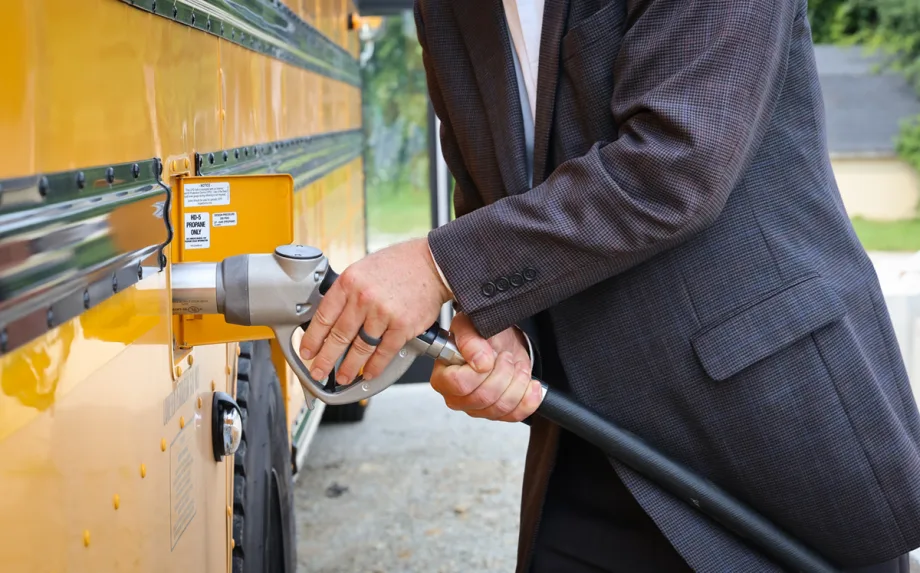
Seymour Schools in Wisconsin recently added its first propane buses to the fleet, run by Kobussen Bus.
Credit:
Shado Rose LaCount-VanEyck
2 min to read
As diesel and gasoline prices are rising again, student transportation leaders are preparing for another unpredictable budget year. As fuel budgets dominate conversations, some say that propane needs to be part of the discussion as an alternative.
According to a new PERC report, through this year’s swings, propane autogas moved by cents while diesel moved by dollars, allowing districts to maintain rates between $1 to $2 per gallon.
Thanks to its abundant domestic supply, propane autogas pricing has remained far lower and more stable than gasoline and diesel, allowing districts to secure multi-year contracts with local marketers, often including low-to-no-cost fueling infrastructure implementation in exchange for long-term energy commitments.
“Districts are realizing they can’t just wait out this volatility,” said Joel Stutheit, senior manager, autogas business development for the Propane Education & Research Council (PERC). “Whether it’s the immediate savings seen in districts like Beaverton, or the operational flexibility of using propane autogas to balance fleet savings, sustainability, and performance, the solution is about regaining budget control.”
Examples in action
Recently, Beaverton School District in Oregon shared the roadmap of its nine-year journey with propane autogas. By growing their fleet from 10 to 65 propane autogas-powered buses, Beaverton has realized annual savings of approximately $400,000 to $500,000.
The district also likes that propane autogas engines, which lack the complex after-treatment systems (like DPF or DEF) required by modern diesel engines, have significantly lowered their total cost of ownership and reduced mechanical downtime.
PERC notes that a similiar success is mirrored by Wa-Nee Community Schools in Nappanee, Indiana. Honored as one of the 2026 Top Transportation Teams, Wa-Nee reported paying an average of $0.99 per gallon for propane autogas during the 2025–2026 school year. Compare this to local diesel costs reaching $5.06 per gallon; a savings of about $10,000 for every 30,000 miles driven.
“Every year we save money so that our kids can continue in sports and music programs with no fees,” said Amy Rosa, director of safety and transportation at Wa-Nee. “That’s our goal — to continue reducing costs for our students and our taxpayers.”
Clean air without complexity
Transportation leaders are finding they no longer have to choose between fiscal responsibility and environmental stewardship, PERC noted in its release. While diesel engines are becoming increasingly complex and expensive to meet tightening 2027 EPA emissions standards, propane autogas offers a cleaner, near-zero emissions profile that is already compliant today, PERC said.
More than 24,000 propane autogas school buses currently operate across 1,100 districts, safely transporting over 1.3 million students every day.
More Alternative Fuels

Alt-Fuel Moves: New Buses, Charging Hubs & Real-World EV Testing
Propane and electric school bus deployments continue to grow as districts add new vehicles, expand charging infrastructure, and gather more real-world operating data.
Read More →
Fewer Electric School Bus Models Reshape the U.S. Market
WRI’s latest buyer’s guide points to a consolidating electric school bus market, but fewer options may reflect a maturing industry rather than fewer meaningful choices for school bus operators.
Read More →
The Fuel Budget You Can Actually Predict: How Propane Autogas Keeps Money in the Classroom
Learn how propane autogas helps school districts manage fuel costs with predictable pricing, lower maintenance, and reduced emissions from former transportation director Joel Stutheit.
Read More →
Hendrickson, Driventic Introduce New Electric Powertrain for School Buses
ELECTRAAX, the electrified, lightweight drive axle offers integrated ePowertrain efficiency and modular flexibility for Class 6–7 school bus use.
Read More →
The Mobility House Joins PowerFlex in Fleet Electrification Deal
The acquisition combines intelligent charging software, bidirectional charging expertise, and fleet electrification services to support the growing adoption of electric school buses across North America.
Read More →
Alt-Fuel Moves: Electric School Bus Investments Hit the Road
See which districts across the U.S. are putting electric school buses into service, expanding charging infrastructure, and planning the next phase of fleet electrification.
Read More →
EPA Unveils Proposed Changes to 2027 Heavy-Duty Engine Rules
The federal agency has proposed changes to next year’s targets that would eliminate DEF derates, ease warranty requirements, and retain current NOx emissions standards.
Read More →
Alt-Fuel Moves: EV Charging & Infrastructure Projects Gain Momentum
The latest developments include new funding, charging infrastructure, utility investments, and fleet technologies designed to support the transition to electric school buses nationwide.
Read More →
Alt-Fuel Moves: Fleets Power Up Beyond the Bus
See how districts are pairing electric buses with charging, solar, and V2G technology to cut costs, boost resilience, and unlock new fleet value.
Read More →
What the EPA’s Updated Clean School Bus Program Means for Fleet Electrification in 2026 and Beyond
A guide to the EPA’s evolving school bus grants, including how the Trump administration changed funding priorities and how school districts can prepare for future bus purchases.
Read More →