




Thomas Built Buses Gets Visit from Vice President Harris During Earth Week
Harris meets with school bus manufacturer employees and parent company Daimler Trucks North America CEO, who detail the benefits of electric buses. Daimler also inaugurates its Electric Island vehicle charging station.
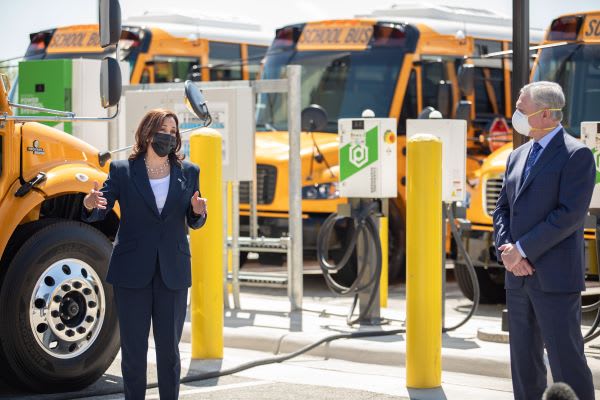
Vice President Kamala Harris visited Thomas Built Buses' North Carolina-based plant and met with John O’Leary, president and CEO of Daimler Trucks North America.
Photo courtesy Daimler Trucks North America
In honor of Earth Week, Thomas Built Buses’ (TBBs’) parent company, Daimler Trucks North America (DTNA), celebrated several electrification-related milestones, including a visit from Vice President Kamala Harris to the TBB production plant.
DTNA also marked the inauguration of its "Electric Island" charging site in Portland, Oregon, and the continuation of the Freightliner Electric Roadshow, according to a news release from the vehicle manufacturer.
During Vice President Harris’s visit to the High Point, North Carolina-based plant on Monday, she met with John O’Leary, president and CEO of DTNA, as well as several TBB employees, who outlined the benefits of electric buses and demonstrated the technology behind commercial electric vehicle manufacturing.
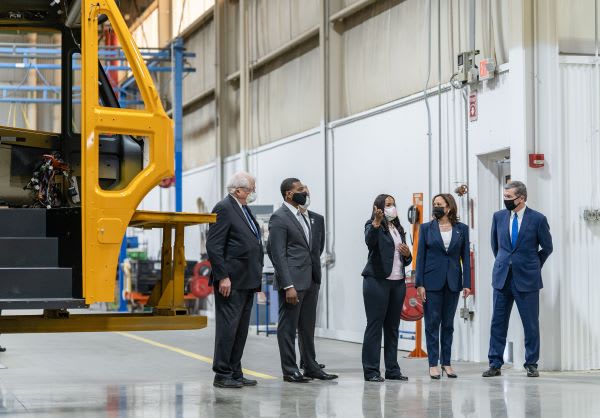
Thomas Built Buses employees took Harris on a tour of the plant. They detailed the benefits of electric buses and demonstrated the technology behind commercial electric vehicle manufacturing.
Photo courtesy Daimler Trucks North America
“Welcoming Vice President Harris to Thomas Built Buses was an honor and a privilege,” O’Leary said in the news release. “It’s exciting to see our electric vehicles recognized by the administration, and to have her visit take place the same week we inaugurate the first public electric vehicle charging station specifically designed for commercial vehicles, and as we continued showcasing the all-electric Freightliner eCascadia and eM2 for customers with our innovative roadshow.”
TBB’s Saf-T-Liner C2 Jouley runs tailpipe-emissions free and noise-pollution free and has a 135-mile operating range according to the school bus manufacturer. With nearly 50 Jouleys already delivered, school districts across the country, from Alaska to Virginia, have already incorporated electric school buses in their daily operations.
The same week and a day before Earth Day, according to DTNA, Electric Island, the first of its kind charging station specifically designed with medium- and heavy-duty vehicles in mind and open to the public, celebrated its grand opening.
Available to electric commercial vehicles and passenger cars, the station is the first one that is aligned to the blueprint of the West Coast Clean Transit Corridor Initiative. The grand opening event featured TBB’s Jouley, an electric city bus, and Freightliner’s eCascadia and eM2.
In addition to the nearly 40 trucks in the hands of customers through the Freightliner Electric Innovation and Customer Experience Fleets, which have thus far accumulated more than 750,000 miles of real-world use, both a Freightliner eM2 and an eCascadia are currently making their way down the West Coast to give customers from Seattle to Los Angeles an opportunity to see and experience the new electric trucks, according to DTNA.
Freightliner recently opened ordering for the eCascadia and eM2 which will begin production in late 2022. At the start of series production, the eCascadia will feature a 250-mile range and max gross combined weight) of 82,000 pounds.
More Alternative Fuels
Alt-Fuel Moves: Electric Bus Rollouts, Bidirectional Charging & Propane Growth
See which fleets are adding electric and propane school buses as districts and operators invest in charging infrastructure, bidirectional technology, and alternative-fuel expansion.
Read More →
Nobody Told Diesel Prices They Were Supposed to Come Down
With diesel prices surging, school bus fleets have new reason to stress-test fuel costs, consider diversification, and calculate what each route really costs to operate.
Read More →
Why Gasoline School Buses Are Making a Comeback
Gasoline is gaining ground in full-size school buses. See how today’s options stack up against diesel on cost, maintenance, emissions, performance, and more.
Read More →
EPA Opens $180M DERA Funding Round for Diesel Upgrades
The 2026 Diesel Emissions Reduction Act program seeks applications from eligible organizations to accelerate the retirement of legacy diesel vehicles.
Read More →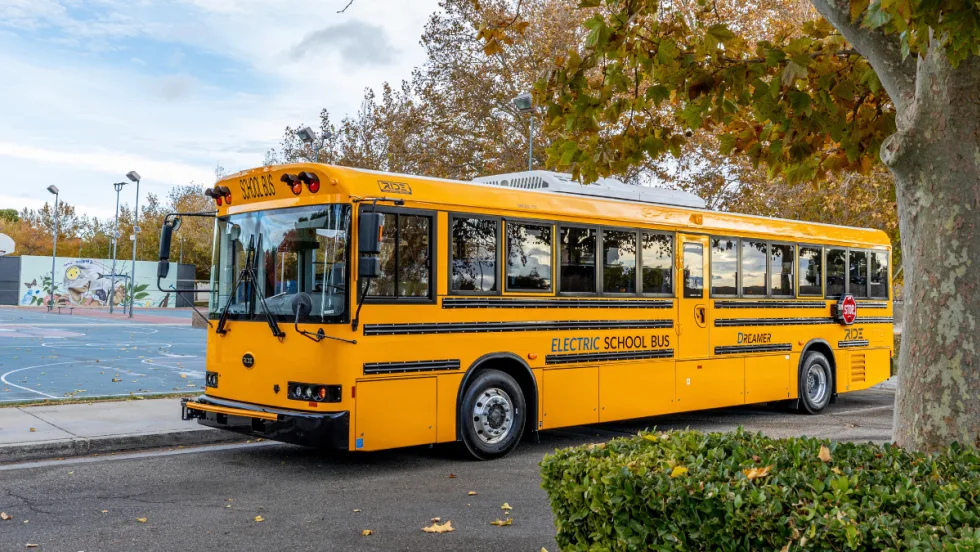
The Secret Life of an Electric School Bus Battery
Batteries change throughout years of daily routes, but degradation doesn’t necessarily mean the end. Here’s what operators should know about performance, safety, and second life.
Read More →
CALSTART and Forth Combine to Form Catalyst Mobility
The new name represents a renewed vision for the nonprofit focused on advancing clean, equitable, and affordable transportation solutions that move people and goods.
Read More →
Alt-Fuel Moves: New Buses, Charging Hubs & Real-World EV Testing
Propane and electric school bus deployments continue to grow as districts add new vehicles, expand charging infrastructure, and gather more real-world operating data.
Read More →
Fewer Electric School Bus Models Reshape the U.S. Market
WRI’s latest buyer’s guide points to a consolidating electric school bus market, but fewer options may reflect a maturing industry rather than fewer meaningful choices for school bus operators.
Read More →
The Fuel Budget You Can Actually Predict: How Propane Autogas Keeps Money in the Classroom
Learn how propane autogas helps school districts manage fuel costs with predictable pricing, lower maintenance, and reduced emissions from former transportation director Joel Stutheit.
Read More →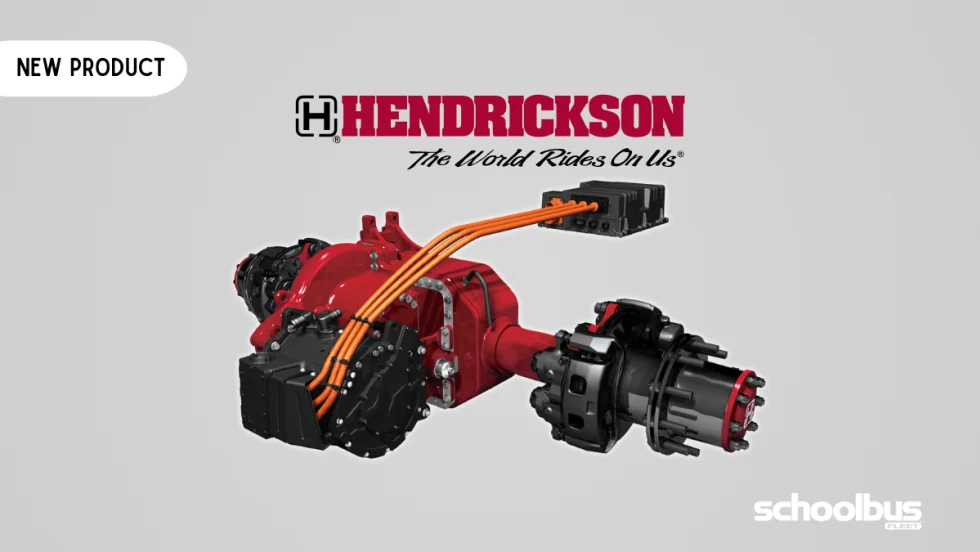
Hendrickson, Driventic Introduce New Electric Powertrain for School Buses
ELECTRAAX, the electrified, lightweight drive axle offers integrated ePowertrain efficiency and modular flexibility for Class 6–7 school bus use.
Read More →