





Keep Reading: School Transportation Data Is Only as Powerful as the Story It Tells
Alt-Fuel Moves: Electric School Bus Investments Hit the Road
See which districts across the U.S. are putting electric school buses into service, expanding charging infrastructure, and planning the next phase of fleet electrification.
August 7, 2026
School districts and transportation partners across the U.S. continue expanding electric school bus fleets and charging infrastructure as previously funded electrification projects move into deployment.
Credit:
Durham School Services/School Bus Fleet
5 min to read
- Various school districts in the U.S. are actively introducing electric school buses to their transportation fleets from prior commitments.
- Efforts are underway to enhance the supporting infrastructure, focusing on expanding charging facilities for these electric buses.
- Planning is in progress for future phases of fleet electrification to ensure a comprehensive transition to alternative fuel vehicles.
*Summarized by AI
As funding concerns grow, electric school bus rollouts continue as school districts, transportation providers, and industry partners turn recent commitments into full-on deployments. From California and Georgia to Florida and New York, recent announcements highlight how organizations are scaling deployments while expanding the charging and energy systems that power them.
In this Alt-Fuel Moves roundup, we take a look at the latest electrification news from the Environmental Defense Fund, Los Angeles Unified School District, DeKalb County School District, Durham School Services, Power Innovations International, and L-Charge.
Report Highlights Growing Momentum for Electric School Bus Deployments
A new analysis from the Environmental Defense Fund (EDF) found that 841 medium- and heavy-duty zero-emission vehicles were announced in June, including school buses, terminal tractors, and Class 8 trucks, signaling continued momentum for fleet electrification.
Among the school bus announcements, student transportation provider Zūm plans to deploy 105 electric school buses for the San Francisco Unified School District. In comparison, New York-based school bus company GVC will add 45 electric buses serving students with special needs in the South Bronx. Both projects include new charging infrastructure to support the fleets.
According to the EDF, the deployments are expected to improve air quality, particularly in communities like the South Bronx, where childhood asthma rates exceed the national average.

Road to 2028 Co-Chairs Russell Westbrook and Matt Petersen kick off the Road to 2028 Summit with a fireside chat moderated by TIME Senior Correspondent Justin Worland, July 14, 2026.
Credit:
LACI
California District Commits to Electrify 25% of School Bus Fleet by 2028
Los Angeles Unified School District (LAUSD) has committed to electrifying 25% of its yellow school bus fleet by 2028 as part of a broader series of climate commitments announced by the Los Angeles Cleantech Incubator (LACI).
Under the initiative, LAUSD plans to purchase 329 electric school buses and 329 charging stations by 2028, making it one of the nation's largest school bus electrification efforts. To support the transition, LACI, LAUSD, and Highland Electric were recently awarded a $2.93 million grant from the California Energy Commission.
The commitment is part of LACI's Road to 2028 initiative to mobilize nearly $600 million in climate-related investments, which is accelerating transportation electrification and clean energy projects ahead of the 2028 Olympic and Paralympic Games in Los Angeles.
The initiative builds on LACI's public-private Transportation Electrification Partnership and Clean Energy Partnership, which aim to advance electrification projects, pilot programs, and policies that support cleaner transportation, job creation, and economic growth across the region.
DeKalb County Schools to Roll Out Georgia's Largest Electric School Bus Fleet
DeKalb County School District is preparing to deploy what officials say will be Georgia's largest electric school bus fleet, with 75 battery-electric buses expected to begin entering service by the end of August.
According to 11ALIVE, the buses were purchased through two grant awards, allowing the district to expand its fleet without using local education funds. Transportation Director Bernando Brown said the district is completing charging infrastructure ahead of the rollout.
Brown said each electric bus costs about $15 per day to charge, offering significant savings compared to diesel fuel as operating costs continue to rise.
District officials also expect the quieter buses to improve the ride experience for students and drivers.
Built by Blue Bird, the 75 electric buses will join DeKalb's fleet of approximately 1,100 buses, which also includes 199 propane-powered buses and one natural gas bus. The district transports about 45,000 students each school day using roughly 700 buses.
Because electric buses weigh more than their diesel counterparts, district staff are also evaluating routes to ensure roads and bridges can safely accommodate the vehicles before they enter service.
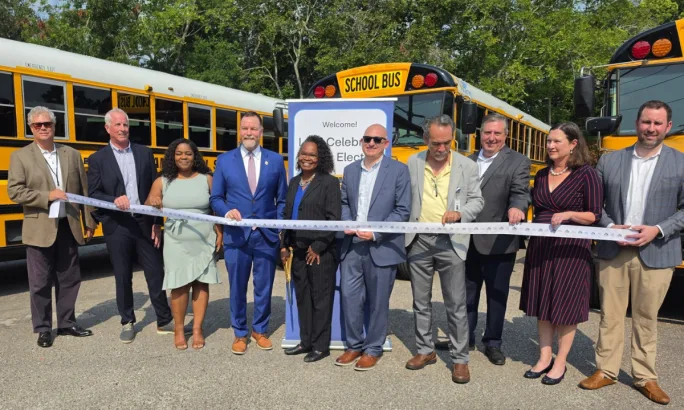
Durham School Services, Duval County Public Schools, and Highland Electric Fleets celebrate the deployment of 26 new electric school buses during a ribbon-cutting ceremony in Jacksonville, Florida.
Credit:
Durham School Services
Durham School Services Deploys 26 Electric School Buses for Duval County Public Schools
Durham School Services has deployed 26 new electric school buses for Duval County Public Schools (DCPS) in Jacksonville, Florida, marking another milestone in the district's transition to cleaner student transportation.
The fleet of IC Bus Type C electric buses, paired with 26 Zerova 30-kW chargers, was funded through the U.S. Environmental Protection Agency's Clean School Bus Program. Durham will operate the buses, while Highland Electric Fleets will support the deployment through its Electrification-as-a-Service (EaaS) model.
The buses are scheduled to enter service for the 2026-27 school year.
"We are excited to have these new buses on the roads contributing to a better experience and environment for our students, families, and the greater community," said Chayla Ferguson, director of transportation for Duval County Public Schools. She added that the project allows the district to realize the benefits of electric school buses "at no additional cost to our taxpayers."
According to the EPA, electrifying one school bus can eliminate as much carbon dioxide over its lifetime as removing four passenger vehicles from the road. For the 26-bus fleet, that equates to the emissions of approximately 104 passenger vehicles.
Durham School Services and Highland Electric Fleets celebrated the deployment with a ribbon-cutting ceremony at Durham's Jacksonville transportation facility, where district officials, school board members, and community partners gathered to mark the launch of the new fleet.
Power Innovations International Joins Current/OS to Support DC Microgrid Standards
Power Innovations International (Pii) has joined the Current/OS Foundation partner network, a move the company says will help advance standards and interoperability for direct current (DC) microgrids as electrification expands across transportation and other industries.
Current/OS brings together technology companies working to develop best practices and technical standards for designing, deploying, and operating DC energy systems at scale.
Pii said its portfolio includes modular power electronics, DC-coupled energy systems, bidirectional charging platforms, and EV charging technologies. Its Tower of Power platform is designed to integrate energy storage, renewable energy, EV charging, and critical loads into DC-coupled microgrids while reducing power conversion losses.
"Current/OS is bringing together organizations that recognize the need for common standards and interoperability across DC systems," said Nick Stone, head of product at Power Innovations International. "We're excited to support that mission and contribute our experience building power electronics and DC-coupled infrastructure."
The partnership comes as interest in DC infrastructure continues to grow for applications including electric vehicle charging, distributed energy, airports, industrial facilities, and data centers.
L-Charge Tops 10 GWh in Fleet EV Charging Milestone
L-Charge announced it has delivered more than 10 gigawatt-hours (GWh) of energy and completed 250,000 charging sessions through its off-grid EV charging and microgrid solutions for fleet customers.
The company said the milestone reflects growing demand for charging infrastructure that can be deployed quickly without waiting for utility upgrades. L-Charge's platform combines generators, battery energy storage, and DC fast charging to provide temporary or permanent charging solutions for fleet operators.
According to the company, its systems can be installed within weeks and are designed to help fleets overcome grid constraints as they transition to electric vehicles. L-Charge serves light-, medium-, and heavy-duty EV fleets across industries including logistics, delivery, and rideshare.
More Alternative Fuels

CALSTART and Forth Combine to Form Catalyst Mobility
The new name represents a renewed vision for the nonprofit focused on advancing clean, equitable, and affordable transportation solutions that move people and goods.
Read More →
Alt-Fuel Moves: New Buses, Charging Hubs & Real-World EV Testing
Propane and electric school bus deployments continue to grow as districts add new vehicles, expand charging infrastructure, and gather more real-world operating data.
Read More →
Fewer Electric School Bus Models Reshape the U.S. Market
WRI’s latest buyer’s guide points to a consolidating electric school bus market, but fewer options may reflect a maturing industry rather than fewer meaningful choices for school bus operators.
Read More →
The Fuel Budget You Can Actually Predict: How Propane Autogas Keeps Money in the Classroom
Learn how propane autogas helps school districts manage fuel costs with predictable pricing, lower maintenance, and reduced emissions from former transportation director Joel Stutheit.
Read More →
Hendrickson, Driventic Introduce New Electric Powertrain for School Buses
ELECTRAAX, the electrified, lightweight drive axle offers integrated ePowertrain efficiency and modular flexibility for Class 6–7 school bus use.
Read More →
The Mobility House Joins PowerFlex in Fleet Electrification Deal
The acquisition combines intelligent charging software, bidirectional charging expertise, and fleet electrification services to support the growing adoption of electric school buses across North America.
Read More →
With Fuel Volatility Ahead, School Districts Turn to Propane
While diesel prices peaked above $5 this spring, districts with propane autogas-powered fleets paid under $2 per gallon, according to PERC.
Read More →
EPA Unveils Proposed Changes to 2027 Heavy-Duty Engine Rules
The federal agency has proposed changes to next year’s targets that would eliminate DEF derates, ease warranty requirements, and retain current NOx emissions standards.
Read More →
Alt-Fuel Moves: EV Charging & Infrastructure Projects Gain Momentum
The latest developments include new funding, charging infrastructure, utility investments, and fleet technologies designed to support the transition to electric school buses nationwide.
Read More →
Alt-Fuel Moves: Fleets Power Up Beyond the Bus
See how districts are pairing electric buses with charging, solar, and V2G technology to cut costs, boost resilience, and unlock new fleet value.
Read More →