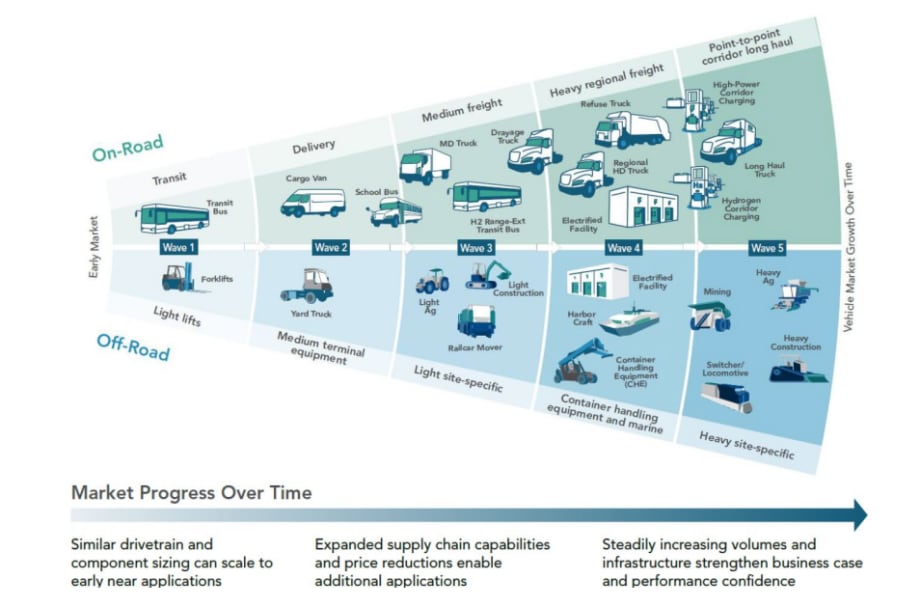
School bus fleets fall within the second wave of the so-called "Beachhead Model" for electric vehicle adoption, with shorter and more predictable routes.
Image: CALSTART
5 min to read
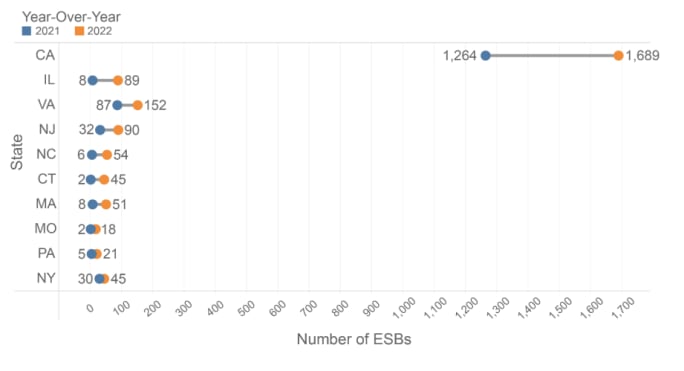
The nation’s school bus fleets in 2022 had 3,043 electric buses, with the states of California, Maryland, Florida, Virginia, and New Jersey serving as the vanguard for EV adoption.
CALSTART’s annual “Zeroing in on Electric School Buses” report released this week indicates that Illinois, New Jersey, North Carolina, Connecticut, and New York also made progress in their zero-emission technology adoption.
“The increase in federal and state funding programs over the past year has reduced the most significant barrier of cost, despite the fact that school districts frequently face resource limitations that prevent them from implementing this technology,” the report states. “For new school districts adopting ESBs, technical support and fleet electrification planning continue to be significant obstacles.”
Buses on the Beachhead
CALSTART and the California Air Resources Board (CARB) developed what’s known as the Beachhead Model to identify “commercial vehicle applications where zero-emissions are most likely to succeed,” such as those like school buses that operate along known, relatively short routes and can charge overnight at fleet depots.
Under this model, electric school buses fall in the second wave and are considered “an ideal application to demonstrate zero-emission technology in real-world scenarios, portraying their capabilities in extreme weather conditions and operating through various terrain environments.”
Charging Up Bus Fleet Electrification
For its 2023 report, CALSTART quantified ESB deployment via funding and award reports from federal, state, and local programs, as well as news releases, social media posts, and the World Resource Institute’s electric school bus adoption dataset.
Ad Loading...
The latest report doesn’t reflect buses forthcoming through the EPA’s 2022 Clean School Bus Rebate Program because it wasn’t finalized yet and remained subject to change. “Considering the number of potential awards through the Clean School Bus Program, we did not want to incorrectly state the adoption numbers,” the report states.
The report went on to note that the rebate program had the potential to award around 2,400 ESBs and that “this round of awards alone would nearly double the total number of ESBs currently adopted in the United States.”
Since September 2021, the report indicates, 888 new electric buses joined school fleets throughout the United States.
The top five states with zero-emission buses:
California: 1,689. This state accounts for 56% of the zero-emission school bus adoption in the U.S., per the report.
Maryland: 336.
Florida: 218.
Virginia: 152.
New Jersey: 90.
Ad Loading...
States with significant zero-emission school bus growth:
Illinois: 81 buses added.
New Jersey: 58 buses added.
North Carolina: 48 buses added.
Connecticut: 43 buses added.
New York: 15 buses added.
Did your state make the top 10 list in the 2023 CALSTART report?
Image: CALSTART
Electric School Bus Funding Programs and Legislation
The Infrastructure Investment and Jobs Act passed in 2021 allocated $5 billion for the EPA Clean School Bus Program, which aims to replace existing diesel school buses with zero- and low-emission alternatives.
The CALSTART report also points out that the EPA Inflation Reduction Act provides tax credits through the 45W Clean Commercial Vehicle Credit, along with the Diesel Emissions Reduction Act (DERA), the American Rescue Plan Act ESB rebates, and the EPA Airshed Grant for school districts that want to electrify their fleets.
And one reason California leads the way when it comes to adopting zero-emission buses: state funding support, including the Hybrid and Zero-Emission Truck and Bus Voucher Program (HVIP), the Carl Moyer Program and Community Air Protection Incentive Program, and the School Bus Replacement Program.
Ad Loading...
The Massachusetts Clean Energy Center (MassCEC) provides funding in that state through its Accelerating Clean School Transportation (ACT) School Bus Advisory Services Program, offering support to school districts with technical assistance.
Other state funding sources beyond California include:
New York Truck Voucher Incentive Program (NYTVIP).
Colorado Department of Public Health and Environment (CDPHE) CleanFleets Vehicle and Technology Grant Program.
Oregon Clean Fuels Program with PG&E.
Volkswagen Settlement Funds through the VW Mitigation Trust.
On the policy side, CALSTART highlighted the Advanced Clean Trucks (ACT) regulation adopted in June 2020 by CARB, which calls for ZEVs in commercial fleets.
“ACT establishes zero-mission medium and heavy-duty vehicle sales targets that will include school bus manufacturers,” the report states. “Massachusetts, New Jersey, New York, Oregon, and Washington have also adopted the ACT regulation, with another dozen states planning to adopt ACT within the next few years.”
Ad Loading...
In Washington, active legislation would require 70% of new school bus purchases to be zero-emission by 2030 and all such purchases by 2033. Massachusetts, Illinois, and Hawaii have proposed legislation as well.
States that have passed school bus fleet electrification legislation include:
California.
Michigan.
New York.
Exploring EV Bus Market Trends
The high upfront cost of an electric school bus – the price can be up to three times more than conventional diesel buses – has discouraged widespread adoption of these vehicles, which currently make up less than 1% of the 480,000 school buses on the road each day. Inflation and supply chain issues led some OEMs to boost their prices even further during the past year.
The CALSTART report delves into the option to repower existing school buses from internal combustion engines to zero-emission high-voltage electric drivetrains and batteries.
Ad Loading...
“Repowered school buses reduce upfront costs compared to purchasing new ESBs,” the report states, “costing less than a new ICE school bus and up to 40% of the cost of a new ESB, depending on the manufacturer and battery range.”
Repowered school buses aren’t sold through dealerships or other common channels, which makes it difficult for the companies that offer the service to achieve market recognition. Also, legislation for funding ESBs may not include language covering repowered vehicles. “However, incentives for repowers could provide a more cost-effective approach to full-scale electrification,” the report states.
In recent years, the market also has seen the rise of new financing models geared toward electric school buses and infrastructure planning that can help accelerate adoption of this technology:
As-a-Service Models: Companies offer school districts a comprehensive financing solution with a subscription service that may include infrastructure installation, charging management, and operations staff training.
Green Banks: These organizations help with the deployment of clean energy technology through loans, loan guarantees, and credit enhancements, using funds from governments, private investors, or charities.
Said Rachel Chard, national program manager for electric school buses at CALSTART: “Despite some barriers to adoption, such as the upfront cost, school districts have more support available to them than ever to help ease the transition to electric school buses. It’s clear from the data that school districts are eager to electrify with increases in adoption and program participation happening across the U.S.”
The new name represents a renewed vision for the nonprofit focused on advancing clean, equitable, and affordable transportation solutions that move people and goods.
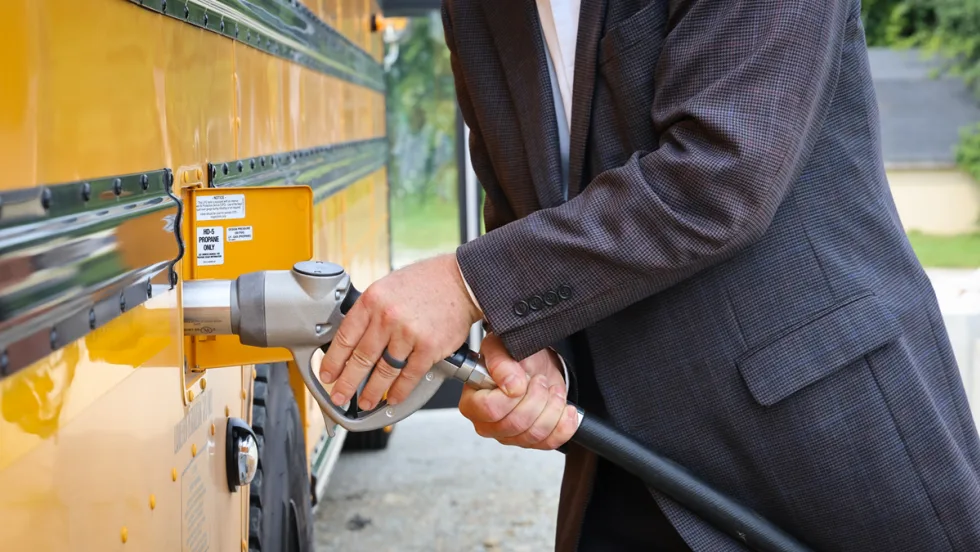
Propane and electric school bus deployments continue to grow as districts add new vehicles, expand charging infrastructure, and gather more real-world operating data.
WRI’s latest buyer’s guide points to a consolidating electric school bus market, but fewer options may reflect a maturing industry rather than fewer meaningful choices for school bus operators.
Learn how propane autogas helps school districts manage fuel costs with predictable pricing, lower maintenance, and reduced emissions from former transportation director Joel Stutheit.
The acquisition combines intelligent charging software, bidirectional charging expertise, and fleet electrification services to support the growing adoption of electric school buses across North America.
See which districts across the U.S. are putting electric school buses into service, expanding charging infrastructure, and planning the next phase of fleet electrification.
The federal agency has proposed changes to next year’s targets that would eliminate DEF derates, ease warranty requirements, and retain current NOx emissions standards.
The latest developments include new funding, charging infrastructure, utility investments, and fleet technologies designed to support the transition to electric school buses nationwide.