





According to NSTA, private school bus contractors account for 38% of the nation’s pupil transportation services.
Fleets in Flux: Adapting to Changing Student Transportation Needs
Gone are the days of school bus fleets being made up of just yellow buses. These days, we’re seeing more fuel and vehicle types than ever, as the use of passenger vehicles and vans increases and the role of alternative transportation providers soars. Let’s dig into it.
May 26, 2025
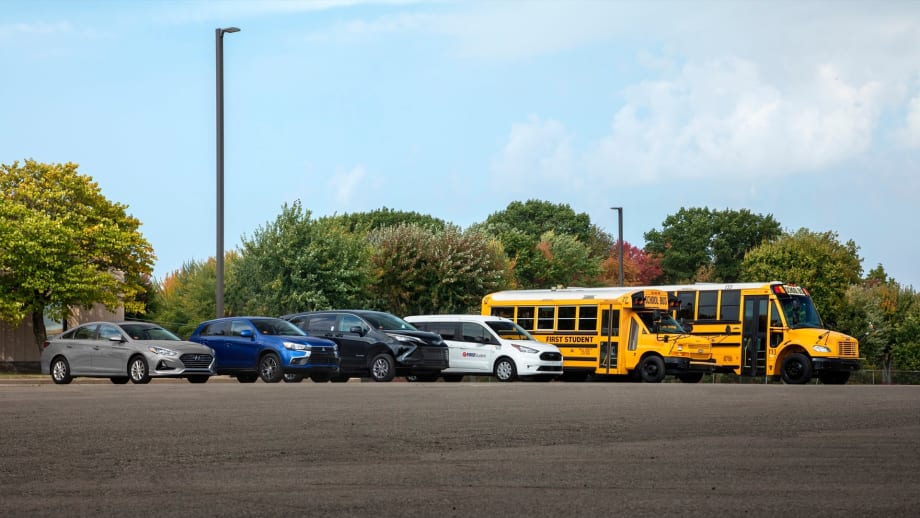
This photo of First Student’s fleet illustrates the varied vehicles now present in most district’s pick-up and drop-off lines, from the good ol’ yellow bus to smaller-capacity vans and passenger vehicles.
Photo: First Student
11 min to read
The times, they are a-changin’.
These lyrics from Bob Dylan may not have been geared toward school transportation, but when they were released in 1964, school district and contractor bus yards were a sea of yellow, boxy buses. And those same buses had far fewer safety standards and efficiencies than they do today.
Sure, a lot has changed about the industry since the days of old. But the fleets themselves are also a sign of the times. Now, we see diversified fleets made up of vehicles of all types getting kids to school and back, and the rise of a multi-modal approach with traditional school buses and supplemental solutions working in tandem.
What does the modern pupil transportation fleet look like and where is it headed? SBF asked numerous industry experts to weigh in.
Changes in District Operations
Nearly all school bus fleets today face similar struggles and have shared success, whether technology adoption, AI usage, fuel and vehicle diversification, regulatory requirements, or spec’ing updates.
While buses of old were primarily either gasoline or diesel, today there are so many options to fuel a school bus, and many fleets have a combination of engine types. We’re seeing propane making gains, natural gas in play, and watching electrification’s mandates and infrastructure readiness. Diesel itself looks different now, too, with new emissions requirements and additives for a cleaner exhaust.
“Having a combination of buses has its pros and cons,” said Teena Mitchell, special needs transportation coordinator at Greenville County Schools in South Carolina. “One of the pros is that it allows us the opportunity to collect data on each fuel type. By analyzing data, it gives us insight into the efficiency of each fuel type, which leads to data-driven decision-making. A con would be the utilization of the buses has to be strategic; range and fueling logistics must be considered.”
One new trend of note: School bus ridership is on the decline. According to SBF’s research, just 50% of students ride a school bus — the least we’ve seen in at least a decade. However, this national trend is not the case in all states or districts.
In Arizona, Florence Unified School District #1 has experienced significant growth, facilitating the need for more transportation staff and buses. Its fleet has tripled in size since 2008. Shannon Weber, director of transportation, says, “The one thing we can count on is change!” and stays closely tuned in to alternative fuels and EVs, technology, GPS, camera improvements, and safety software.
Student population is on the rise at Prosper ISD in Texas, too. Teri Mapengo, director of transportation, said their fleet grew from 87 buses to 226 in just 10 years. Technology has helped streamline many functions in that time, thanks to GPS tracking and vehicle maintenance software.
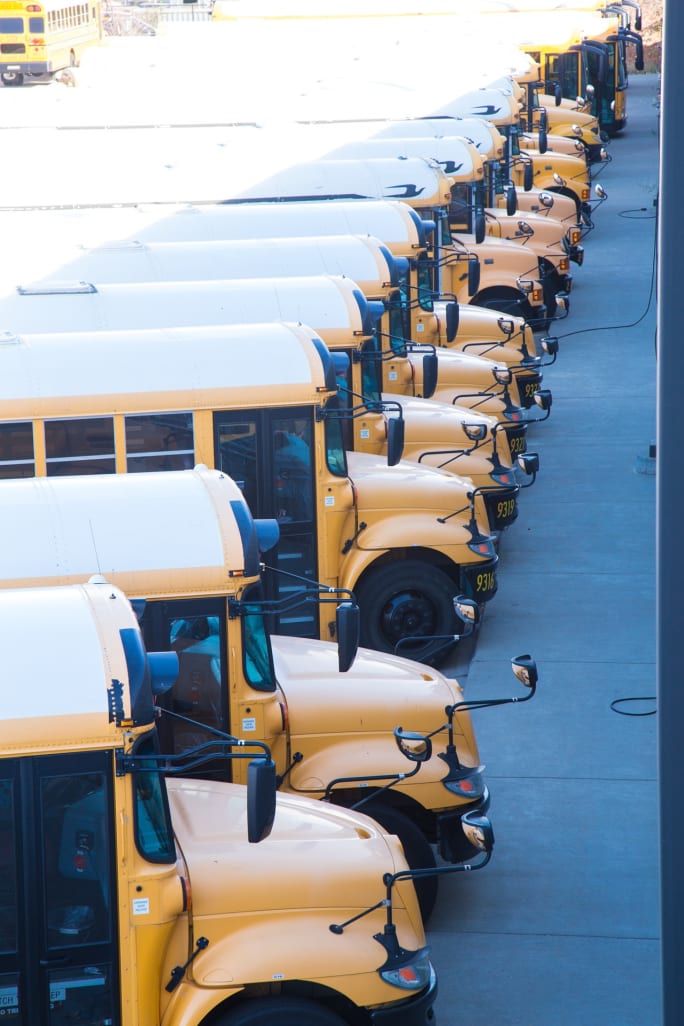
Denver Public Schools owns and operates its own fleet in the Mile High City, supplementing service with two alternative transportation providers.
Photo: Denver Public Schools
Meanwhile at Denver Public Schools (DPS), the fleet size is declining. While it once had as many as 400 buses, it aims to right-size the fleet to about 268 CDL buses, in line with its driver pool. To bridge that gap, it has found success outsourcing to alternative transportation. Tyler Maybee, DPS’ director of operations, transportation department, said they are also slowly replacing diesel buses with alt fuels to meet the district’s sustainability board resolution.
For districts that can’t or don’t want to operate and manage every aspect of transportation, contractors, charter companies, or alternative transportation providers can help for all or a portion of a district’s needs.
Changes in School Bus Contracting
Contracted companies have been helping schools with their transportation needs for nearly as long as school buses have existed. And just like district-operated buses, they’ve seen change, too.
Beacon Mobility calls its fleet “as diverse as the communities we serve.” While yellow buses are foundational to its operations, it also uses passenger vans, SUVs, and sedans. And over the past few years, it’s expanded into alternative fuels and powertrains, including clean diesel, plug-in hybrid, battery electric, compressed natural gas, and liquid propane.
According to NSTA, private school bus contractors account for 38% of the nation’s pupil transportation services.
Many contractors have been greening their fleets, too. Student Transportation of America (STA) now offers a school bus electrification program to the districts it serves, complemented by an analytics program that tracks performance.
In New York, Tim Flood, EVP of The Trans Group, runs over 1,000 buses, over half of which are small Type As. He’s got 88 SUVs in the form of Suburbans and Tahoes, too. The latter are all painted yellow with school bus lights, inspected by the state DOT for McKinney Vento runs, and pick up one or two students each. “Everything we put students in is yellow with protective lights,” he said.
In Minnesota, over half of the Palmer Bus Service fleet is conventional buses, and Jenna Fromm, CEO, notes that Type C capacities have increased: a 64-passenger cap used to be common, where 77 is now standard. She also said that Palmer and others have invested more heavily in propane in recent years.
Shae Harkleroad, president of Raystown Transit in Pennsylvania — which has a fleet of 40 buses and 52 vans — notes an exponential increase in students needing accommodations and more students who are displaced.
Harkleroad fears that some district directors who have been using contractors for years and don’t experience things like the driver shortage may not realize the strain contractors feel. And, those same districts likely won’t bring transportation services back in house.
“I feel that contractors walk a thin line,” Harkleroad said. “While I strive to keep up with the demand of our districts, I am also keenly aware that if I fall too far behind on their requests, I could face the district doing an RFP … I think the role of contractors will remain the standard, but over the next 10 years we will see small contractors like myself begin to decrease.”
Mitchell reminds districts using contractors that it does not decrease district liability. “In fact, it often increases obligations,” she said. “Districts must ensure that contracts clearly outline safety expectations and include a process for oversight to confirm those safety measures are being implemented by the contractor.”
Passenger Vehicle & Van Usage Increases
When Derek Graham, pupil transportation consultant, was North Carolina’s state director, he recalls what was then a new request: districts asking to add vans to their fleets to hire non-CDL drivers for McKinney Vento students.
Now, vans in district or contractor fleets is more and more the norm.
Harkleroad says the requests for van transportation have skyrocketed. And since there’s still the driver shortage, finding non-CDL drivers to run a van route is easier than filling yellow bus routes — so that’s exactly what he did.
“Since December 2024, I have had to purchase 10 vans and hire drivers for those vans just to keep up with the demand,” Harkleroad said. “Two years ago, the number of van routes in any district that I provide transportation for began to outnumber the number of bus routes. Now here in 2025, my van routes are twice the number of bus routes company-wide. I am still getting so many more requests for transportation from public schools that I am probably still going to have to purchase one or two more with only eight weeks to go in the school year.”
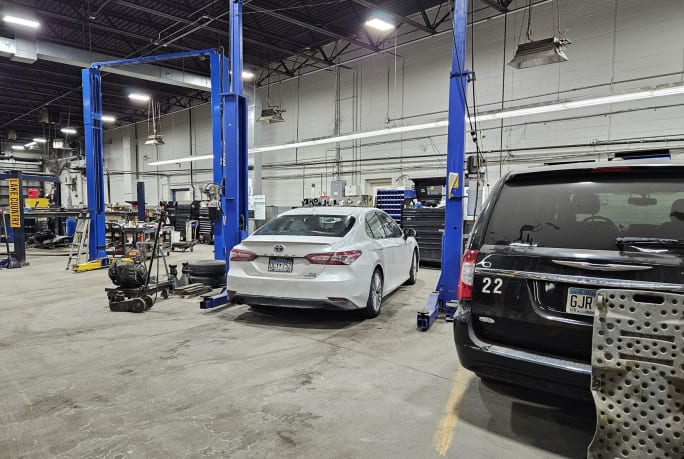
Passenger vans are becoming much more common in school transportation. Here, Lake Country Transportation in Minnesota lines some of its smaller-capacity vehicles up for service in its bus garage.
Photo: Amanda Huggett
Fromm also points out that Type III transportation has grown over the past two decades with more special education transportation and specialized services. About one-quarter of Palmer’s fleet now uses Type III passenger vehicles.
Gaurav Sharda, Beacon Mobility’s chief technology officer, concurs. “We’re seeing a notable increase in demand for smaller, flexible transportation options, particularly for students requiring individualized support,” he said.
Public Transport & Parent Models
Community partnerships can help solve transportation challenges, especially in metro areas.
In Georgia, one district worked with its local public transit system to offer a student pass program. This allowed K-12 students to utilize Chatham Area Transit (CAT) Authority’s fixed-route and paratransit services for free for a limited time. Megan Davidson, district chief operations officer, said, “We work daily to improve our transportation services and continue to seek expanded service offerings to overcome transportation barriers and to ensure all students can travel freely to school, after-school programs, and the many unique learning opportunities that our school district provides.”
In Chicago, SBF’s Administrator of the Year Kimberly Jones manages 1,500 public transit passes for students. This helps them prioritize their most vulnerable passengers on buses.
Some districts still run taxicabs for out-of-district students.
When Greg Jackson, director of business development at School Bus Logistics, was a transportation director, he used this four-question formula to plan the best transportation outcome for a student:
Can we put them on a yellow bus, and will that bus meet their needs?
If so, will it be a comfortable ride for a child with special needs?
If not, can we give the parents a mileage reimbursement if they can transport themselves?
If not, then we look at alternative transportation or another solution.
Question three is one overlooked option, he says. “That parent reimbursement model can be powerful, because in many ways, the parent is a better option than any other driver. Not only do they know their kid better than anyone else, but that kid knows that vehicle.”
What’s Behind the Changes?
Of course change is inevitable, but a few facets in particular accelerated it.
Emily Uhland, VP of customer success at HopSkipDrive, believes several key factors drive recent shifts: the ongoing bus driver shortage, the growing need to transport students with diverse requirements, and the constant pressure on districts to manage budgets effectively.
“Your fleet changes because you’re trying to find every creative way not to cancel routes, to get students to school. That’s what we do! If you hit a wall, open your mind to other ideas. If you narrow in on only one option, you're way behind.” — Greg Jackson, School Bus Logistics
Fleets also must evolve as school offerings increase. “Education programs are all well-intentioned and conceived as a way to improve student learning and outcomes,” Graham said. “But they aren’t always designed with transportation in mind. Very simply, when small numbers of students are being transported places that are different from where most students who live nearby are being transported, it puts stress on the system.”
Graham names McKinney Vento as a prime example of this, as well as special ed and learning programs located outside the normal attendance zone of program attendees.
“In my view, the biggest catalyst is the broader shift in the workplace environment, not just in the school bus industry, but across all sectors,” said Alex Spann, state transportation director for Tennessee. “In the past, smaller districts could rely on people like farmers, preachers, and other professionals who had the flexibility to work split shifts without neglecting their primary duties. However, today’s workforce is characterized by high turnover and less job stability, making it harder to find long-term employees. This constant turnover has pushed districts to explore alternative solutions to meet transportation needs and ensure students have the opportunities they deserve.”
Dr. Stephanie Burrage, CEO of Collaborative Student Transportation, believes COVID further created new challenges and exacerbated the driver shortage, accelerating the need for new solutions. “This season caused school leaders to reimagine every aspect of their operations, including transportation,” she said. “We have seen districts become more and more willing to use vans for services that they previously never would have considered, particularly special education transportation.”
Alternative Transportation
It’s impossible to avoid the rise of alternative transportation these days. There has been massive growth and attention on specialized providers offering smaller-vehicle transportation that moves beyond the yellow bus and district-operated vans.
Like some districts that outsource their school bus service, more are choosing to turn to passenger-vehicle operators, too. These providers specialize in transporting students who aren’t the right fit for school bus service: students with special needs, students qualifying for McKinney Vento, or those who live outside district boundaries.
While we all agree that the yellow bus is best most of the time for most students, there is a growing case for alternative providers to step in.
“Over the past two decades, alternative transportation has evolved from a niche service into a critical component of modern public education infrastructure,” said Mitch Bowling, EverDriven CEO. “What began as a supplemental option has now emerged as a vital solution for helping students access the education they deserve.”
To explore this trend in depth, watch for our article coming soon for more on use cases, safety considerations, arguments for and against, stats, new standards, tips for interviewing potential partners, and a list of providers to consider.
What’s Next?
It’s impossible to predict what new change the future will bring for student transportation fleets, but a few things are certain.
Here’s what some say is coming:
“Managed solutions will continue to grow as districts look to simplify their transportation ecosystem with a consistent single service provider solution. Why manage 10 companies when you can manage one and provide a consistent solution for all students?” — Ryan King, VP of operations, Adroit
“We believe the future of student transportation will be increasingly dynamic, tech-driven, and student-focused. Contractors … will evolve into full-service mobility partners — integrating school buses, vans, electric vehicles, and smart routing to create seamless, efficient systems. In 10 years, we expect to see more electrification, stronger integration with school district technology platforms, and a greater emphasis on equity and access.” — Gaurav Sharda, Beacon Mobility
“I believe there will be more and more specialized transportation.” — Jenna Fromm, Palmer Bus Service
“I believe that a multi-modal solution for transportation systems is here to stay and, in my opinion, benefits districts to operate in this service model to create better efficiency where applicable.” — Tyler Maybee, Denver Public Schools
“Looking ahead, multi-modal student transportation will continue in its role as an essential component of the education ecosystem, creating more pathways for students to safely and reliably get to school.” -Emily Uhland, HopSkipDrive
“We envision a future where alternative transportation is seamlessly integrated with district operations. Technology will play a crucial role in enhancing real-time communication, optimizing routes, and improving transparency.” — Amen Pawar-LaRosa, Pawar Transportation
“Modern student transportation has to set a higher bar — it must be smarter, more efficient, and, above all, more transparent. … Looking ahead, we expect to see a rise in visibility expectations, a deeper reliance on data, AI, and machine learning, continued advancements in safety standards, rising demand for equity-focused transportation, and a stronger push for operational efficiency amid budgetary pressures.” — Mitch Bowling, EverDriven
Subscribe to Our Newsletter
More Management

How to Build a Better Driver Training Program
Ready to boost up your school bus instructor training? Here’s how to pick the right talent and improve recruitment, retention, and safety.
Read More →
CALSTART and Forth Combine to Form Catalyst Mobility
The new name represents a renewed vision for the nonprofit focused on advancing clean, equitable, and affordable transportation solutions that move people and goods.
Read More →
What Makes a Great School Bus Driver Trainer?
Choosing the right school bus driver trainer takes more than experience. Learn six keys to selecting and developing trainers and evaluating program effectiveness.
Read More →

School Bus Contractors Expand Through New Deals, Acquisitions & Partnerships
STA's Canadian division acquires Ontario-based G&L Stevenson Transport while Durham School Services adds a new district contract in California, First Student adds a New Jersey contract, and Minnesota Coaches acquires Halo Transportation.
Read More →
Logan Bus Company Rolls Out AI Phone System for NYC School Bus Families
A summer pilot found that AI agents could handle most routine calls, freeing up time for customer service staff to focus on emergencies and complex family concerns.
Read More →
From Intent to Impact: What I Learned About Leadership from TAPT
A Texas transportation supervisor shares lessons on self-awareness, accountability, managing stress and building trust — and why investing in leadership development matters at every stage of your career.
Read More →
NAPT Names 2026 Award Recipients, Hall of Fame Inductee
Who earned national recognition for their work in student transportation? This year, NAPT named five recipients of its 2026 awards for service, safety, and leadership, plus its newest Hall of Famer.
Read More →
Sponsored•September 2, 2026
2026 State of Student Transportation Report
Driver shortages. Rising costs. Growing safety expectations. More data, but not enough time to act on it. The 2026 State of Student Transportation Report reveals what transportation leaders say is putting the most pressure on their operations—and where they’re investing next. See how your priorities compare.
Read More →
How to De-Escalate an Angry Person: 5 Steps for Handling Workplace Conflict
What makes emotions run high, and how should you handle an angry colleague or parent? Follow these steps for staying calm, listening, showing empathy, and resolving conflict.
Read More →
Sponsored•September 1, 2026
What Readiness Looks Like This School Year
Learn about the challenges shaping the 2026–2027 school year, from persistent driver shortages and budget pressure to technology and readiness gaps. See how school districts are responding and adapting in Zonar’s 2026 Back-to-School Readiness Report.
Read More →