




Biodiesel Putting Down Roots in School Bus Market
See how school districts used biodiesel to reduce school bus emissions while weighing fuel costs, availability, maintenance, and cold-weather performance.

You can have a cleaner fleet tomorrow. So goes the marketing push for biodiesel, an alternative fuel that promises emissions reductions, local economic benefit, national security rewards and few additional costs beyond the price differential for traditional diesel fuel.
A growing number of school districts is filling up on that promise.
In New Jersey, Medford Township Public Schools has switched half of its fleet from petroleum diesel to an 80/20 blend of petroleum diesel and vegetable oil (B20).
The biodiesel program, part of a U.S. Department of Energy (DOE) demonstration, kicked off in 1997 when the incremental cost was $1.05 per gallon. Seven years later, 22 of the 44 buses are still running on the stuff, at only 20 cents more per gallon than conventional diesel, according to Joe Biluck, Medford’s director of operations and technology.
Biluck says Medford’s experiment with biodiesel was prompted by a desire to prove two points: that the fleet could run on an alternative fuel without adverse effects and that biodiesel would lead to a significant reduction in emissions. Biluck says his buses are running smoothly, with noticeably less noxious fumes.
Not just an illusion
But there’s more than just anecdotal evidence. The Environmental Protection Agency (EPA) found decreases of 10 percent in carbon monoxide, 10 percent in total hydrocarbon emissions, 15 percent in particulate matter and 20 percent in sulfates for diesel engines running on B20.
Says Janet Cohen, team leader for the EPA’s Clean School Bus program, “I think everybody is motivated to reduce exposure to diesel exhaust.”
In Michigan, Mike Thompson, transportation supervisor for Ithaca Public Schools, has noticed less smoke from his fleet, a less powerful stench in his power washer and a marked improvement in one driver’s serious asthma since he began running his 30-bus fleet and maintenance vehicles on B20 last April. The dramatic effect on drivers is an often unheralded, but substantial, positive of moving to alternative fuels.
“Drivers are the ones who are out there first thing in the morning, starting up and doing pretrips,” says Pauline Gervais, director of transportation for the Denver-area Adams Twelve Five Star Schools. Especially in colder climates, biodiesel has the potential to reduce the drivers’ exposure to unhealthful emissions of an idling petroleum diesel engine.
There are other green reasons to pursue biodiesel. Its higher flashpoint makes it safer to handle and the percentage of biodiesel that is not petroleum-based is biodegradable and a renewable resource. While most biodiesel is derived from soybean oil, it can be made of any vegetable oil, including recycled cooking oil. School buses in Clark and Washoe counties, the two largest in Nevada, are fueled by used cooking oil from casinos and fast-food restaurants.
Easy to climb aboard
While biodiesel is not the only alternative fuel that offers similar environmental advantages, fans like Biluck say the ease of implementation sets it apart.
“There’s no additional tanks, facility upgrades or dedicated vehicles,” Biluck says. “You can use it on one or two vehicles to get comfortable with it and then expand ... it’s a win-win for both the municipality and the residents of the community and state.”
A seamless transition is what sold a consortium of 12 Denver-area school districts represented by the Regional Air Quality Council (RAQC) on biodiesel. The group received $400,000 of $5 million in available grant money from the EPA’s Clean School Bus USA program. They plan to use it to install diesel catalyst mufflers and to cover the incremental cost of moving to B20.
“We do have access to compressed natural gas and propane, but there’s a cost incurred making that switch,” says Gervais, a participant in the grant program. “With biodiesel, if you have a bus making a long trip, it can just pull up to a gas station and fill up with diesel.”
Differential can vary widely
The cost of biodiesel is in the fuel. Incremental differences are anywhere from 10 to 24 cents a gallon. Jenna Higgins, a spokeswoman for the National Biodiesel Board, says the price varies based on the going rate for soybean oil. Increased demand, as well as a tax incentive currently before lawmakers in Washington, D.C., should make biodiesel cheaper for all users, she says.
Another factor in the price of biodiesel is its availability. For fleets that are located some distance from fuel manufacturers or distributors, transportation costs must be factored in. Donn Dalton, fleet maintenance coordinator for Washoe County School District in Reno, Nev., says one of his primary challenges is how to get alternative fuels, including biodiesel, into northern Nevada. An increase in popularity should make the fuel both easier to come by and cheaper. That’s already happened in New Jersey, where biodiesel is on the state program, allowing it to be purchased as part of a state contract.
Efficiency is also a factor
Alternative fuel is not all about cost, however. One place where biodiesel may save fleets money is on efficiency. Thompson in Ithaca has noticed a half-mile per gallon gain in fuel economy since beginning his biodiesel program last spring. Biluck has not seen a mileage gain, but says that drivers have commented on a smoother ride. And in Littleton, Colo., there have been savings on maintenance, says Sara O’Keefe, communications manager for the RAQC.
School districts are also fueling up on biodiesel because it can be produced domestically. A concern with cutting dependence on foreign oil has encouraged some fleets to consider alternative fuels, as has the potential for biodiesel to contribute to local economies, making it especially popular in soybean-producing areas.
Says Thompson, “If all the school districts in Michigan were using B20, there wouldn’t be enough soybeans grown in the state to satisfy the market.”
Thompson is investing in biodiesel without any outside funding, but financial and strategic help is available for fleets that want to move to alternative fuels. Local air quality districts, state health, energy and agriculture departments, as well as DOE’s Clean Cities Coalition, are all possible sources for grant money and information.
Says O’Keefe, “If you can get in on the loop and work in partnership, you will have a much better chance in getting in on when and where the money will be available.”
Strength in numbers
Working in tandem with other school districts may provide more time and expertise for grant writing, as well as an advantage in grant awards.
“The RAQC coalition is creating a fleet of 1,900 buses that could be run on biodiesel,” says Gervais. “That’s one of the selling points in being successful in a grant, especially when there are really limited funds. There is power in numbers when you’re looking at cleaning up emissions and cleaning up the environment.”
After all is said and done, does biodiesel live up to its PR? The broad answer seems to be yes. That doesn’t mean, however, that the fuel is perfect. Here’s some advice on how to maintain buses powered by biodiesel:
In order to avoid clogging, one of the most commonly cited problems associated with biodiesel, Biluck recommends cleaning your tanks and paying increased attention to the filters on older vehicles for the first six months. Biodiesel is an aggressive cleanser, and will scrub loose any deposits left by previous fuels.
Gelling is a concern that can be eliminated by fine-tuning the mix. Gervais, Biluck and Higgins all recommend working with your vendor to keep biodiesel flowing in cold climates.
Another option is to ramp up to B20. Dalton’s fleet of 292 buses began running on B5 this fall and will move to B10 next year and B20 in 2005. “Our primary concern is the safety of our students and taking care of their health while safely transporting them,” he says.
Screen vendors closely
The best way to pre-empt problems is to make sure you work with an EPA-certified vendor. The Clean School Bus USA program has verified soybean blends from several sources to ensure quality.
“We don’t want school districts purchasing technologies with nothing but the manufacturer’s word that it works,” says Clean School Bus USA’s Cohen.
Higgins seconds that. “The critical thing is that the biodiesel meets the national standard for biodiesel and that you go with a company that’s registered with the EPA rather than a home brewer,” he says. “It’s important to ask where the fuel comes from and if it meets the national standard. You can buy it directly from the manufacturer or from a distributor, but it’s the same question.”
Biluck, who has the longest-running biodiesel school bus fleet in the nation, feels confident in the future of the fuel. “It’s a technology that’s passed the test of time,” he says. “It’s not fly-by-night. It’s been able to meet the marketing hype.”
For more information about biodiesel, see these sources:
More Alternative Fuels
Bipartisan Bill Seeks to Extend Clean School Bus Program Through 2031
The proposed legislation would renew federal support for cleaner school buses as districts navigate funding uncertainty, rising fuel and infrastructure costs, and fleet replacement needs.
Read More →
Alt-Fuel Moves: Electric Bus Rollouts, Bidirectional Charging & Propane Growth
See which fleets are adding electric and propane school buses as districts and operators invest in charging infrastructure, bidirectional technology, and alternative-fuel expansion.
Read More →
Nobody Told Diesel Prices They Were Supposed to Come Down
With diesel prices surging, school bus fleets have new reason to stress-test fuel costs, consider diversification, and calculate what each route really costs to operate.
Read More →
Why Gasoline School Buses Are Making a Comeback
Gasoline is gaining ground in full-size school buses. See how today’s options stack up against diesel on cost, maintenance, emissions, performance, and more.
Read More →
EPA Opens $180M DERA Funding Round for Diesel Upgrades
The 2026 Diesel Emissions Reduction Act program seeks applications from eligible organizations to accelerate the retirement of legacy diesel vehicles.
Read More →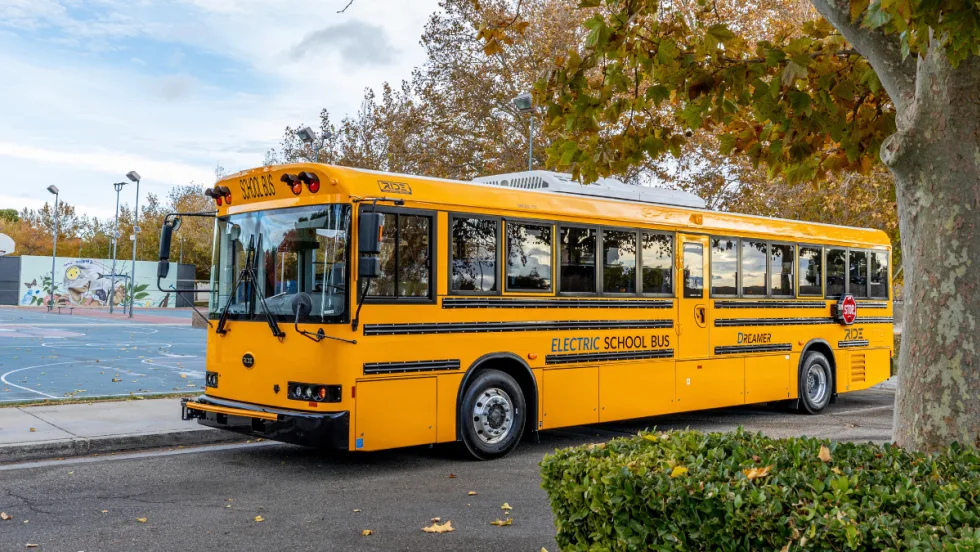
The Secret Life of an Electric School Bus Battery
Batteries change throughout years of daily routes, but degradation doesn’t necessarily mean the end. Here’s what operators should know about performance, safety, and second life.
Read More →
CALSTART and Forth Combine to Form Catalyst Mobility
The new name represents a renewed vision for the nonprofit focused on advancing clean, equitable, and affordable transportation solutions that move people and goods.
Read More →
Alt-Fuel Moves: New Buses, Charging Hubs & Real-World EV Testing
Propane and electric school bus deployments continue to grow as districts add new vehicles, expand charging infrastructure, and gather more real-world operating data.
Read More →
Fewer Electric School Bus Models Reshape the U.S. Market
WRI’s latest buyer’s guide points to a consolidating electric school bus market, but fewer options may reflect a maturing industry rather than fewer meaningful choices for school bus operators.
Read More →
The Fuel Budget You Can Actually Predict: How Propane Autogas Keeps Money in the Classroom
Learn how propane autogas helps school districts manage fuel costs with predictable pricing, lower maintenance, and reduced emissions from former transportation director Joel Stutheit.
Read More →