




NASDPTS Session Points to 3-Point Belts’ Potential to Reduce School Bus Injuries
The state directors’ annual gathering also addresses the use of tablets and GPS units for school bus drivers.

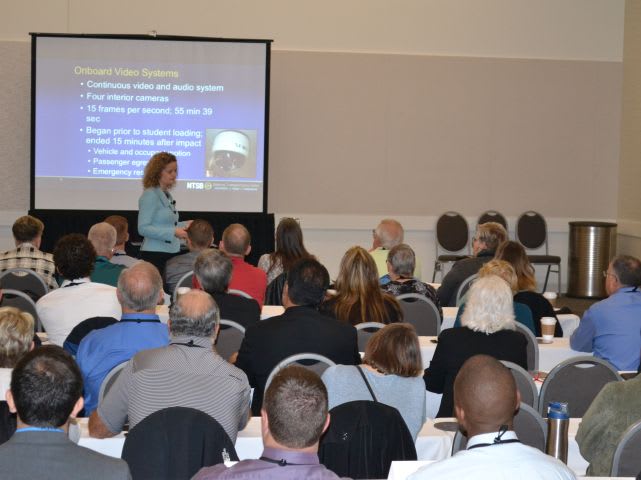
Kristin Poland of the National Transportation Safety Board shares findings from school bus crash investigations during a NASDPTS conference session on lap-shoulder belts.
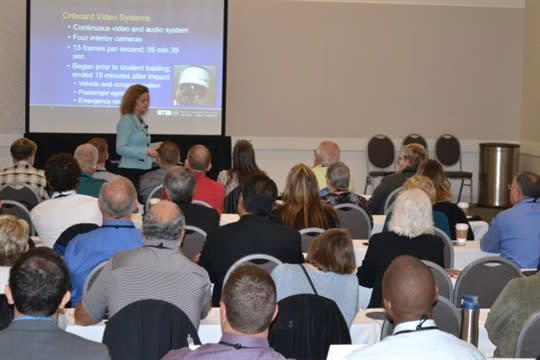
Kristin Poland of the National Transportation Safety Board shares findings from school bus crash investigations during a NASDPTS conference session on lap-shoulder belts.
COLUMBUS, Ohio — Lap-shoulder belts for students and mobile devices for drivers on school buses were among the topics discussed at the annual gathering of state directors last week.
The National Association of State Directors of Pupil Transportation Services (NASDPTS) held its 2017 conference from Nov. 4 to 8 in Columbus.
The headliner session for the NASDPTS conference took on a long-debated topic in pupil transportation: seat belts in school buses. While the issue remains contentious in the industry, NASDPTS has in recent years bolstered its support for lap-shoulder belts for school bus passengers.
In the conference session, Kristin Poland, a mechanical/biomechanical engineer with the National Transportation Safety Board (NTSB), recapped investigation findings from fatal crashes that involved school buses with lap belts or lap-shoulder belts. NTSB has found that lap-shoulder belts reduce flailing injuries and provide greater protection for passengers.
Poland also shared details from NTSB’s investigation of a school bus crash in Centerville, Louisiana, in 2014. The agency studied concussion data from baseball players on the bus, which was not equipped with seat belts. The team was already taking part in a concussion management program, so NTSB researchers were able to compare data from before and after the crash.
“Sixteen out of 30 athletes had significant post-crash cognitive changes suggestive of a concussion,” Poland said, noting that the effects lasted for months for some of the players.
NTSB has published a study on the concussion analysis from the Centerville crash.
The NASDPTS conference session on lap-shoulder belts also featured Charlie Gauthier, former head of the National Highway Traffic Safety Administration’s (NHTSA’s) school bus safety program and former executive director of NASDPTS.
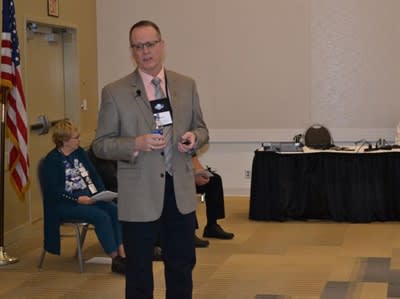
Iowa state director Max Christensen moderates a discussion on the use of mobile data terminals (tablets, for example) for school bus drivers.
Gauthier said that the potential to reduce passenger injuries has been underemphasized in the debate on whether school buses should be equipped with lap-shoulder belts.
“It shouldn’t be based solely on the number of fatalities saved each year,” Gauthier said. “Injuries seem to have disappeared off the discussion table.”
Gauthier also said that supporting lap-shoulder belts is a way for pupil transportation leaders to show parents that they are committed to the safety of their children.
“We don’t want to lose the parents,” he said. “If we lose the parents, we’ll have more kids getting to school some other way.”
NASDPTS President Diana Hollander also pointed to the parent factor.
“Parents prefer seat belts,” Hollander said, although she added that more should be done to promote the safety record of school buses in general. “We have done a poor job of convincing parents that even if you don’t have lap-and-shoulder belts, the school bus is still the safest place for their children.”
Hollander and NASDPTS President-Elect Michael LaRocco also discussed their experience witnessing IMMI’s recent crash test, which involved a semi-truck hitting the side of a school bus to compare the results for belted and unbelted crash dummies on the bus. Hollander and LaRocco played a video of the dramatic demonstration, which shows one of the unbelted dummies being ejected from the bus through a window.
Another NASDPTS conference session focused on mobile data terminals for school bus drivers. The term refers to devices like tablets and GPS units that are used for routing directions and student ridership management.
Max Christensen, past president of NASDPTS and state director in Iowa, said that the industry needs to ensure that these devices serve “as an aide and not a distraction.” The goal, he noted, is to propose specification language for mobile data terminals at the next National Congress on School Transportation, which will be held in 2020 in Des Moines, Iowa.
Pupil transportation officials in Iowa began discussing mobile data terminals when a state inspector saw a device mounted on a school bus and was unsure how to handle it. That led to a NASDPTS survey of the issue. Of the 22 states that responded to the survey, 16 allow mobile data terminals for routing, five do not, and one didn’t answer the question.
Iowa has since allowed mobile data terminals for school bus routing and ridership management. Using information from other states, the Iowa Department of Education developed its own guidelines for the use of mobile data terminals.
Rick Lecker, chair of the NCST school bus specifications writing committee, shared the details of Washington's guidelines for mobile data terminals. They say, for example, that the devices must not block the driver's view out of the windshield, of any mirrors, or of any gauges or controls. The devices also can't pose a snagging hazard for students in the loading and unloading process.
The NASDPTS conference agenda also included updates from an array of federal agencies, including NHTSA, NTSB, the Transportation Security Administration, the Environmental Protection Agency, and the Federal Motor Carrier Safety Administration.
Linda Bluth of the Maryland State Department of Education led a panel presentation on education reform and its impact on school transportation. Another session addressed media coverage of school bus driver qualifications and performance, with an eye on recent high-profile crashes and driver oversight issues.
More Management

How to Build a Better Driver Training Program
Ready to boost up your school bus instructor training? Here’s how to pick the right talent and improve recruitment, retention, and safety.
Read More →
CALSTART and Forth Combine to Form Catalyst Mobility
The new name represents a renewed vision for the nonprofit focused on advancing clean, equitable, and affordable transportation solutions that move people and goods.
Read More →
What Makes a Great School Bus Driver Trainer?
Choosing the right school bus driver trainer takes more than experience. Learn six keys to selecting and developing trainers and evaluating program effectiveness.
Read More →

School Bus Contractors Expand Through New Deals, Acquisitions & Partnerships
STA's Canadian division acquires Ontario-based G&L Stevenson Transport; Durham School Services adds a new district in California; First Student expands in New Jersey; and Minnesota Coaches rebrands and acquires Halo Transportation.
Read More →
Logan Bus Company Rolls Out AI Phone System for NYC School Bus Families
A summer pilot found that AI agents could handle most routine calls, freeing up time for customer service staff to focus on emergencies and complex family concerns.
Read More →
From Intent to Impact: What I Learned About Leadership from TAPT
A Texas transportation supervisor shares lessons on self-awareness, accountability, managing stress and building trust — and why investing in leadership development matters at every stage of your career.
Read More →
NAPT Names 2026 Award Recipients, Hall of Fame Inductee
Who earned national recognition for their work in student transportation? This year, NAPT named five recipients of its 2026 awards for service, safety, and leadership, plus its newest Hall of Famer.
Read More →
2026 State of Student Transportation Report
Driver shortages. Rising costs. Growing safety expectations. More data, but not enough time to act on it. The 2026 State of Student Transportation Report reveals what transportation leaders say is putting the most pressure on their operations—and where they’re investing next. See how your priorities compare.
Read More →
How to De-Escalate an Angry Person: 5 Steps for Handling Workplace Conflict
What makes emotions run high, and how should you handle an angry colleague or parent? Follow these steps for staying calm, listening, showing empathy, and resolving conflict.
Read More →
What Readiness Looks Like This School Year
Learn about the challenges shaping the 2026–2027 school year, from persistent driver shortages and budget pressure to technology and readiness gaps. See how school districts are responding and adapting in Zonar’s 2026 Back-to-School Readiness Report.
Read More →