




NASDPTS bolsters support for lap-shoulder belts
The state directors association had previously expressed its support for lap-shoulder belts if funding is made available. At the annual NASDPTS conference, the board strengthens its position by dropping the funding clause. Safety topics were the focus of many conference sessions.

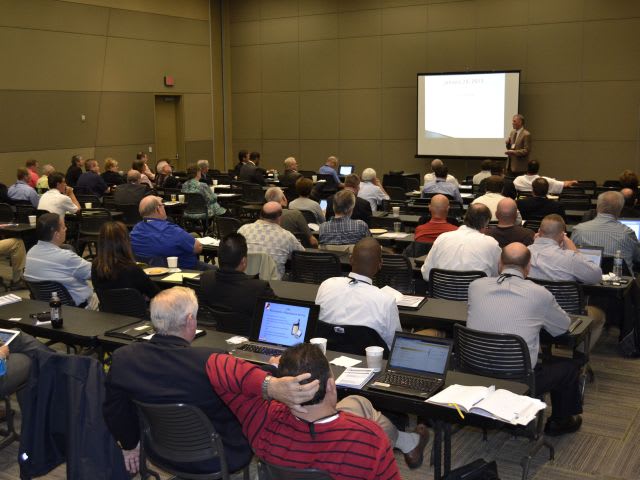
The state directors association strengthened its position in support of lap-shoulder belts for school buses, a key development during the group’s annual conference in Grand Rapids, Mich., in October.
Previously, the National Association of State Directors of Pupil Transportation Services (NASDPTS) had gone on the record to support lap-shoulder belts if funding is made available for them. But that statement had begun to seem inconsequential considering economic conditions.
“All of us know that funding is not currently generally available, and I doubt anyone thinks it will become available anytime in the near future,” NASDPTS President Max Christensen said. “Thus our position really seemed to be a ‘non-position.’”
At the Grand Rapids gathering, the NASDPTS board decided to bolster its support for the three-point restraints by dropping the funding clause from its position.
“As of today, NASDPTS fully supports the installation and use of lap-shoulder belts in school buses, period, with no ifs, ands or buts,” Christensen said.
However, the board noted that it should be left up to school districts whether to equip their buses with the restraints.
“We are not recommending the installation and use, nor are we asking that lap-shoulder belts be required,” Christensen said. “We believe this should be a local decision based on local need.”
NASDPTS’ position papers on the topic will be updated to reflect the new position.
Seat belts on school buses has been a contentious topic in the industry for several decades, but Christensen said that the NASDPTS board felt it was time to take “a true leadership position” on the issue.
[PAGEBREAK]

Attendees watch the heartrending film “Impact: After the Crash,” on the catastrophic bus crash and fire in Carrollton, Ky., in 1988. On screen is Harold Dennis, who escaped from the bus but was severely burned.
Michigan matters
During NASDPTS conference sessions at the DeVos Place Convention Center, on the banks of the chilly Grand River, attendees heard from several Michigan officials involved in transportation safety. That included a welcome from state pupil transportation director Ken Micklash and an overview of the Michigan Traffic Crash Facts website (www.michigantrafficcrashfacts.org), which allows users to analyze accidents involving school buses, among other vehicles.
Sgt. Mike McLaughlin of the Michigan State Police shared details on changes to the state’s school bus inspection program. The agency is implementing tablets for its inspectors and moving to an electronic inspection form, which McLaughlin said will increase efficiency and access to key information.
“All the data that’s in there will be searchable,” he said. “We’re going to have more data available to us than we even realize now.”
Crash analyses
NASDPTS held two joint keynote sessions with the National Association for Pupil Transportation (NAPT). Both of those presentations examined fatal bus crashes.
Christopher Hart, vice chairman of the National Transportation Safety Board, discussed his agency’s investigations of two similar school bus accidents in 2012 — one in Chesterfield, N.J., and the other in Port St. Lucie, Fla. In the other session, attendees watched a documentary on the 1988 Carrollton, Ky., bus tragedy. (For more on those two sessions, see this article.)
Also during the joint gathering of NASDPTS and NAPT attendees, the American School Bus Council presented its School Bus Champions award to Washington State Superintendent Randy Dorn and his chief of staff, Ken Kanikeberg. Both have been instrumental in increasing pupil transportation funding and protecting regional coordinator positions in their state.
“During the last [legislative] session, they secured another $109 million in funding for pupil transportation in Washington for the next two years,” said Don Carnahan, former Washington state pupil transportation director and now president of NAPT. “This is not a one-time deal for these gentlemen. They have actively supported pupil transportation initiatives for many years.”
Variety of topics
Other NASDPTS sessions included:
• Donny Bynum, superintendent of Dale County (Ala.) Schools, shared his district’s experiences and lessons learned in the early 2013 incident in which school bus driver Charles “Chuck” Poland Jr. was fatally shot and a 5-year-old student was taken hostage.
• Launi Hardin, transportation director at Washington County School District in St. George, Utah, discussed Obamacare and its implications for school districts and their bus drivers.
• Washington state pupil transportation director Allan Jones put a humorous spin on his presentation about marijuana legalization in Washington and its possible effects on school bus drivers.
The 2014 NASDPTS conference will be held in Kansas City, Mo., Nov. 9-12.
More Management

How to Build a Better Driver Training Program
Ready to boost up your school bus instructor training? Here’s how to pick the right talent and improve recruitment, retention, and safety.
Read More →
CALSTART and Forth Combine to Form Catalyst Mobility
The new name represents a renewed vision for the nonprofit focused on advancing clean, equitable, and affordable transportation solutions that move people and goods.
Read More →
What Makes a Great School Bus Driver Trainer?
Choosing the right school bus driver trainer takes more than experience. Learn six keys to selecting and developing trainers and evaluating program effectiveness.
Read More →

School Bus Contractors Expand Through New Deals, Acquisitions & Partnerships
STA's Canadian division acquires Ontario-based G&L Stevenson Transport while Durham School Services adds a new district contract in California, First Student adds a New Jersey contract, and Minnesota Coaches acquires Halo Transportation.
Read More →
Logan Bus Company Rolls Out AI Phone System for NYC School Bus Families
A summer pilot found that AI agents could handle most routine calls, freeing up time for customer service staff to focus on emergencies and complex family concerns.
Read More →
From Intent to Impact: What I Learned About Leadership from TAPT
A Texas transportation supervisor shares lessons on self-awareness, accountability, managing stress and building trust — and why investing in leadership development matters at every stage of your career.
Read More →
NAPT Names 2026 Award Recipients, Hall of Fame Inductee
Who earned national recognition for their work in student transportation? This year, NAPT named five recipients of its 2026 awards for service, safety, and leadership, plus its newest Hall of Famer.
Read More →
2026 State of Student Transportation Report
Driver shortages. Rising costs. Growing safety expectations. More data, but not enough time to act on it. The 2026 State of Student Transportation Report reveals what transportation leaders say is putting the most pressure on their operations—and where they’re investing next. See how your priorities compare.
Read More →
How to De-Escalate an Angry Person: 5 Steps for Handling Workplace Conflict
What makes emotions run high, and how should you handle an angry colleague or parent? Follow these steps for staying calm, listening, showing empathy, and resolving conflict.
Read More →
What Readiness Looks Like This School Year
Learn about the challenges shaping the 2026–2027 school year, from persistent driver shortages and budget pressure to technology and readiness gaps. See how school districts are responding and adapting in Zonar’s 2026 Back-to-School Readiness Report.
Read More →