





Electric School Bus Maintenance: Key Similarities, Differences
Georgia Roadshow Advocates Tout Alternative Fuel Options
The second of three Clean Energy Roadshow events made a stop at Mercer University in Macon.
November 17, 2021
4 min to read
Scott Schultz, senior associate dean at Mercer University’s College of Engineering, has been working on restoration of a 1957 Ford Thunderbird at home.
“I was bemoaning the fact that I couldn’t find leaded gas,” he said during remarks at Wednesday’s Clean Energy Roadshow at the Georgia college. “Sixty-five years from now, when our grandkids are restoring 2022 cars, will they be able to find gas?”
Schultz said it’s an exciting and transformative time in the field of energy and transportation.
“A lot of changes are coming quickly,” he said. “I never expected to see so much change happening so fast.”
The roadshow, produced by Event Energy Partners and hosted by Georgia Public Service Commissioner Tim Echols, started in 2010 as an alternative fuels technology roundtable but grew into a series of energy seminars with ride-and-drive opportunities.
The roadshow events “helped me see we needed to create the public-private partnership,” Echols said. And, he said, it goes beyond the borders of the state of Georgia. “Our target may be one college, one city, one county looking to decide about alternative fuel, but we see more takers on this technology every year.”
Glenn Halliday, electric transportation manager for Georgia Power, noted that growth in the electric vehicle market is undeniable.
“You can’t open a newspaper or look at the internet without seeing people talking about electrification,” he said during a roadshow session. “We can’t wait for when the vehicles get here to put the infrastructure in the ground. We have to prepare now.”
Ian Skelton with Atlanta Gas Light promoted compressed natural gas (CNG) vehicles. AGL has worked with fleet customers such as the Metropolitan Atlanta Rapid Transit Authority (MARTA), DeKalb County, and UPS.
Currently, there are 26 CNG stations distributed throughout Georgia.
“With our infrastructure program, if you have a fleet, you can location a (CNG) station on property, work with a gas station to co-locate, or share with another company,” Skelton said.
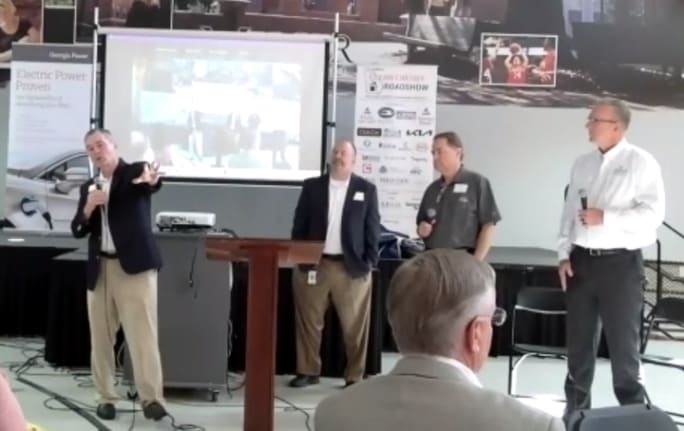
Georgia Public Service Commissioner Tim Echols (left) hosted Wednesday's seminar at Mercer University.
Stephen Whaley with Propane AutoGas said that a resource must accomplish four things before it can replace diesel and gasoline:
Be cleaner
Be cheaper
Be as good or better when it comes to performance
Be abundant
Whaley said the United States exports 20-billion gallons each year while using 10-billion domestically.
“We move (propane) in pipelines, rail cars, transport trucks,” he said. “It’s a very portable fuel.”
Andy Moore, Blue Bird Corporation’s director of electrification and a 2010 graduate of the host university, noted that more than half the buses built by the company these days use alternative fuels such as CNG, propane, and electric. He expects demand for electric buses to keep rising with the passage of President Joe Biden’s bipartisan infrastructure legislation.
“Besides being the cleanest way to get to school, buses could be used for storage of renewable energy,” Moore said. “Most of the time, buses sit idle during the school day or in the summer. Using (vehicle-to-grid) technology, buses can store excess power when demand is down, and then at night when the sun goes down, export power as demand comes back up.”
He also envisioned making electric buses available for disaster response.
“I see a future where buses can pull up and plug in, helping power relief operations until crews get the grid up and running again,” Moore said. “Electric school buses can be used for a lot more than safely transporting students to and from school.”
Greg Boike, director of public administration at the Middle Georgia Regional Commission, said he’s excited about the opportunities awaiting communities seeking to shift to alternative fuels, not just because it keeps air clean, “but it’s good for your local economy and good for your business’ bottom line.”
He urged school districts and other organizations to build a team and be ready for the federal grant process as the infrastructure funding legislation turns into action.
“If you don’t have a plan, you’re not going to be successful,” Boike said. “The time to be building that team is yesterday. If you didn’t build that team yesterday, today is a great day to be starting on that too.”
The Clean Energy Roadshow makes one final stop Thursday at the Georgia Institute of Technology in Savannah. Registration is free. The event is available for in-person and virtual attendance.
More Alternative Fuels

CALSTART and Forth Combine to Form Catalyst Mobility
The new name represents a renewed vision for the nonprofit focused on advancing clean, equitable, and affordable transportation solutions that move people and goods.
Read More →
Alt-Fuel Moves: New Buses, Charging Hubs & Real-World EV Testing
Propane and electric school bus deployments continue to grow as districts add new vehicles, expand charging infrastructure, and gather more real-world operating data.
Read More →
Fewer Electric School Bus Models Reshape the U.S. Market
WRI’s latest buyer’s guide points to a consolidating electric school bus market, but fewer options may reflect a maturing industry rather than fewer meaningful choices for school bus operators.
Read More →
The Fuel Budget You Can Actually Predict: How Propane Autogas Keeps Money in the Classroom
Learn how propane autogas helps school districts manage fuel costs with predictable pricing, lower maintenance, and reduced emissions from former transportation director Joel Stutheit.
Read More →
Hendrickson, Driventic Introduce New Electric Powertrain for School Buses
ELECTRAAX, the electrified, lightweight drive axle offers integrated ePowertrain efficiency and modular flexibility for Class 6–7 school bus use.
Read More →
The Mobility House Joins PowerFlex in Fleet Electrification Deal
The acquisition combines intelligent charging software, bidirectional charging expertise, and fleet electrification services to support the growing adoption of electric school buses across North America.
Read More →
Alt-Fuel Moves: Electric School Bus Investments Hit the Road
See which districts across the U.S. are putting electric school buses into service, expanding charging infrastructure, and planning the next phase of fleet electrification.
Read More →
With Fuel Volatility Ahead, School Districts Turn to Propane
While diesel prices peaked above $5 this spring, districts with propane autogas-powered fleets paid under $2 per gallon, according to PERC.
Read More →
EPA Unveils Proposed Changes to 2027 Heavy-Duty Engine Rules
The federal agency has proposed changes to next year’s targets that would eliminate DEF derates, ease warranty requirements, and retain current NOx emissions standards.
Read More →
Alt-Fuel Moves: EV Charging & Infrastructure Projects Gain Momentum
The latest developments include new funding, charging infrastructure, utility investments, and fleet technologies designed to support the transition to electric school buses nationwide.
Read More →