What do megawatt charging and vehicle-to-grid technology mean for electric school bus implementation? New Eagle's latest EV controller offers a glimpse at the future of fleet charging and energy management.
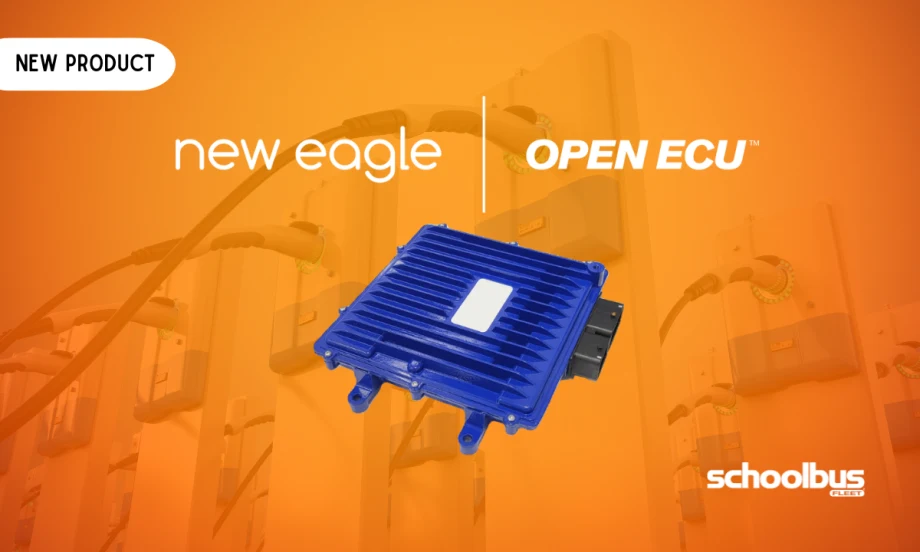
Last month at ACT Expo, the company, which offers embedded control systems for intelligent vehicles and machines, launched its OpenECU NX3, a next-generation control platform designed to simplify electrified vehicle architectures by consolidating charging and supervisory control into a single electronic control unit (ECU).
Leveraging expanded hardware, software, and engineering capabilities from recently acquiring Pi Innovo, the company said the NX3 extends New Eagle’s platform, enabling new levels of system integration, scalability, and development efficiency across electrified vehicle programs.
According to the company's announcement, the NX3 is the industry’s first single-controller solution combining Megawatt Charging System and Combined Charging System (CCS) protocols with full vehicle supervisory control, eliminating the need for multiple controllers and reducing system complexity, wiring overhead, and failure points.
As commercial EV platforms scale, traditional multi-box architectures can drive unnecessary cost, wiring complexity, and integration risk. The NX3 addresses these limitations by enabling OEMs to consolidate key vehicle functions into one production-ready controller.
What this means for school bus fleets
Megawatt charging systems and the ISO15118-20 standard support vehicle-to-grid power transfer, enabling school bus fleets to support electric grids during off-peak hours with no communication changes between vehicle, charger, and grid. Charging can be scheduled according to energy availability, and transfers can be requested and scheduled based on provider requirements.
Megawatt charging can enable improved fleet management flexibility by reducing charging times, and therefore the number of individual chargers required for a single fleet, enhancing route flexibility for multiple or mid-day routes.
Additional capabilities include:
- Ultra-Fast Charging: Megawatt Charging, with power levels between 1 and 4.75MW for commercial applications, enable much faster charging and on-demand energy support.
- Dual-Inlet Charging Control: MCS and CCS support from a single ECU, eliminating redundant controllers.
- Full Vehicle Supervisory Control: Integrated management of powertrain, charging, and auxiliary systems.
- Production-Ready Safety & Security: Designed to meet ASIL-D functional safety and ISO 21434 cybersecurity requirements.
- Flexible Development Environment: Support for model-based development and C-code workflows.
In addition to the NX3, New Eagle is introducing new charge control and driveline solutions, including the Charge Control Unit and DLC-12, expanding its portfolio of scalable, production-ready controllers for electrified vehicle systems.