





Looking For More? A Quick Guide to School Bus Alternative Fuels
Alt-Fuel Moves: EV Charging Expansion & Fleet Deployments
From EV charging growth to V2G testing and new bus deployments, districts and providers advance alt-fuel goals amid challenges.
March 19, 2026
On top of various alternative fuel deployments, read more on Pioneer's charging expansions, V2G testing from Xos, as well as one district's electrification challenges.
Credit:
Prince William County Public Schools/School Bus Fleet
7 min to read
Between major charging investments and real-world deployment challenges, the school transportation sector is balancing rapid progress with on-the-ground realities when it comes to sustainability.
In this alternative fuel roundup, we take a look at the latest moves, product announcements, and deployments, including news from Pioneer Power Solutions, Xos, Prince William County Public Schools, Arlington Public School District, San Dieguito Union High School District, and Montgomery County Public Schools.
Pioneer Secures $1.8M in New Orders, Expands EV Charging Projects
Pioneer Power Solutions, Inc., a company in the design, manufacture, service, and integration of distributed energy resources, power generation equipment, and mobile electric vehicle charging solutions, recently announced $1.8 million in new orders received through mid-February 2026.
“Securing over $1.75 million in new orders within the first few weeks of the year confirms the continued relevance of our broad suite of charging and power solutions,” said Nathan J. Mazurek, chairman and CEO of Pioneer. “Enterprises simply cannot secure enough reliable power in an economically reasonable timeframe. Our ability to deliver high-capacity, off-grid power solutions to customers across North America today is a more significant competitive advantage than ever before.”
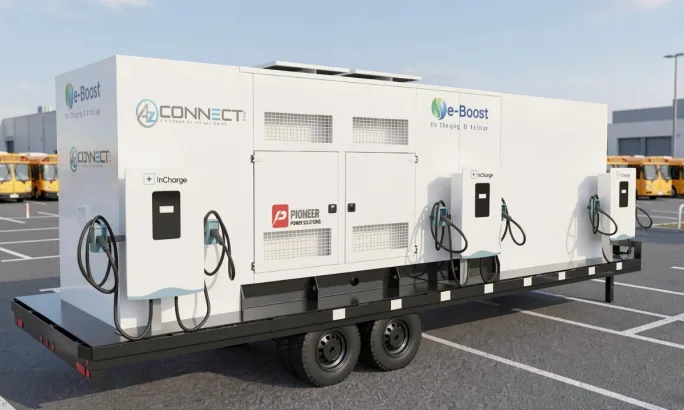
Pictured here is an A-Z Bus Sales, Inc., modified e-Boost Mobile 175 with three InCharge DCFC chargers featuring six ports.
Credit:
Pioneer Power Solutions, Inc.
In select new business highlights, Pioneer, in partnership with A-Z Bus Sales, Inc., has agreed to provide an e-Boost Mobile unit that delivers 180 kW of power dispensed via six DCFC charging ports to one of Southern California’s leading school districts to support its growing fleet of electric school buses.
Plus, Pioneer is supporting a rapidly expanding fleet of all-electric vehicles for a nationally ranked metropolitan school district in Central Florida, which is facing infrastructure delays, by deploying two e-Boost PureEnergy units with 60 kW fast-charging ports. This critical infrastructure will be used to charge the school district’s recent acquisition of 26 IC Bus and Thomas Built electric school buses.
“From electric school bus deployments in California and Florida to off-grid charging solutions for utilities in Southeastern U.S. and an aviation mega-hub in Canada, we are removing the primary barriers to EV adoption,” added Geo Murickan, president of Pioneer eMobility. “We aren't just selling chargers or power, we are providing operational certainty for large-scale fleet transitions.”
Xos Announces Production Rollout of Vehicle-to-Grid Capability
Xos, Inc., a provider of electric commercial vehicles and mobile charging solutions, recently announced that Vehicle-to-Grid (V2G) production will begin in April 2026 on a major electric school bus platform in North America. The roadmap for the V2G project will also work on extending bidirectional capability across its product portfolio, transforming its vehicle and energy ecosystem into active grid assets.
Xos will enter production this April with bidirectional charging on a “school bus platform serving tens of thousands of routes across the United States.” Fleet vehicles entering production at this stage will be able to discharge stored energy back to the grid during peak demand events, opening a direct revenue stream for school districts and operators without requiring hardware retrofits or complex utility approvals.
According to a company release, by embedding bidirectional capability at the depot level, Xos enables fleets, school districts, and utilities to reduce peak demand charges, defer infrastructure upgrades, and participate in demand response programs, “turning every depot into an active contributor to grid stability.”
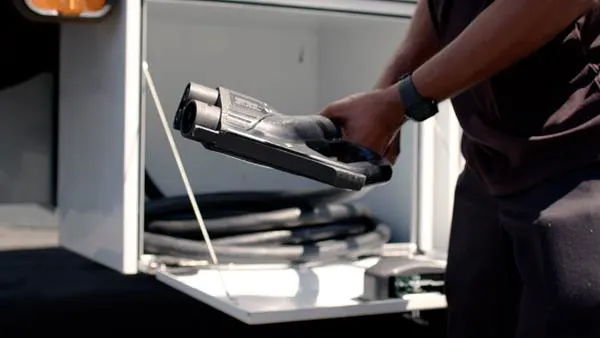
According to Xos, commercial fleets present favorable conditions for V2G deployment.
Credit:
Xos
Commercial fleets present favorable conditions for V2G deployment, XOS wrote in the release. Vehicles follow predictable schedules, return to a central depot each night, and spend a significant portion of the day parked and connected. School buses typically sit idle outside of morning and afternoon routes, creating extended windows where stored energy can be made available to the grid without affecting daily operations.
“The engineering challenge with V2G at commercial scale is not just bidirectional hardware,” said Saleh Heydari, chief technology officer of Xos. “It is building the capability to manage energy flow across vehicles and sites without disrupting daily operations. We designed this to handle predictive scheduling, depot-level coordination, and utility integration, making V2G operationally seamless and financially meaningful from day one.”
New Alternative Fuel Deployments
Alternative fuel adoption is gaining momentum nationwide as districts roll out propane and electric buses. However, some districts are still grappling with real-world limitations.
Virginia District Unveils 62 New Propane Buses Equipped with Driver Airbags
On March 18, Prince William County Public Schools unveiled its new fleet of propane school buses at its Brentsville facility. The 62 Blue Bird Vision Propane buses are also the first from the company to come equipped with standard driver airbags.
The propane buses were purchased from Blue Bird Bus Sales of Virginia. According to a release, in collaboration with its corporate headquarters in Gibsonia, Pennsylvania, the dealer provided a fully equipped 78-passenger propane school bus demonstrator to the school district. Following a successful six-week demonstration, PWCPS placed an order for 62 propane buses, bringing them to its fleet for the first time.
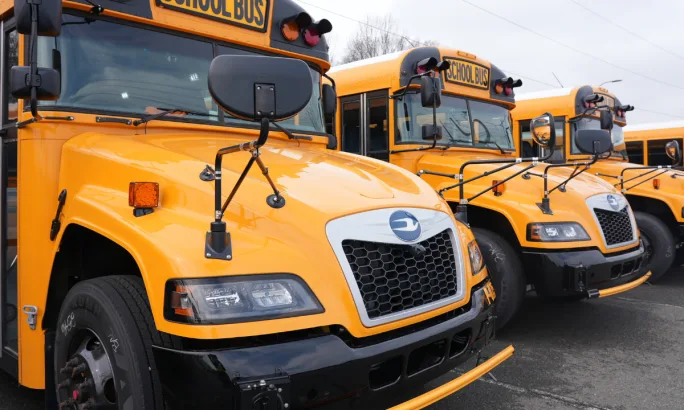
The 62 Blue Bird Vision Propane buses are also among the first from the company to be equipped with standard driver airbags.
Credit:
Prince William County Public Schools
Each Blue Bird Vision Propane 72-passenger school bus is equipped with an IMMI 4Front driver airbag, a 7.3L V8 Ford engine, and a ROUSH CleanTech propane fuel system. With Ford’s 335-hp 7.3L engine, the school district’s propane buses retain equivalent horsepower, torque, and warranty coverage as its gas and diesel counterparts.
“Prince William County Public Schools’ investment in propane buses marks a significant step toward cleaner, safer student transportation,” said Steve Whaley, propane product segment leader for Blue Bird Corporation. “We’re thrilled to deliver our first propane buses equipped with standard driver airbags, combining industry-leading safety with ultra-low emissions.”
Massachusetts District Receives Third Electric School Bus
Arlington Public School District recently secured a new electric school bus as part of its journey to become carbon neutral by 2050. In compliance with its Zero Emission Vehicle First policy (which requires all vehicles needing to be replaced to prioritize zero-emission technologies), Arlington’s new addition brings its electric bus count to three.
According to a town release and Your Arlington, the new electric school bus is expected to be commissioned later this month and will participate in the Massachusetts Clean Energy Center (MassCEC) Vehicle-to-Everything (V2X) Demonstration program.
The pilot program is designed to test the viability of bidirectional charging stations, granting a charging station to the town at no cost. The charging station will be installed at the Ed Burns Arena & Skating Rink to charge the third electric school bus.
“The Town is excited to be piloting this cutting-edge EV charging technology,” said Arlington Town Manager Jim Feeney. “We are grateful to MassCEC for this opportunity to work toward lowering the Town’s energy costs while contributing to local and regional energy resilience goals.”
California District Adds First Round of Electric School Buses
In early March, the San Dieguito Union High School District unveiled its first four electric school buses, with nine more expected by the end of the year. The buses, built in Lancaster by electric transit company RIDE, use lithium-iron phosphate batteries.
According to The Coast News Group, the district’s fleet currently contains 54 diesel vehicles. For each new electric bus, one diesel bus will be retired.
“By the end of this summer, we expect to be at nearly 25% electric, and by 2029, nearly 40% of our fleet will be EV,” said Antonio Perez, San Dieguito Union High School District director of transportation. “This is an exciting step forward for our district, and we are proud to be moving forward in this direction.”
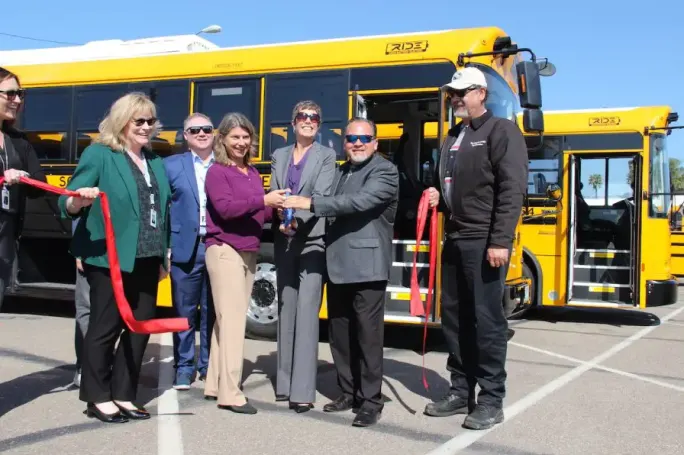
Officials with the San Dieguito Union High School District cut the ribbon for four new electric buses at the district’s transportation yard on Thursday, March
Credit:
Leo Place
The buses were purchased at a low cost due to several grants, including the Volkswagen Mitigation Trust, the Environmental Protection Agency’s Clean School Bus Program, the state Zero Emission School Bus and Infrastructure (ZESBI) program, and California’s Clean Truck and Bus Voucher Incentive Project.
Maryland District Requests Diesel School Buses Despite Move to Electric
Montgomery County Public Schools is receiving backlash from the community for recently requesting the purchase of 150 new diesel school buses. In an attempt to move toward an all-electric fleet, funds for new district buses were allocated specifically for electric buses as of 2025, despite this recent request.
“Maybe the county council and us need to consider legislation saying that county money can’t be spent on diesel buses,” Montgomery County Executive Marc Elrich told NBC4 Washington.
However, MCPS recently reported late deliveries, non-working buses, and charging issues from supplier Highland Electric Fleets.
“Current electric bus technology is not fully capable of meeting all of our transportation requirements, particularly for longer routes, special education needs, field trips and mid-day services that exceed charging capacities,” Liliana López, director/public information officer at MCPS, said in a statement to NBC4 Washington.
The county recently outlined new climate action goals to increase sustainable transportation. With 285 electric buses in its fleet of 1,300, the school district said it remains committed to existing climate-action goals.
More Alternative Fuels

CALSTART and Forth Combine to Form Catalyst Mobility
The new name represents a renewed vision for the nonprofit focused on advancing clean, equitable, and affordable transportation solutions that move people and goods.
Read More →
Alt-Fuel Moves: New Buses, Charging Hubs & Real-World EV Testing
Propane and electric school bus deployments continue to grow as districts add new vehicles, expand charging infrastructure, and gather more real-world operating data.
Read More →
Fewer Electric School Bus Models Reshape the U.S. Market
WRI’s latest buyer’s guide points to a consolidating electric school bus market, but fewer options may reflect a maturing industry rather than fewer meaningful choices for school bus operators.
Read More →
The Fuel Budget You Can Actually Predict: How Propane Autogas Keeps Money in the Classroom
Learn how propane autogas helps school districts manage fuel costs with predictable pricing, lower maintenance, and reduced emissions from former transportation director Joel Stutheit.
Read More →
Hendrickson, Driventic Introduce New Electric Powertrain for School Buses
ELECTRAAX, the electrified, lightweight drive axle offers integrated ePowertrain efficiency and modular flexibility for Class 6–7 school bus use.
Read More →
The Mobility House Joins PowerFlex in Fleet Electrification Deal
The acquisition combines intelligent charging software, bidirectional charging expertise, and fleet electrification services to support the growing adoption of electric school buses across North America.
Read More →
Alt-Fuel Moves: Electric School Bus Investments Hit the Road
See which districts across the U.S. are putting electric school buses into service, expanding charging infrastructure, and planning the next phase of fleet electrification.
Read More →
With Fuel Volatility Ahead, School Districts Turn to Propane
While diesel prices peaked above $5 this spring, districts with propane autogas-powered fleets paid under $2 per gallon, according to PERC.
Read More →
EPA Unveils Proposed Changes to 2027 Heavy-Duty Engine Rules
The federal agency has proposed changes to next year’s targets that would eliminate DEF derates, ease warranty requirements, and retain current NOx emissions standards.
Read More →
Alt-Fuel Moves: EV Charging & Infrastructure Projects Gain Momentum
The latest developments include new funding, charging infrastructure, utility investments, and fleet technologies designed to support the transition to electric school buses nationwide.
Read More →