




Quiet, Clean, and Green: The Future of School Buses in Pennsylvania and Montana
School districts from Pennsylvania to Montana are pioneering the use of electric school buses. From reducing emissions and improving student health to cutting costs and noise pollution, these districts are exploring the path forward to sustainable, zero-emission transportation.

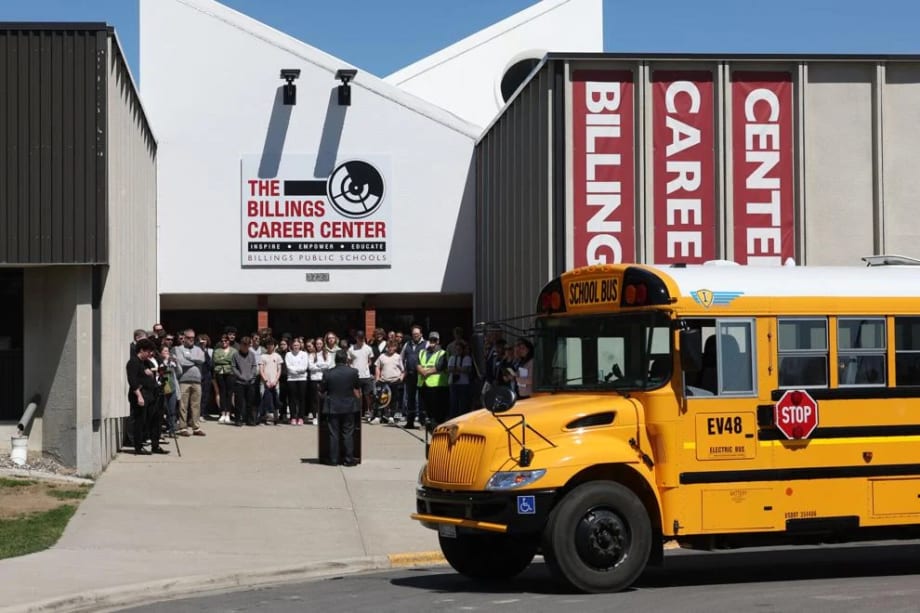
Billings acquired their eight EV buses through the Montana Department of Environmental Quality grant program, which leverages Volkswagen settlement funds for emission reduction efforts. The district also has 10 chargers, funded by local utility provider NorthWestern Energy, to accommodate additional electric buses when needed.
Source: Billings (Montana) School District
Two school districts couldn’t be more different: Steelton-Highspire is a small district operating six buses in Steelton, Pennsylvania’s urban streets.
Travel about 2,000 miles west, along the same longitude, and you’ll arrive in Montana at Billings Public Schools, a much larger fleet of more than 100 school buses traveling longer routes in a less populated, sometimes rural, environment. The thing they have in common? They both employ a small fleet of electric school buses.
Steelton-Highspire purchased its six electric buses with Environmental Protection Agency (EPA) Clean School Bus funds. Billings acquired their eight EV buses through the Montana Department of Environmental Quality grant program, which leverages Volkswagen settlement funds for emission reduction efforts.
The district also has 10 chargers, funded by local utility provider NorthWestern Energy, to accommodate additional electric buses when needed. First Student, the largest school transportation solutions provider in North America, aided the districts in their grant writing efforts to fund EV buses.
On Earth Day, April 20, 2024, Billings launched the first two of its eight electric buses, and deployed two more pairs of electric buses over the next two weeks.
At the beginning of the 2024-2025 school year, Steelton-Highspire will put its six electric buses into service, becoming the first school district to have a 100% electric school bus fleet — as well as the first completely solar-powered EV bus fleet.
Although both districts are early in their green technology journey, they anticipate some profound and unexpected outcomes.
Reduced School Bus Emissions and Student Health
First Student has aspired to reduce school bus emissions since it introduced lower-emission CNG and propane models in the 1990s. Now, green technology is helping them level up their efforts. Currently, First Student operates over 350 zero-emission buses that have driven more than 3.5 million miles.
“We've always had a commitment to provide the safest ride possible for our children, and that includes their environmental health,” said Kevin Matthews, head of fleet electrification for First Student. “Every study you look at, from the American Lung Association to the EPA, shows there are definite downsides to exposing young children with sensitive lungs to fossil fuel environments. Children have smaller, not fully developed lungs, so they breathe in more air on a volume basis than adults. When you consider children’s health, that’s a strong argument for zero-emission buses.”
With about 460,000 school buses operating 180 days per year in the United States, transitioning from fossil fuel-powered to zero-emission buses can significantly reduce emissions that affect climate change and community health.
“It’s a much cleaner experience. You’re not breathing diesel bus fumes,” said Mark “JJ” Carnes, business manager for the Steelton-Highspire School District. “It’s about more than transporting students; it’s also about keeping them healthy. It’s obviously better for the environment because we’re not burning fossil fuels. Those reductions in carbon emissions are also important for our community as a whole.”
Lower Costs for Fleet Management
Reducing harmful emissions can yield economic benefits as well. A recent study published in the journal PNAS estimated the per-mile benefits of replacing diesel buses with electric ones in 3,108 U.S. counties.
The study concluded that replacing the average diesel bus would cut 181 metric tons of carbon dioxide emissions per bus and reduce childhood deaths and asthma cases from diesel emissions. Replacing just one fossil fuel bus would generate a benefit of $84,200 per bus on average. In dense metropolitan areas, that figure can total as much as $247,600.
Another clear economic benefit of zero-emission buses is virtually wiping out one of the top fleet costs: fuel.
“Speaking as a business manager, the first benefit is savings because I don't have to purchase diesel fuel,” Carnes said. “We’re looking at saving around $20,000 a year. That may sound like a small amount, but our operating budget is about $33 million in expenditures and around $29 million in revenue. We’re upside down, so any little wins like that help us.”
Lindsay Gran, Billings Public Schools transportation director, said she anticipates lower maintenance costs as well. “I imagine there will be cost savings in parts and labor; there is no engine inside that’s going to break, so we hope to see some cost savings that way,” Gran said.
While school districts will incur initial costs for electric buses and charging infrastructure, grant funding is available. For ongoing utility costs, school districts can work with their local utilities to learn low-demand, and therefore lower-cost, charging times. As is the case for Billings, a local utility may even provide funding for charging infrastructure. Another option is solar power, which Steelton-Highspire employs.
Noise Reduction in School Bus Transportation
Because zero-emission school buses don’t have engines, they operate far quieter than their fossil fuel counterparts. As a result, student interactions tend to be quieter too.
“Normally, you feel like you have to speak louder on a bus just to be heard over the engine. With electric buses, the noise level tends to be lower because students don’t have to talk over something so loud,” Gran said. “I think the reduction in noise is going to be really helpful for the staff, students, and drivers that ride these buses — especially for our students that have sensory sensitivities.”
Carnes said electric buses are so quiet, the driver can hear a student’s conversation in the very back seat of the bus.
“When the kids get to school, they’re less rambunctious because they’re not yelling and screaming over top of one another the whole ride to school,” he said. “You have the benefit of cleaner air for the kids to breathe but then also, on the emotional side of things, kids are calmer.”
Having spoken with many districts operating electric buses, Matthews has consistently heard drivers and teachers comment on how quieter buses affect student behavior.
“One of the things drivers tell us is that on electric buses, kids know drivers can hear them, so they talk more softly because they don’t want them to know what they’re talking about,” he said. “We would like to see a study done because teachers have told their administrators they can tell the kids that came in on zero-emission school buses that morning because they’re quieter and better behaved.”
Matthews also said noise reduction could aid in driver retention. “School bus drivers quit for two primary reasons: One is pay, and the second is student behavior. If you’re driving around rush hour with 72 screaming kids behind you, that’s stressful,” he said. “If you’re now driving around 72 kids that are calm and quiet and laid back, we take that reason off the table for why drivers are quitting. That could be a huge benefit to the school bus industry.”
More Alternative Fuels

CALSTART and Forth Combine to Form Catalyst Mobility
The new name represents a renewed vision for the nonprofit focused on advancing clean, equitable, and affordable transportation solutions that move people and goods.
Read More →
Alt-Fuel Moves: New Buses, Charging Hubs & Real-World EV Testing
Propane and electric school bus deployments continue to grow as districts add new vehicles, expand charging infrastructure, and gather more real-world operating data.
Read More →
Fewer Electric School Bus Models Reshape the U.S. Market
WRI’s latest buyer’s guide points to a consolidating electric school bus market, but fewer options may reflect a maturing industry rather than fewer meaningful choices for school bus operators.
Read More →
The Fuel Budget You Can Actually Predict: How Propane Autogas Keeps Money in the Classroom
Learn how propane autogas helps school districts manage fuel costs with predictable pricing, lower maintenance, and reduced emissions from former transportation director Joel Stutheit.
Read More →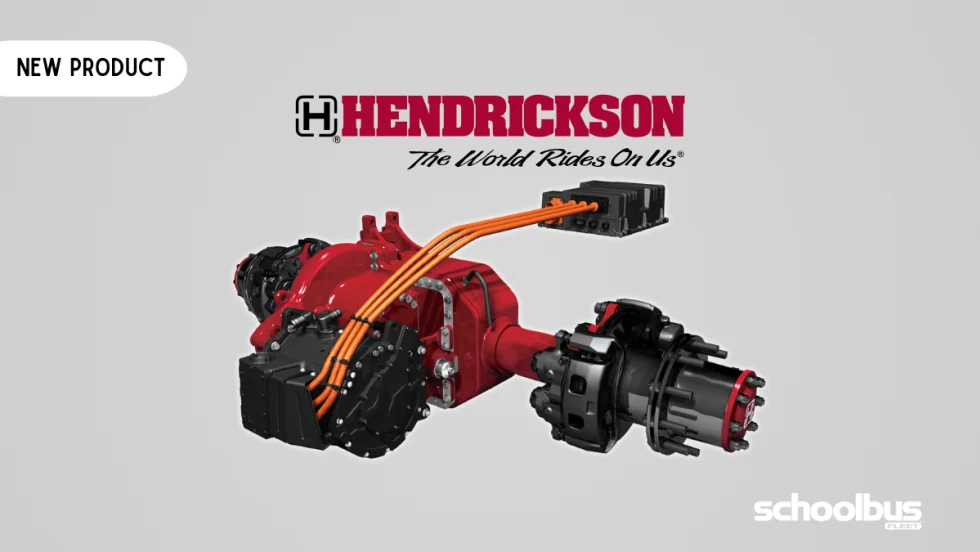
Hendrickson, Driventic Introduce New Electric Powertrain for School Buses
ELECTRAAX, the electrified, lightweight drive axle offers integrated ePowertrain efficiency and modular flexibility for Class 6–7 school bus use.
Read More →
The Mobility House Joins PowerFlex in Fleet Electrification Deal
The acquisition combines intelligent charging software, bidirectional charging expertise, and fleet electrification services to support the growing adoption of electric school buses across North America.
Read More →
Alt-Fuel Moves: Electric School Bus Investments Hit the Road
See which districts across the U.S. are putting electric school buses into service, expanding charging infrastructure, and planning the next phase of fleet electrification.
Read More →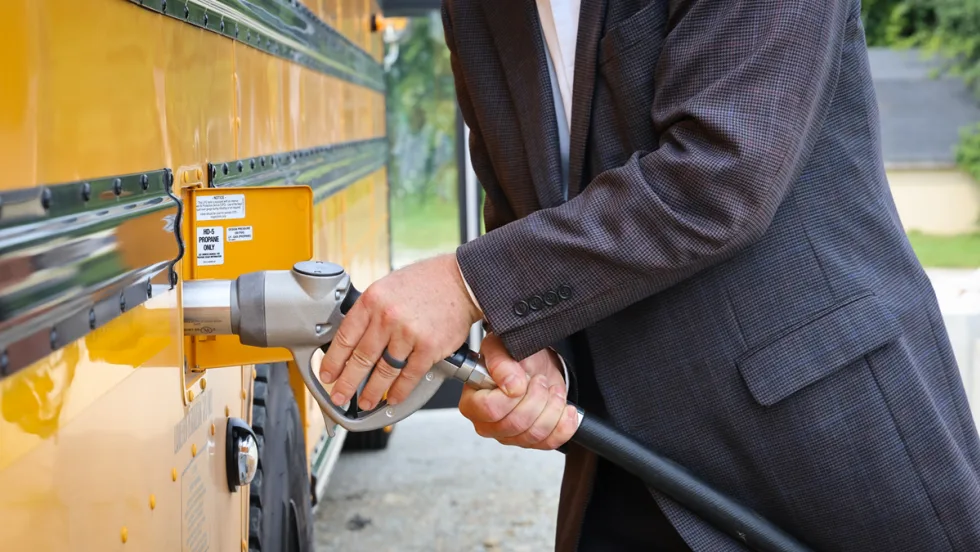
With Fuel Volatility Ahead, School Districts Turn to Propane
While diesel prices peaked above $5 this spring, districts with propane autogas-powered fleets paid under $2 per gallon, according to PERC.
Read More →
EPA Unveils Proposed Changes to 2027 Heavy-Duty Engine Rules
The federal agency has proposed changes to next year’s targets that would eliminate DEF derates, ease warranty requirements, and retain current NOx emissions standards.
Read More →
Alt-Fuel Moves: EV Charging & Infrastructure Projects Gain Momentum
The latest developments include new funding, charging infrastructure, utility investments, and fleet technologies designed to support the transition to electric school buses nationwide.
Read More →