





Don't Miss: Clean Heavy-Duty Vehicle Grants Program Now Open
New Safety Standards Proposed for Electric School Buses
The National Highway Traffic Safety Administration (NHTSA) proposes FMVSS No. 305a, upgrading electric vehicle safety regulations, including heavy vehicles like school buses. Comments accepted until June 14.
April 25, 2024
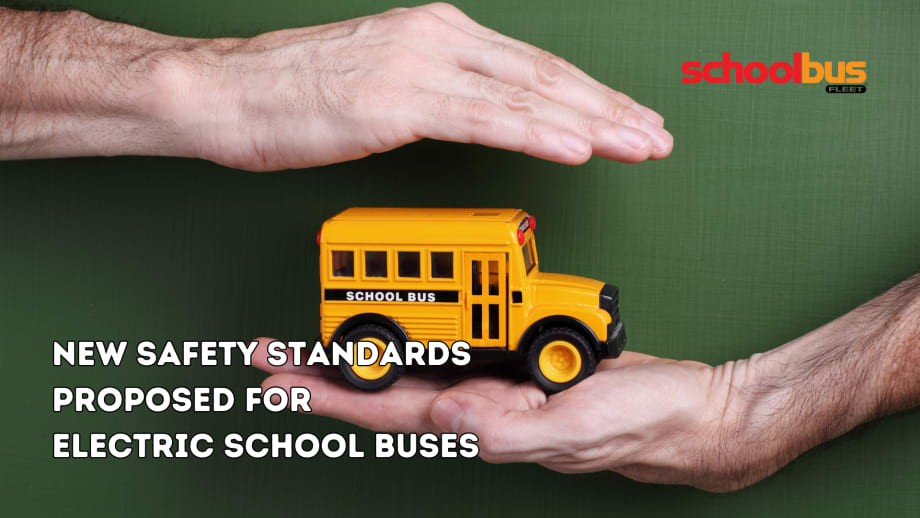
Notably, this proposal seeks to broaden the applicability of safety standards to encompass vehicles with a gross vehicle weight rating (GVWR) exceeding 10,000 pounds, including heavy school buses.
Source: Canva
5 min to read
In a move to enhance safety protocols, the National Highway Traffic Safety Administration (NHTSA) has unveiled a proposal for upgraded regulations governing electric vehicles, including school buses.
The proposed regulation, known as FMVSS No. 305a, aims to replace and expand upon the existing FMVSS No. 305, introducing comprehensive safety measures tailored to electric-powered vehicles. Notably, this proposal seeks to broaden the applicability of safety standards to encompass vehicles with a gross vehicle weight rating (GVWR) exceeding 10,000 pounds, including heavy school buses.
Key aspects of the proposed regulations include:
Expanded coverage to heavier vehicles, such as large electric school buses, with a focus on post-crash safety measures related to electrical systems.
Alignment with international safety standards to ensure consistency in safety regulations across borders.
Enhanced documentation requirements for manufacturers to address evolving battery technologies and diverse vehicle designs.
Standardized Emergency Response Guides (ERGs) and rescue sheets to equip first responders with vital information for safe handling during emergencies.
Additionally, NHTSA emphasizes that the proposed regulations aim to minimize associated costs, as many manufacturers are already implementing similar safety measures voluntarily.
What Does the Existing Regulation Do?
FMVSS No. 305, titled "Electric-powered vehicles: electrolyte spillage and electrical shock protection," aims to mitigate the risk of fatalities and injuries caused by electrical shock in electric vehicles. The standard primarily applies to light vehicles, defined as those with a gross vehicle weight rating (GVWR) less than or equal to 10,000 pounds.
During normal vehicle operations, FMVSS No. 305 mandates measures to prevent direct and indirect contact with high-voltage sources, ensure electrical isolation from the electric chassis, and mitigate driver error risks. This includes indicating active-driving mode during startup and preventing vehicle movement while connected to an external power supply.
In post-crash scenarios, the standard requires vehicles to limit electrolyte spillage from propulsion batteries and maintain attachment of the Rechargeable Electrical Energy Storage System (REESS) to the vehicle exterior. High-voltage sources must be electrically isolated, maintain safe voltage levels, or be physically inaccessible to occupants and emergency personnel.
FMVSS No. 305 already incorporates many requirements from Global Technical Regulation (GTR) No. 20 for light vehicles, covering electrical safety during normal operation, post-crash electrolyte spillage, REESS retention, and various post-crash electrical safety options for high voltage sources.
What Is GTR No. 20 and What Did It Do?
The adoption of Global Technical Regulations (GTRs) stems from a 1998 agreement, overseen by the United Nations Economic Commission for Europe's World Forum for the Harmonization of Vehicle Regulations. NHTSA played a pivotal role in the development and ratification of GTR No. 20, aimed at addressing safety concerns associated with electric vehicles.
GTR No. 20 establishes performance-based requirements focused on reducing safety risks during EV operation and post-crash scenarios. These requirements encompass electrical shock prevention and mitigation of hazards related to lithium-ion batteries and other Rechargeable Electrical Energy Storage Systems.
Key highlights of GTR No. 20 include:
Phase-Based Development: The standard was developed in phases to address evolving technologies. Phase 1 focused on safe REESS operation and risk-mitigation strategies, while Phase 2 continues to explore long-term research and verification.
Comprehensive Coverage: Unlike FMVSS No. 305, which is limited to light vehicles, GTR No. 20 applies to all electric-powered vehicles, irrespective of Gross Vehicle Weight Rating (GVWR). It encompasses safety requirements for REESS beyond those in FMVSS No. 305.
REESS Safety Requirements: GTR No. 20 outlines extensive safety measures for REESS, including protection under various conditions such as external fault, extreme temperatures, and water exposure. It also mandates warning systems for REESS operation and specifies installation requirements.
NHTSA's proposal aims to align FMVSS No. 305 with GTR No. 20 by extending electrical safety requirements to heavy vehicles, including school buses. Additionally, the proposal seeks to adopt GTR No. 20's REESS requirements for both light and heavy vehicles, except for certain redundant provisions already covered under existing regulations.
While GTR No. 20 includes post-crash requirements, it doesn’t prescribe specific crash tests. Instead, it allows contracting parties to establish their own crash tests or utilize component-level mechanical integrity and shock tests to evaluate REESS safety performance.
Acknowledging the unique safety considerations for heavy school buses carrying children, NHTSA proposes specific crash testing requirements consistent with current school bus safety standards. This aligns with the evolving technology landscape, where lithium-ion battery technologies have addressed previous concerns regarding cost and weight implications
NHTSA Seeks Input on Mechanical Integrity and Shock Tests
NHTSA is soliciting feedback on the proposal to introduce a mechanical integrity test for Rechargeable Electrical Energy Storage Systems (REESS) on heavy vehicles to evaluate post-crash safety at the component level. Here are the key points:
Current Evaluation Methods: Currently, there are no specified crash tests in FMVSSs for assessing the integrity of fuel or propulsion systems in heavy vehicles other than heavy school buses. GTR No. 20 suggests a mechanical integrity test for light vehicles, involving a crush test of the REESS.
Purpose of the Test: The mechanical integrity test subjects the REESS to a quasi-static load, simulating the impact forces experienced in a crash. The REESS must withstand the load without signs of electrolyte leakage, fire, or explosion, while also maintaining electrical isolation.
Heavy-Vehicle Considerations: NHTSA seeks comments on the feasibility and parameters of conducting a similar crush test for REESS on heavy vehicles. The agency is particularly interested in feedback on the practicality of the test, inclusion of subsystem components, and potential data to support assertions.
NHTSA also seeks input on a mechanical shock test for REESS on heavy vehicles, aiming to assess post-crash safety at a component level. Here are the main aspects for consideration:
Test Objectives: The mechanical shock test evaluates the performance of REESS mountings and fixtures under inertial loads experienced during an impact. However, there are concerns about the test's relevance and adequacy for heavy vehicles.
Test Parameters: NHTSA requests feedback on the appropriateness of acceleration levels and test requirements specified in GTR No. 20 for heavy vehicle applications. Commenters are encouraged to provide insights on representative acceleration levels and necessary requirements for the test.
Alternative Approaches: The agency invites comments on other applicable safety tests and objective performance criteria for evaluating propulsion system crash safety in heavy vehicles. Additionally, feedback on the feasibility of applying the moving contoured barrier crash test proposed for heavy school buses to all heavy vehicles is welcomed.
The NHTSA is accepting comments on the proposed rulemaking until June 14. The proposed compliance date would be two years after the date of publication of the final rule. Small-volume manufacturers, final-stage manufacturers, and alterers would get an extra year to comply.
Subscribe to Our Newsletter
More Alternative Fuels

CALSTART and Forth Combine to Form Catalyst Mobility
The new name represents a renewed vision for the nonprofit focused on advancing clean, equitable, and affordable transportation solutions that move people and goods.
Read More →
Alt-Fuel Moves: New Buses, Charging Hubs & Real-World EV Testing
Propane and electric school bus deployments continue to grow as districts add new vehicles, expand charging infrastructure, and gather more real-world operating data.
Read More →
Fewer Electric School Bus Models Reshape the U.S. Market
WRI’s latest buyer’s guide points to a consolidating electric school bus market, but fewer options may reflect a maturing industry rather than fewer meaningful choices for school bus operators.
Read More →
The Fuel Budget You Can Actually Predict: How Propane Autogas Keeps Money in the Classroom
Learn how propane autogas helps school districts manage fuel costs with predictable pricing, lower maintenance, and reduced emissions from former transportation director Joel Stutheit.
Read More →
Hendrickson, Driventic Introduce New Electric Powertrain for School Buses
ELECTRAAX, the electrified, lightweight drive axle offers integrated ePowertrain efficiency and modular flexibility for Class 6–7 school bus use.
Read More →
The Mobility House Joins PowerFlex in Fleet Electrification Deal
The acquisition combines intelligent charging software, bidirectional charging expertise, and fleet electrification services to support the growing adoption of electric school buses across North America.
Read More →
Alt-Fuel Moves: Electric School Bus Investments Hit the Road
See which districts across the U.S. are putting electric school buses into service, expanding charging infrastructure, and planning the next phase of fleet electrification.
Read More →
With Fuel Volatility Ahead, School Districts Turn to Propane
While diesel prices peaked above $5 this spring, districts with propane autogas-powered fleets paid under $2 per gallon, according to PERC.
Read More →
EPA Unveils Proposed Changes to 2027 Heavy-Duty Engine Rules
The federal agency has proposed changes to next year’s targets that would eliminate DEF derates, ease warranty requirements, and retain current NOx emissions standards.
Read More →
Alt-Fuel Moves: EV Charging & Infrastructure Projects Gain Momentum
The latest developments include new funding, charging infrastructure, utility investments, and fleet technologies designed to support the transition to electric school buses nationwide.
Read More →