




Watch: Planning & Considerations for School Bus Electrification [VIDEO]
Navigating the Road Ahead for Electric School Buses
With federal funds in flux, school bus fleets turn to state incentives and creative financing for electric bus adoption.
by Maggie Clancy, Zenobē Americas
February 27, 2025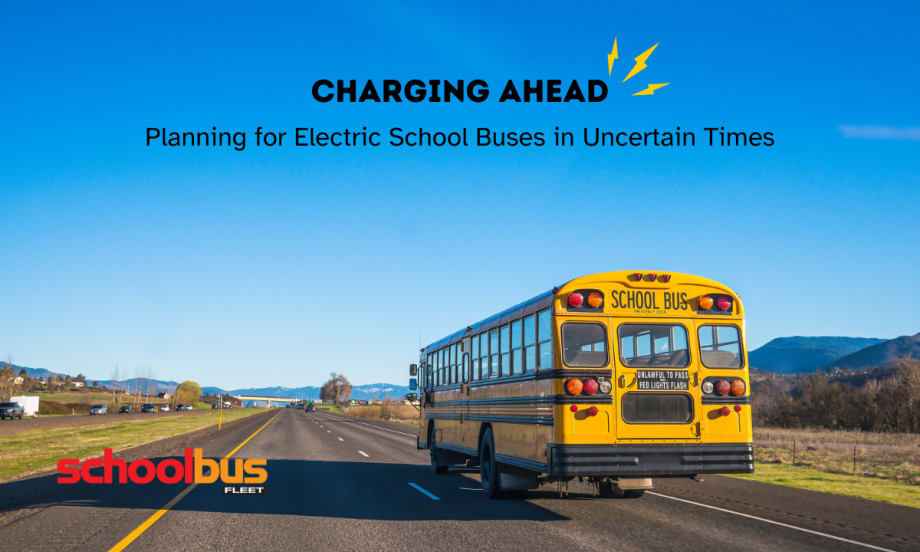
Despite a bump in the road on the federal side, there's still plenty of support for electric buses.
Photo: SBF/Canva
4 min to read
The federal funding outlook for electric school buses (ESB) is at best uncertain, and school bus fleet managers are looking for alternatives. The good news is that there are numerous pathways open to help them switch to electric bus fleets and deliver clean rides for students. These include state and regional funding opportunities as well as innovative private financing solutions.
The Future of the Clean School Bus Program
Before it was put on hold, the U.S. Environmental Protection Agency’s Clean School Bus (CSB) Program had given out about $3 billion for more than 8,000 electric school buses. Word on its future is expected by the beginning of the second quarter of 2025.
As the latest update, the WRI ESB Initiative reported on Feb. 19 that the payment portals for awarded CSB and Clean Heavy-Duty Vehicles Program have reopened, at least selectively. They’re advising that school districts and companies that have an active award under these programs screenshot and save the portal data.
While the CSB program to date has funded the majority of America’s ESB fleet, close to one in every three committed electric school buses were funded or financed through alternate means.
Other Funding Sources for Electric School Buses
More than 100 alternative funding sources are available to help student transportation providers. For instance, California, New York, Michigan, Texas and other states offer incentives of their own. Other sources include local governments and utilities with grants, rebates and other forms of assistance.
“There are many different funding opportunities out there,” said Zenobē Grant Manager Angela Shuck who works with student transportation providers to connect them to funding assistance. “The challenge is understanding each program’s unique eligibility requirements and guidelines.”
Leveraging the Long-Term Value of ESB Batteries
Another approach is to shift the cost of a fleet’s batteries to a third-party under a “battery-as-a-service”program. Under this model, the school transportation provider sells their fleet batteries to a third party who then leases the batteries back to them. The fleet operator still owns the buses, but they have offloaded the batteries which are the largest share of an ESB’s price. This practice brings down the initial fleet electrification cost substantially. In addition to moving the financial risk to a third party, it also places the battery’s performance risk with them too. This model is well established with transit organizations in the U.K. who lease their electric fleet’s batteries for exactly these reasons.
When ESB batteries are viewed as assets to be operated over a longer time horizon, their “residual value” can be calculated and applied upfront to further reduce a project’s costs. Residual value is the battery’s estimated worth at the end of its driving life based on a “second life” in a battery energy storage system. Having a plan to repurpose ESB batteries and derive greater residual value from them improves the economics of fleet electrification.
“Understanding residual values isn’t just about predicting the future – it’s about unlocking financing for zero-emission buses today,” explained Kabir Nadkarni, EV industry assessment specialist at CALSTART.
Zenobē has used its experience with second-life bus batteries and maximizing residual value in fleet batteries to contribute to CALSTART’s Innovative Financing Toolkit. This is a valuable resource for learning more about electric fleet financing.
Reducing Costs through Battery Management
Battery management, including monitoring performance and maximizing health during its driving life, is a way to reduce the lifetime costs of an electric fleet by extending a battery’s lifespan and avoiding the need for premature replacement in an ESB.
“The goal is to delay replacements to keep costs down,” said Robert Long, second-life business development manager for Zenobē.
Through driver training, techniques like regenerative braking can reduce charging costs. Gentle driving and maintaining charge levels between 20% and 80% are simple practices that can significantly enhance battery longevity to reduce costs.
The Future of Clean Rides for Kids
The transition away from dirty diesel vehicles, especially for transporting children, will continue. This will be as a result of state mandates, the growing evidence of the public health benefits, the investments that ESB manufacturers have made in retooling factories and scaling up production and the downward movement on ESB and battery prices as range and performance continue to improve.
While zero-emission school buses may have hit a federal bump in the road, they still have many routes to funding and financing to continue the progress made for our students, drivers, and communities.

Maggie Clancy
Photo: Zenobē Americas
About the Author: Maggie Clancy is the EVP of business development (Fleet) for Zenobē North America. A version of this article first appeared on Zenobē’s blog.
Subscribe to Our Newsletter
More Alternative Fuels

CALSTART and Forth Combine to Form Catalyst Mobility
The new name represents a renewed vision for the nonprofit focused on advancing clean, equitable, and affordable transportation solutions that move people and goods.
Read More →
Alt-Fuel Moves: New Buses, Charging Hubs & Real-World EV Testing
Propane and electric school bus deployments continue to grow as districts add new vehicles, expand charging infrastructure, and gather more real-world operating data.
Read More →
Fewer Electric School Bus Models Reshape the U.S. Market
WRI’s latest buyer’s guide points to a consolidating electric school bus market, but fewer options may reflect a maturing industry rather than fewer meaningful choices for school bus operators.
Read More →
The Fuel Budget You Can Actually Predict: How Propane Autogas Keeps Money in the Classroom
Learn how propane autogas helps school districts manage fuel costs with predictable pricing, lower maintenance, and reduced emissions from former transportation director Joel Stutheit.
Read More →
Hendrickson, Driventic Introduce New Electric Powertrain for School Buses
ELECTRAAX, the electrified, lightweight drive axle offers integrated ePowertrain efficiency and modular flexibility for Class 6–7 school bus use.
Read More →
The Mobility House Joins PowerFlex in Fleet Electrification Deal
The acquisition combines intelligent charging software, bidirectional charging expertise, and fleet electrification services to support the growing adoption of electric school buses across North America.
Read More →
Alt-Fuel Moves: Electric School Bus Investments Hit the Road
See which districts across the U.S. are putting electric school buses into service, expanding charging infrastructure, and planning the next phase of fleet electrification.
Read More →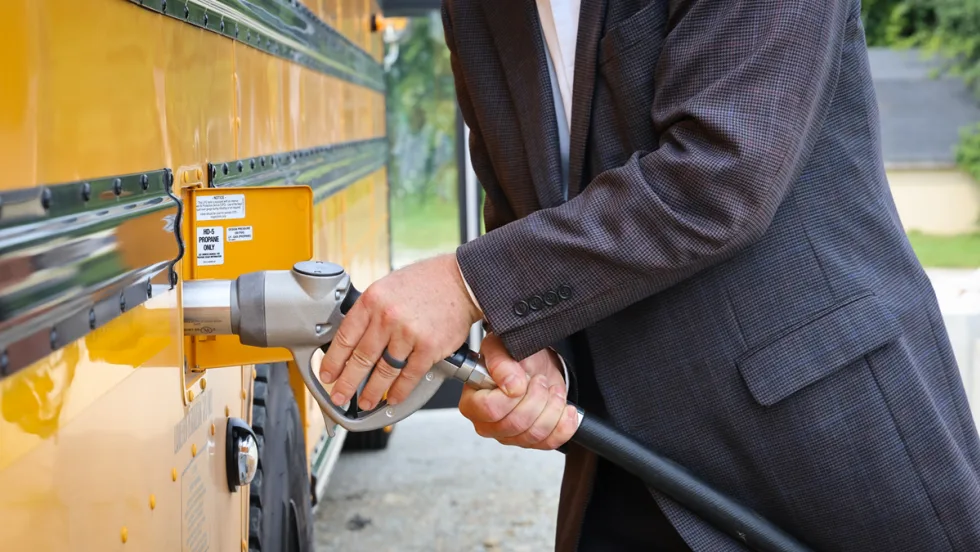
With Fuel Volatility Ahead, School Districts Turn to Propane
While diesel prices peaked above $5 this spring, districts with propane autogas-powered fleets paid under $2 per gallon, according to PERC.
Read More →
EPA Unveils Proposed Changes to 2027 Heavy-Duty Engine Rules
The federal agency has proposed changes to next year’s targets that would eliminate DEF derates, ease warranty requirements, and retain current NOx emissions standards.
Read More →
Alt-Fuel Moves: EV Charging & Infrastructure Projects Gain Momentum
The latest developments include new funding, charging infrastructure, utility investments, and fleet technologies designed to support the transition to electric school buses nationwide.
Read More →