




Electric School Bus Roundtable: Jed Routh (Thomas Built Buses)
The vice president of sales, service, and marketing looks forward to more safety features in school bus software, not just in the mechanical components.

From building new factories to pushing to reclaim momentum lost during the pandemic shutdown of 2020, electric school bus manufacturers are rolling forward with ambitions to make their vehicles more accessible and affordable.
Those ambitions could get a boost thanks to the federal government in August passing bipartisan infrastructure legislation, which includes billions of dollars for electric and low-emission school buses.
School Bus Fleet asked several manufacturers to give their forecasts for the coming year as we emerge from the COVID-19 pandemic:
Jed Routh (Thomas Built Buses)
SBF: How would you assess school bus industry market conditions for 2022?
Jed Routh: Overall, we anticipate that the need for school buses will remain healthy moving into 2022. In fact, we anticipate a small bounce back in demand next year as remote learning will hopefully dwindle and demand for student transportation begins to pick back up. However, we also anticipate some residual impact from the supply chain issues that we are currently facing as an industry – a least in the beginning of 2022. For the first time in a while, we expect to see demand outrun supply, mainly stemming from constraints in the supply chain. In addition, we have our eye on electric school buses. In 2022 and beyond, EVs will present a significant paradigm shift that will affect the school bus industry’s production capabilities and demand as a whole.
SBF: What kind of feedback has your company received at demonstrations/deployments of its electric bus?
Routh: We have received an overwhelmingly positive response to our Saf‐T‐Liner C2 Jouley electric school bus. Across the board, fleet managers are seeing total cost of ownership reductions in fuel and maintenance costs, maintenance crews are loving the reduced maintenance needs, drivers and students alike are excited and proud of the buses, and superintendents are loving the cost savings and general positive impact of electric school buses in the community.
For example, we spoke with Nathan Oliver, transportation director for Monroe County Community Schools in Indiana. He found that in just 46 days of running routes with the Jouley electric bus, his district avoided 6.5 tons of CO2 emissions and saved 275 gallons of diesel with just one electric school bus. That means that in one school year, he anticipates a reduction of CO2 by 27 tons and a savings of 1,080 gallons of diesel, again with just one electric school bus in the fleet. Plus, he saves around $15 per day by using electricity to power the bus instead of diesel. To share a bit more, we even have one bus in Alaska, which I’ll speak to a bit later, that is performing extremely well even in sub‐zero temperatures.
To be honest though, there have been some growing pains as customers transition to electric school buses – growing pains that we are seeing across the industry. Switching to electric school buses is a transition, and some customers have had issues with infrastructure, route planning, funding and even driving styles. Electric school buses are a different animal altogether, which is why we focus so heavily on our Electric Bus Authority to provide our customers support through the entire journey.
From the moment a customer even considers an electric school bus for their fleet through deployment, our Electric Bus Authority team is with the customer every step of the way assisting with financing and funding, route optimization, infrastructure planning, utility provider partnerships, and driver and technician training.
SBF: In August, the U.S. Senate passed the bipartisan Infrastructure Investment and Jobs Act, which includes $5 billion for electric and low‐emissions school buses. How do you think the increase in funding will impact the transition to zero‐emission/electric buses for school transportation?
Routh: The Infrastructure Investment and Jobs Act will accelerate the adoption of EV much more quickly than if it had taken off on its own. However, for those not as familiar with electric school buses, we must caution that this transition to electric school buses will be a steady increase that will build over time. Here’s why: the typical purchasing cycle for an electric school bus can last up to 18 months. In addition to choosing the right electric school bus, school districts must also plan for charging infrastructure, utility provider partnerships, driver and maintenance training, and route optimization. While the Electric Bus Authority here at Thomas Built Buses is committed to helping customers navigate these crucial steps, converting to an electric fleet requires careful planning, strong partnerships and commitment. So, while this infrastructure bill will increase interest in EV, and we are thrilled that it will, we will see the actual purchase of electric school buses grow over time as fleets get their arms around the complete electric ecosystem.
SBF: With more funding available comes an increase in demand. How is your company working to meet the increasing demand for zero‐emissions/electric buses?
Routh: It is our goal to produce electric school buses on the production line like all other vehicles. To achieve that, we’ve invested significantly in our chassis and body production facilities and have done some extensive work to optimize our supply chain and logistics functions within Thomas Built Buses. And most important, we are hiring to meet demand and investing in employee, dealer and customer training to ensure a smooth manufacturing process as well as a positive driver and mechanic experience upon delivery.
SBF: What lasting impacts do you think the COVID‐19 pandemic will have on the manufacturing side of school transportation? Particularly for electric school buses?
Routh: The pandemic has caused significant supply chain issues, which we will continue to navigate at least through the beginning of next year. But beyond that, COVID‐19 has only affected our manufacturing process in terms of the way we do things. Like other manufacturers, we enacted strict health and safety protocols early on with the use of social distancing, masking, disinfecting and protective partitions. We also reengineered some jobs, changing how some of the tasks were performed. And many of these changes will remain in place well beyond the surge of COVID‐19. While these changes have not had an impact on production, they have caused us to do things a little bit differently. All in all, it’s a new way of doing business and a new way of manufacturing – one that goes a step beyond in order to protect the health and safety of our staff.
SBF: How is your company addressing performance concerns, such as surmounting hilly terrain and coping with cold weather impacts on batteries and regenerative braking?
Routh: On the Saf‐T‐Liner C2 Jouley electric school bus, our customers do not have to worry about cold weather performance as much as they might with other electric school buses. In fact, one of our customers in Tok, Alaska is showing phenomenal performance with his Jouley electric bus, even in sub‐zero temperatures. The bus has had no issues starting, heating the interior, or even charging out in the elements.
However, hilly terrain, cold weather, and even adverse driver behaviors can reduce range. To compensate for these issues, we are focused on continually upgrading our battery pack system to provide more range to our customers. Jouley currently offers one of the longest operating ranges in the industry, with up to 138 miles. But, even more important, DC fast‐charging comes standard on our electric buses. As long as our customers have an output of at least 60Kw, they can produce a nominal charge in their buses in as little as two to three hours and fully charge the bus in four to six hours. Our customers can charge their buses in the middle of the day, thereby doubling their range. Finally, if some districts are still concerned about range, our Electric Bus Authority experts are happy to assist with route optimization to ensure the most efficient use of an electric school bus in any fleet.
SBF: What other kinds of changes or new developments do you see in the coming years for the industry?
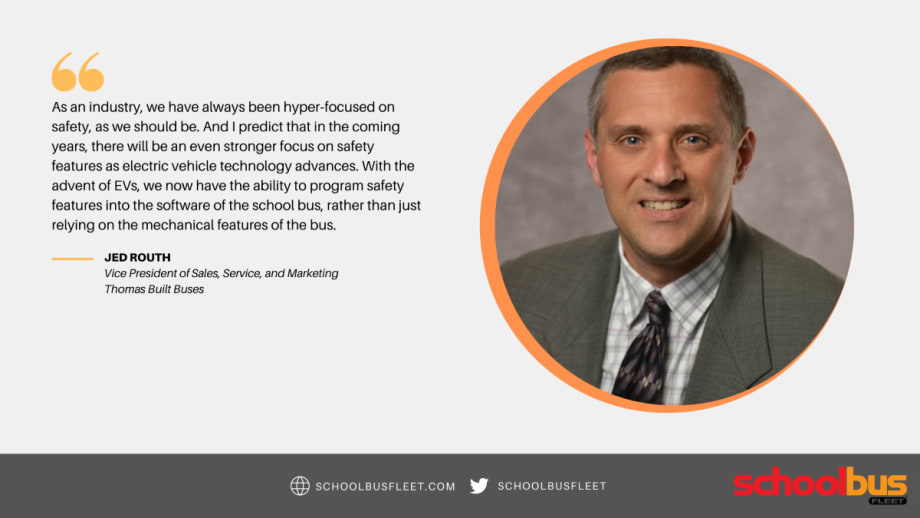
Routh: As an industry, we have always been hyper‐focused on safety, as we should be. And I predict that in the coming years, there will be an even stronger focus on safety features as electric vehicle technology advances. With the advent of EVs, we now have the ability to program safety features into the software of the school bus, rather than just relying on the mechanical features of the bus. In addition, we also expect to welcome new players into the student transportation industry who specialize in EV technologies.
SBF: Are there any new developments at your company that you would like to share?
Routh: Here at Thomas Built Buses, we will continue to invest in safety features, electric school bus technologies, as well as in key partnerships within the industry that help to further advance school bus transportation. In addition, we will continue to invest in our people to meet the needs of our customers and the industry as a whole. Currently, our Electric Bus Authority team is poised to help districts as they transition to an electric fleet. We will continue to invest in and grow this group to service our EV customers from production through deployment.
More Alternative Fuels

CALSTART and Forth Combine to Form Catalyst Mobility
The new name represents a renewed vision for the nonprofit focused on advancing clean, equitable, and affordable transportation solutions that move people and goods.
Read More →
Alt-Fuel Moves: New Buses, Charging Hubs & Real-World EV Testing
Propane and electric school bus deployments continue to grow as districts add new vehicles, expand charging infrastructure, and gather more real-world operating data.
Read More →
Fewer Electric School Bus Models Reshape the U.S. Market
WRI’s latest buyer’s guide points to a consolidating electric school bus market, but fewer options may reflect a maturing industry rather than fewer meaningful choices for school bus operators.
Read More →
The Fuel Budget You Can Actually Predict: How Propane Autogas Keeps Money in the Classroom
Learn how propane autogas helps school districts manage fuel costs with predictable pricing, lower maintenance, and reduced emissions from former transportation director Joel Stutheit.
Read More →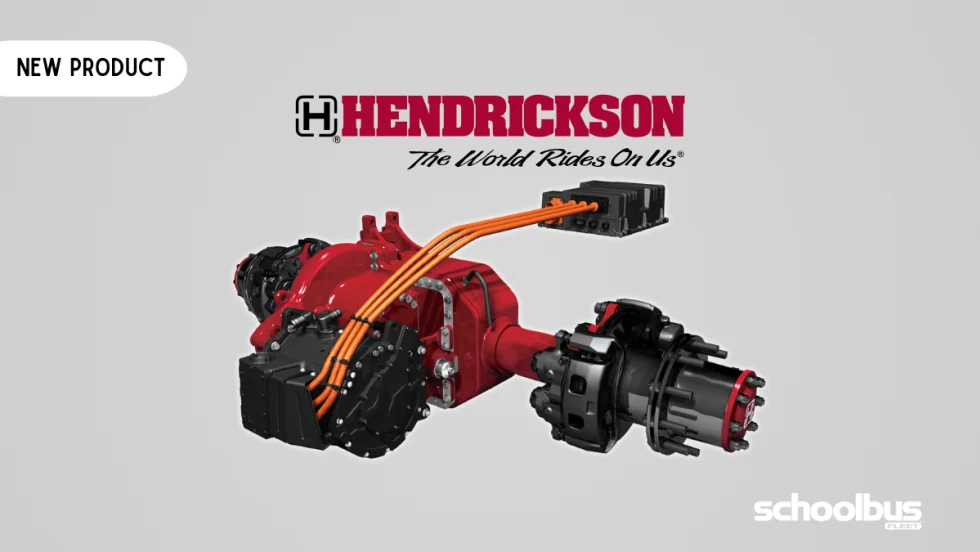
Hendrickson, Driventic Introduce New Electric Powertrain for School Buses
ELECTRAAX, the electrified, lightweight drive axle offers integrated ePowertrain efficiency and modular flexibility for Class 6–7 school bus use.
Read More →
The Mobility House Joins PowerFlex in Fleet Electrification Deal
The acquisition combines intelligent charging software, bidirectional charging expertise, and fleet electrification services to support the growing adoption of electric school buses across North America.
Read More →
Alt-Fuel Moves: Electric School Bus Investments Hit the Road
See which districts across the U.S. are putting electric school buses into service, expanding charging infrastructure, and planning the next phase of fleet electrification.
Read More →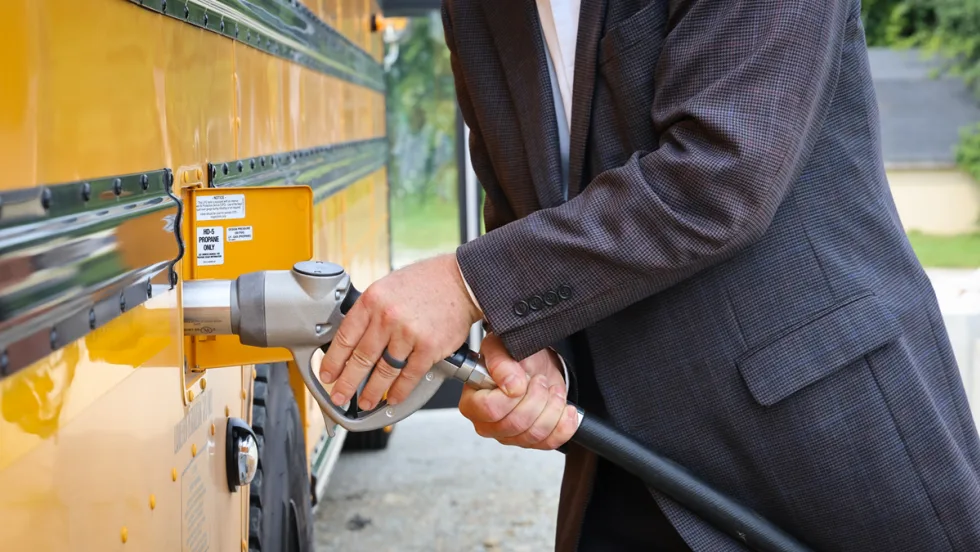
With Fuel Volatility Ahead, School Districts Turn to Propane
While diesel prices peaked above $5 this spring, districts with propane autogas-powered fleets paid under $2 per gallon, according to PERC.
Read More →
EPA Unveils Proposed Changes to 2027 Heavy-Duty Engine Rules
The federal agency has proposed changes to next year’s targets that would eliminate DEF derates, ease warranty requirements, and retain current NOx emissions standards.
Read More →
Alt-Fuel Moves: EV Charging & Infrastructure Projects Gain Momentum
The latest developments include new funding, charging infrastructure, utility investments, and fleet technologies designed to support the transition to electric school buses nationwide.
Read More →