




Electric School Bus Roundtable: Chris Hiebert (Collins Bus)
The vice president and general manager expects his company to balance increased demand against supply chain disruptions.

From building new factories to pushing to reclaim momentum lost during the pandemic shutdown of 2020, electric school bus manufacturers are rolling forward with ambitions to make their vehicles more accessible and affordable.
Those ambitions could get a boost thanks to the federal government in August passing bipartisan infrastructure legislation, which includes billions of dollars for electric and low-emission school buses.
School Bus Fleet asked several manufacturers to give their forecasts for the coming year as we emerge from the COVID-19 pandemic:
Chris Hiebert (Collins Bus)
SBF: How would you assess school bus industry market conditions for 2022?
Chris Hiebert: It feels much like the push from built up demand everyone thought we would get at the end of 2020 is just now happening. We are seeing stocking orders return in normal quantities which is a good indication that old inventory is moving out and demand is returning.
SBF: What kind of feedback has your company received at demonstrations/deployments of its electric bus?
Hiebert: More and more info is being requested daily. We are just now starting to be able to see customers in person again, so I look forward to in-person tradeshows and onsite visits to customers to share our products. So far, feedback has been enthusiastic and interest in the Collins EV products is growing rapidly.
SBF: In August, the U.S. Senate passed the bipartisan Infrastructure Investment and Jobs Act, which includes $5 billion for electric and low‐emissions school buses. How do you think the increase in funding will impact the transition to zero‐emission/electric buses for school transportation?
Hiebert: States that have been slower to adopt EV are starting to pursue zero emissions and gain knowledge of what is available in the market. As more and more funding is made available, it will help accelerate pockets of the country that have not been focused on EV, as well as encourage more utility companies to get involved.
SBF: With more funding available comes an increase in demand. How is your company working to meet the increasing demand for zero‐emissions/electric buses?
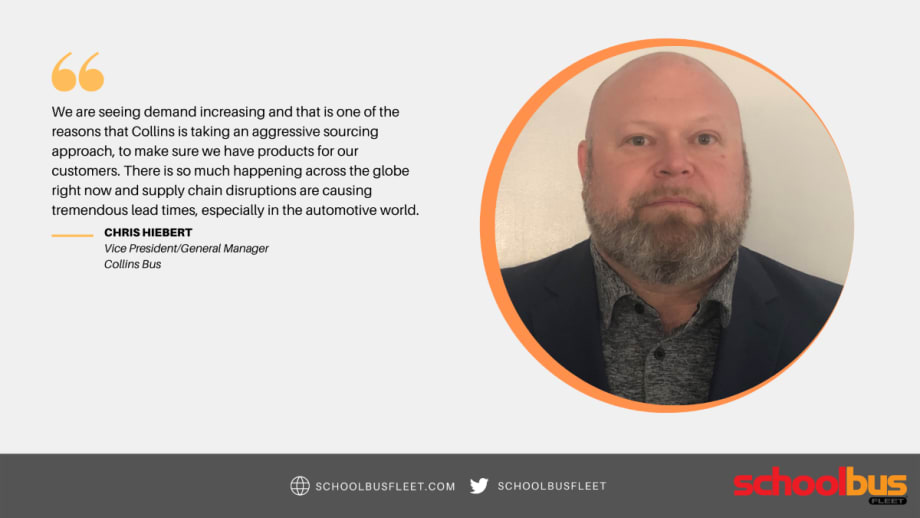
Hiebert: We are seeing demand increasing and that is one of the reasons that Collins is taking an aggressive sourcing approach, to make sure we have products for our customers. There is so much happening across the globe right now and supply chain disruptions are causing tremendous lead times, especially in the automotive world. By diversifying our supply chain, we hope to improve our delivery and help ensure our customers have the buses they need when they need them.
SBF: What lasting impacts do you think the COVID‐19 pandemic will have on the manufacturing side of school transportation? Particularly for electric school buses?
Hiebert: I believe we will continue to see companies embrace work from home and continue to collaborate remotely, while inside factories many of the social distancing strategies could lead to more automation. Wearing masks more often and deploying disinfecting applications both to product and to manufacturing spaces may all become more frequent long term.
SBF: How is your company addressing performance concerns, such as surmounting hilly terrain and coping with cold weather impacts on batteries and regenerative braking?
Hiebert: Collins has worked with our expert suppliers to combat problems such as climate fluctuation and hilly terrain with Hill Hold features and programmable regenerative braking, making backsliding on inclines or navigating through inclement weather easily adjustable.
SBF: What other kinds of changes or new developments do you see in the coming years for the industry?
Hiebert: We will see a progression of technology both fuel cell and battery electric products taking shape and costs for these technologies coming down. Post COVID technologies such as Far UVC lighting and various antimicrobial surfaces will play a big part in the future of pupil transportation.
SBF: Are there any new developments at your company that you would like to share?
Hiebert: Our latest developments are our EV products and we are excited to see the products hit the streets. In addition to our Collins EV School Bus, we continue to innovate our products so that we can provide the safest and most efficient bus on the road.
More Alternative Fuels
Bipartisan Bill Seeks to Extend Clean School Bus Program Through 2031
The proposed legislation would renew federal support for cleaner school buses as districts navigate funding uncertainty, rising fuel and infrastructure costs, and fleet replacement needs.
Read More →
Alt-Fuel Moves: Electric Bus Rollouts, Bidirectional Charging & Propane Growth
See which fleets are adding electric and propane school buses as districts and operators invest in charging infrastructure, bidirectional technology, and alternative-fuel expansion.
Read More →
Nobody Told Diesel Prices They Were Supposed to Come Down
With diesel prices surging, school bus fleets have new reason to stress-test fuel costs, consider diversification, and calculate what each route really costs to operate.
Read More →
Why Gasoline School Buses Are Making a Comeback
Gasoline is gaining ground in full-size school buses. See how today’s options stack up against diesel on cost, maintenance, emissions, performance, and more.
Read More →
EPA Opens $180M DERA Funding Round for Diesel Upgrades
The 2026 Diesel Emissions Reduction Act program seeks applications from eligible organizations to accelerate the retirement of legacy diesel vehicles.
Read More →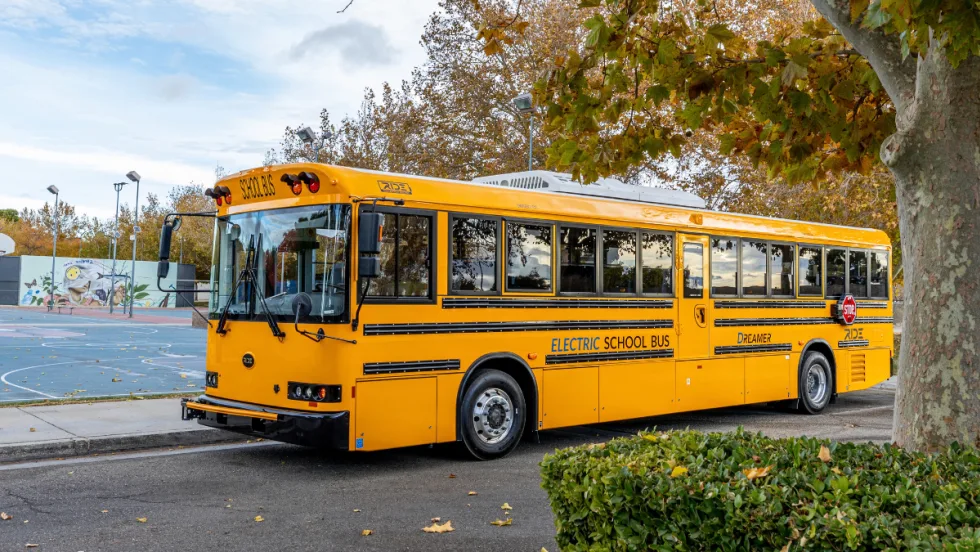
The Secret Life of an Electric School Bus Battery
Batteries change throughout years of daily routes, but degradation doesn’t necessarily mean the end. Here’s what operators should know about performance, safety, and second life.
Read More →
CALSTART and Forth Combine to Form Catalyst Mobility
The new name represents a renewed vision for the nonprofit focused on advancing clean, equitable, and affordable transportation solutions that move people and goods.
Read More →
Alt-Fuel Moves: New Buses, Charging Hubs & Real-World EV Testing
Propane and electric school bus deployments continue to grow as districts add new vehicles, expand charging infrastructure, and gather more real-world operating data.
Read More →
Fewer Electric School Bus Models Reshape the U.S. Market
WRI’s latest buyer’s guide points to a consolidating electric school bus market, but fewer options may reflect a maturing industry rather than fewer meaningful choices for school bus operators.
Read More →
The Fuel Budget You Can Actually Predict: How Propane Autogas Keeps Money in the Classroom
Learn how propane autogas helps school districts manage fuel costs with predictable pricing, lower maintenance, and reduced emissions from former transportation director Joel Stutheit.
Read More →