




Alternative Fuel Use On the Rise
Alternative fuels aren’t new to pupil transportation, but their use in school buses has become more widespread in recent years. Officials estimate ...

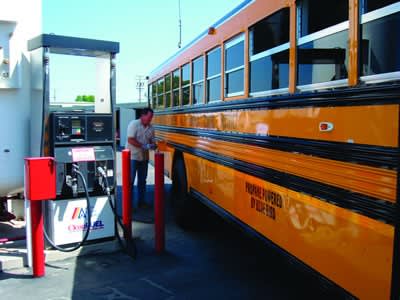
Alternative fuels aren’t new to pupil transportation, but their use in school buses has become more widespread in recent years. Officials estimate that there are now about 2,500 school buses running on propane and about 3,000 running on natural gas in the U.S.
The more recent introduction of hybrid technology for school buses has also garnered growing demand. And many pupil transporters are now supplementing traditional petroleum diesel with biodiesel.
Support from several key companies and non-profit organizations has contributed to this growth. By providing guidance and assistance with everything from outreach programs to grant acquisition to refueling station installation, they are enabling school districts and contractors around the country to clean up their fleets and save money.
Pushing for propane
One such organization is the Propane Education and Research Council (PERC). In addition to providing an $856,000 grant for the manufacture of Blue Bird Corp.’s propane-powered Vision school bus, PERC has provided information about the bus to Blue Bird’s dealers and the public.
PERC Vice President Brian Feehan says the council’s staff has distributed an outreach kit to familiarize dealers with the product. The binder contains information on the environmental and economic benefits of propane, PERC’s involvement in developing the propane Vision and the technology behind its fuel system.
In the initial stages of its partnership with Blue Bird, PERC bought two propane Vision models and put them into use in California and Texas as demonstration units. PERC now plans to expand this program.
“In March, our board of directors authorized the acquisition of six more buses for a demonstration fleet,” Feehan reveals. “We’ll provide financing for the lease of the buses for a year, and they will be positioned by Blue Bird at its dealerships in several states across the country.”
In April, PERC also participated in the California Propane Alternative Fuel Road Show, which educates air quality regulators, school bus purchasers and propane customers about propane products. At the final show in Diamond Bar, Calif., attendees heard presentations by officials from organizations like the California Air Resources Board and the EPA and asked questions about the vehicles displayed, including the propane Vision.
The Texas Railroad Commission (TRC), a state agency that promotes propane use and provided Blue Bird with guidance for its propane Vision, organized a road show as well. During the seven-city tour in May, TRC Chairman Michael Williams and other propane industry officials spoke about the benefits of propane buses and explained the federal rebates available to operations that purchase them.
For an outline of these alternative fuels incentives, visit www.usepropane.com/sae and click on “Tax Credit Summary.” Districts operating compressed natural gas (CNG) buses and CNG refueling infrastructure can also apply for these credits.
Providing the fuel
As fleets begin to use the propane Vision, propane providers like Delta Liquid Energy (DLE) can assist them with their refueling needs. Ted Olsen, manager of the company’s Paso Robles, Calif., plant and chairman of the Western Propane Gas Association’s Clean Fuels Committee, says DLE’s 10 facilities serve 18 school districts in California.
DLE not only delivers propane to school districts and installs refueling infrastructure, it provides refueling training. “We can train the transportation personnel on the refueling process,” Olsen says, “and provide them with a certificate indicating that they’ve received propane refueling training. We’ll renew that certification every year.”
Olsen says installing the refueling infrastructure takes two to three months. After the building, county and fire permits are obtained, DLE installs the propane tank, a pump, a motor and a dispenser on a concrete foundation. The company’s sales representatives can help customers learn how to obtain grants to fund the installation costs.
To further assist districts, DLE has a network of public refueling sites where anyone with an access card can refuel. The card can be distributed to bus drivers at the school transportation department’s request.
Touting natural gas
Natural Gas Vehicles for America (NGVAmerica) is expanding the natural gas market by educating policymakers on its benefits, guiding marketing efforts and providing information to its members.
The organization represents over 100 companies, environmental groups and government entities interested in using natural gas as a transportation fuel, two of which are Thomas Built Buses and Blue Bird.
Fleet owners stand to benefit from becoming an NGVAmerica member. The organization has assisted in developing federal incentive programs to fund the purchase and use of natural gas-powered vehicles.
Moreover, NGVAmerica aids its fleet members in securing grants by monitoring federal announcements and publications to ensure that members are aware of new funding opportunities.
By representing Thomas Built and Blue Bird, Stephe Yborra, NGVAmerica’s director of marketing and communications, says the organization works with over 130 school districts. He estimates that approximately 100 are in California, with the others spread throughout the country.
CNG school buses generally cost $36,000 to $40,000 more than their diesel counterparts because the fueling system is expensive. However, Yborra believes purchasing CNG school buses is a worthwhile investment considering the money that can be saved on fuel — natural gas is about two dollars cheaper per gallon compared to diesel — and he says that more districts are purchasing the buses.
“The sales of natural gas school buses have been slow and steady, but they’re starting to pick up now,” Yborra says. “The interest is growing as the cost of fuel increases and the new emissions standards kick in.”
Refueling station installation
James Harger, senior vice president of marketing and sales for Clean Energy, has also found that an increasing number of school districts are fueling their fleets with CNG. In addition to California, he says CNG buses are operating in Arizona, New Mexico, Nevada, Colorado, Texas, Georgia, Pennsylvania, New York, Utah, Ohio and Massachusetts.
Clean Energy is a natural gas provider. It has a network of public refueling stations and can design, build, operate and maintain refueling stations for its customers. In April, for instance, the company was building a second station to service 70 new CNG buses owned and operated by Tucson (Ariz.) Unified School District.
For qualifying fleet clients, the company can cover 100 percent of the refueling station building and installation costs. To qualify, a school district must purchase about 200,000 gallons of fuel annually or operate at least 50 CNG buses.
“Once a district commits to purchasing CNG buses and agrees to meet our threshold of 200,000 gallons per year over a two- to three-year period, we will sign a fueling contract and commence the construction of the station,” Harger explains.
Since school buses are often parked for long periods, Harger says Clean Energy generally installs time-fill stations at districts. This type of system shuts down automatically when a vehicle’s fuel cylinder is full.
Toronto-based FuelMaker Corp. manufactures and installs CNG vehicle refueling appliances (VRAs). Marketing Manager Jeff Harju says the company’s systems work best for operations that are just starting to use CNG buses — a fleet of up to six is ideal.
FuelMaker’s VRAs are available as multiple- or single-compression module units and can be configured to accommodate time-fill and fast-fill applications.
Harju explains that the type of unit a school district should invest in depends on its fleet size, the daily mileage each bus travels and the amount of refueling time available. The multiple-compression units typically comprise four compression modules that provide built-in redundancy and allow for remote fueling and manifold fueling (i.e., several units grouped together), each of which is accomplished by using a refueling panel. The single-compression units are electrically driven and allow for direct fueling (by attaching a hose to the vehicle) as well as remote and manifold fueling.
“A district that has one CNG bus could start with the FMQ-2-36,” Harju says. “This single-compression unit with one hose can refuel one bus. Once the district has two or more buses, it could use the FMQ-8-36 [a multiple-compression unit], which refuels vehicles approximately four times faster than the FMQ-2-36.”
There are several advantages to using FuelMaker’s VRAs, he adds. Since the units are designed to fuel small bus fleets, they are a cost-effective infrastructure investment for school districts with only a few CNG buses. Also, the units’ modular design enables them to be expanded upon as a district’s needs grow. When its needs exceed a system’s capability, the equipment can be easily and economically moved to another site.
New developments
While much has already been done to facilitate alternative fuel use within the pupil transportation industry, these companies and organizations are developing projects to increase its use.
PERC’s Feehan, for instance, says that the organization’s board of directors has approved over $100 million for General Motors Corp. to develop a 6-liter engine that operates on propane. “We expect the engine to be available in the marketplace by the end of the year, or by early 2009,” he says, “and we hope to incorporate it into the smaller-sized school buses.”
Additionally, NGVAmerica’s Yborra reveals that the organization is working to introduce Type C natural gas-powered school buses from Blue Bird and Thomas Built. “Within the next two years, we’ll probably announce that we’ve got some demo units of a Type C style natural gas school bus,” Yborra says. “We’re lobbying with the U.S. Department of Energy for funding to help Blue Bird and Thomas Built develop the bus.”
Hybrid news
On the hybrid front, IC Bus announced in March a $30,000 to $40,000 price decrease for its hybrid school bus. (The initial purchase price was previously around $200,000.)
John McKinney, vice president and general manager, says IC was able to lower the price due to increased demand, and the company recognizes that a price decrease will allow more operations to purchase the bus.
The bus features Enova Systems’ hybrid drive system, which uses a post transmission and parallel drive configuration, allowing for the MaxxForce diesel engine, the electric motor and the hybrid system’s battery pack to work in tandem to optimize fuel economy and reduce emissions output.
Thomas Built Buses has also stepped into the hybrid arena. The company has begun evaluating a prototype of a hybrid Saf-T-Liner C2 school bus, which is powered by a Mercedes-Benz diesel engine, an Eaton Corp. transmission and an electric motor. It was developed jointly by Thomas Built, Eaton and Freightliner Custom Chassis Corp.
“Thomas Built is very committed to advancing hybrid technology in our school buses,” President and CEO John O’Leary says. “That said, we want to make sure we have a well-tested and reliable product before bringing it to market.”
The powertrain used in the bus has been refined for more than two years in a delivery van application developed by Freightliner and Eaton. About 200 of those vehicles have been built and are in operation.
Officials say that testing of the hybrid vans has revealed a fuel savings of 300 to 450 gallons per year, based on an annual mileage of 10,000.
The hybrid prototype will be unveiled at pupil transportation industry events this year, including the STN Expo in Reno, Nev., in July and the NAPT Conference and Trade Show in Myrtle Beach, S.C., in October.
More Alternative Fuels
Alt-Fuel Moves: Electric Bus Rollouts, Bidirectional Charging & Propane Growth
See which fleets are adding electric and propane school buses as districts and operators invest in charging infrastructure, bidirectional technology, and alternative-fuel expansion.
Read More →
Nobody Told Diesel Prices They Were Supposed to Come Down
With diesel prices surging, school bus fleets have new reason to stress-test fuel costs, consider diversification, and calculate what each route really costs to operate.
Read More →
Why Gasoline School Buses Are Making a Comeback
Gasoline is gaining ground in full-size school buses. See how today’s options stack up against diesel on cost, maintenance, emissions, performance, and more.
Read More →
EPA Opens $180M DERA Funding Round for Diesel Upgrades
The 2026 Diesel Emissions Reduction Act program seeks applications from eligible organizations to accelerate the retirement of legacy diesel vehicles.
Read More →
The Secret Life of an Electric School Bus Battery
Batteries change throughout years of daily routes, but degradation doesn’t necessarily mean the end. Here’s what operators should know about performance, safety, and second life.
Read More →
CALSTART and Forth Combine to Form Catalyst Mobility
The new name represents a renewed vision for the nonprofit focused on advancing clean, equitable, and affordable transportation solutions that move people and goods.
Read More →
Alt-Fuel Moves: New Buses, Charging Hubs & Real-World EV Testing
Propane and electric school bus deployments continue to grow as districts add new vehicles, expand charging infrastructure, and gather more real-world operating data.
Read More →
Fewer Electric School Bus Models Reshape the U.S. Market
WRI’s latest buyer’s guide points to a consolidating electric school bus market, but fewer options may reflect a maturing industry rather than fewer meaningful choices for school bus operators.
Read More →
The Fuel Budget You Can Actually Predict: How Propane Autogas Keeps Money in the Classroom
Learn how propane autogas helps school districts manage fuel costs with predictable pricing, lower maintenance, and reduced emissions from former transportation director Joel Stutheit.
Read More →
Hendrickson, Driventic Introduce New Electric Powertrain for School Buses
ELECTRAAX, the electrified, lightweight drive axle offers integrated ePowertrain efficiency and modular flexibility for Class 6–7 school bus use.
Read More →