





5 Questions: Inside Micro Bird’s Market Growth
5 Questions: How CharterUP Brought a Marketplace to Student Transportation
What does it take to bring a transportation marketplace into K-12? Hear firsthand what CharterUP has learned about the unique needs of schools and bus operators.
October 30, 2026

CharterUP K-12 Sales Lead Bill Pepping discusses how the company is adapting its transportation technology to meet schools' needs.
Credit:
CharterUP/School Bus Fleet
7 min to read
Even for a company already in the business of moving people, school transportation comes with a learning curve.
CharterUP is bringing its transportation marketplace and technology into the K-12 space, with tools designed to connect schools, operators, and companies while simplifying booking, tracking, communication, and trip management.
We checked in with Bill Pepping, K-12 sales lead at CharterUP, to learn what the company has discovered about school transportation and where technology could help districts and operators.
Q: For SBF readers unfamiliar with CharterUP, can you describe the marketplace services you offer to school bus operators?
Bill Pepping: CharterUP connects schools and districts with a nationwide network of vetted transportation operators, helping them find the right bus at the right price point, quickly. Instead of chasing down availability, coordinating details, and managing everything through email and phone calls, admins can handle management through a single platform with greater visibility, from booking through trip completion.
I would put us in the category of either another source of business or supplemental. We have been doing a really good job of creating these win-win relationships that ultimately keep buses moving at a higher utilization rate and give operators opportunities to take on more business and make more money.
Sometimes it is simply because we happen to be more visible. So a lot of times it’s easier for customers to find us, in which case we can partner with those school bus operators and work on a project together. Other times it might come in the form of a larger project where an individual school bus operator might not have the fleet size to go after that business themselves. We can work with them and maybe another company, and together, we can pursue a larger project that maybe wasn’t an option for any of us individually.
Q: What kind of testing or research did your team do to make sure certain platforms deliver the kind of insights districts and families expect?
Pepping: We’ve spent a lot of time with transportation teams to understand their biggest pain points and most time-consuming elements. Those learnings have shaped our technology, from real-time tracking and routing to automated communication between administrators, drivers, and other relevant stakeholders. Our goal is to give transportation teams greater transparency and more information so they can quickly see what’s happening with each trip and keep families informed when needed.
[One example] is the ability for our K-12 and university clients to gather and compare multiple quotes simultaneously. Often, they may have a requirement that if it goes over a certain dollar threshold, they have to generate, for example, three quotes. Instead of calling three or four vendors and waiting on callbacks, they can get multiple quotes from different vendors in their area directly from CharterUP.
After they get a quote from us, they can electronically share it with anyone in their organization. That way, whoever does the final approval has everything they need to give it a thumbs up or thumbs down.
Plus, whether [a trip] is booked by the transportation director or by the coach directly, we have the tools to enable the end person — the person who’s actually on the ground, that coach or teacher — to track the vehicle when it leaves the depot on its way to pick them up. They know exactly where the bus is before it even gets there, and they have all the driver contact information they need.
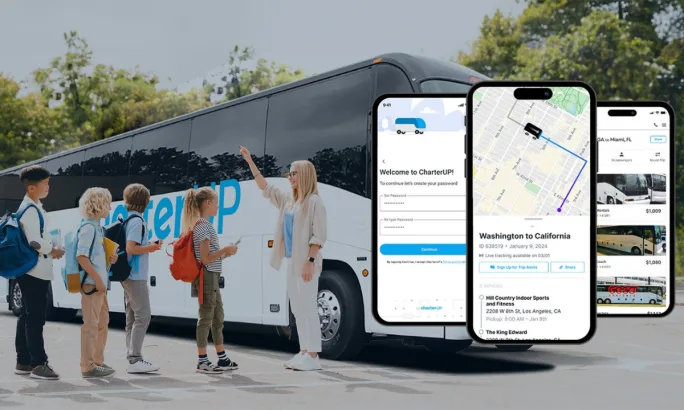
"Over the next few years, we anticipate K-12 transportation moving toward a more connected approach," Pepping said. "Schools will want real-time visibility, easier management, and an even greater focus on safety."
Credit:
CharterUP
Q: What have you learned about the school transportation industry so far and how it differs from the other markets you serve?
Pepping: We work across many industries, from employee and construction shuttles to transportation for large conferences and events, and each group has very different priorities.
What we’ve learned in K-12 is that transportation needs go far beyond the daily home-to-school route, with teams also managing athletics, field trips, extracurriculars, and constantly changing schedules. With so many stakeholders, trip types, and overlapping schedules, having a centralized platform for visibility and budget management has been crucial. We had to navigate the flexibility to cancel and reschedule trips based on things like weather for the first time, because that’s not something that happens very often with corporate or professional business travel. Usually, it’s a rain-or-shine situation.
Many public schools and universities have certain things they cannot agree to because of state law. So we had to completely change the way that we go after larger partnerships and agreements with schools to help them stay compliant with state law.
We had to completely change how we assign and vet vehicles for K-12 customers. For example, in California, we need SPAB-certified drivers and vehicles. That SPAB (School Pupil Activity Bus) certification is not something that everybody on our marketplace has. [We pride ourselves on] being able to proactively serve those up to our K-12 clients so that, inside of the marketplace, they are still getting the same quality of experience that our corporate clients are getting, but it is tailored very specifically for what they need and also to make sure that everyone is staying compliant with California state law.
Q: Where do you see technology having the greatest potential to help address changing transportation needs?
Pepping: Technology lets teams take much of the manual work out of transportation, giving administrators and teachers time back to focus on their responsibilities instead of chasing down buses, schedules, and updates.
Better routing, real-time visibility, and centralized data can help teams respond faster, catch issues earlier, and make better use of their resources. If something does go wrong, having a clear record of what happened creates greater accountability.
Often, if a principal, athletic director, or transportation director is booking a trip, they’re not physically going on that trip. So a teacher or coach might be outside for pickup and ask, “Where’s the bus?” or “Is it picking us up on this side of the building or on that side of the building?”
They end up contacting the principal and the athletic director or the transportation director to ask that question. Then that person has to turn around and call someone else to figure out whether the pickup will be on the west side or the east side of the building, or whether the bus will be there five minutes early. They have this massive game of telephone that they have to play. It gives coaches and teachers the flexibility and power to respond in real time and manage every aspect of a trip as needed.
Another tool that operators have access to is our dedicated 24/7 customer support team, which, if something does go wrong on the topic of accountability, conducts a full investigation where they look through trip logs and records, and they will do investigations with both the client and the operator to cross-reference what happened on the ground against the data that we have. We want to figure out the truth of what happened and take the appropriate action to make sure our clients are taken care of.
Q: Looking ahead, how is CharterUP preparing its technology and services for industry changes over the next few years?
Pepping: Over the next few years, we anticipate K-12 transportation moving toward a more connected approach. Schools will want real-time visibility, easier management, and an even greater focus on safety. Having clear visibility into every trip and overall accountability across trips is also increasingly important.
We’re building for that by bringing booking, routing, tracking, communication, and accountability into one platform, backed by a highly vetted network of providers and drivers.
One thing we implemented for K-12 and universities is operator history, profiles, and reviews. We developed this specifically for K-12. We are not just aiming to give them a similar experience with the same company, because often they’ll say, “We had a great experience with company ABC. We would love to work with them again.”
It’s important to provide true visibility so [parents and stakeholders] know exactly where the bus was, with timestamps, and can look back at the route it took. If something went wrong, if [the bus] did get there late, being able to infer why.
We repurposed our trip status and GPS tracking for K-12 and universities because there is such a need for visibility, and for good reason, because the safety of the students always has to be the number one concern.
Subscribe to Our Newsletter
More Management
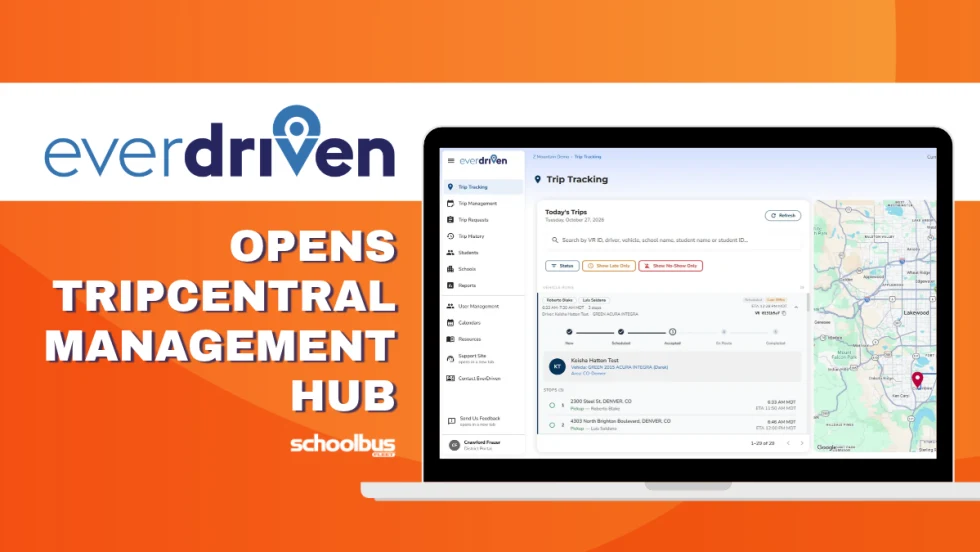
EverDriven Expands TripCentral Transportation Management Platform to All Partner Districts
The platform provides school districts with real-time trip tracking, student transportation scheduling tools, and pickup and drop-off management capabilities.
Read More →
6 School Transportation Trends to Watch: 2026 District Survey Results
School bus buying is up, fuel choices are shifting, and driver shortages persist. This and more in the latest K-12 public school survey, plus the largest fleets in the U.S.
Read More →
The 100 Largest School Bus Fleets in America: 2026 Rankings
Which public K-12 school districts are the largest in the nation in terms of bus fleet size? Here are the new standings of the top 100 district fleets.
Read More →
EverDriven Launches Route Consolidation Calculator to Estimate Diesel Savings
As diesel prices hit record highs, the largest alternative transportation provider says a 10% route consolidation could save a 120-route district more than $78,000 a year in fuel alone.
Read More →
Zum Secures Continued Financing Support for School Bus Expansion
Generate Private Credit has financed approximately $75 million in school bus deployments across three states, supporting more than 500 buses as Zum expands across the county.
Read More →
Beyond Discipline: A Different Approach to Student Behavior on the Bus
After implementing a dean of students program in Oregon, North Clackamas is seeing positive improvements. Here’s how it worked. The Route is brought to you by IC Bus.
Read More →
A Dean of Transportation's Different Approach to Student Behavior on the School Bus
After implementing a dean of students program in Oregon, North Clackamas is seeing positive improvements on the bus. Here’s how it worked.
Read More →
Inside NAPT ACTS 2026: Highlights from Louisville
From federal updates and student behavior strategies to new school bus technology and industry awards, see highlights from NAPT ACTS 2026 in Louisville.
Read More →
Meet the 2026 School Bus Driver Hero Winner: Annette Brown
We caught up with Wa-Nee Community Schools' Annette Brown on site at SBFX, where she was named the 2026 School Bus Driver Hero Award winner. Hear about her reaction, what she loves most about being a school bus driver, and more!
Read More →
Predictability Is Like Ketchup (According to 6-Year-Olds)
To students, a different school bus can feel like a full-blown crisis. One driver reflects on why familiar routines, showing up on time, and being reliably boring matter more than we think.
Read More →