




Extra Red Lights Linked to Decrease in Illegal Passing
Five Iowa districts that tested supplemental warning lights on school buses have seen stop-arm violations drop by at least 50%.

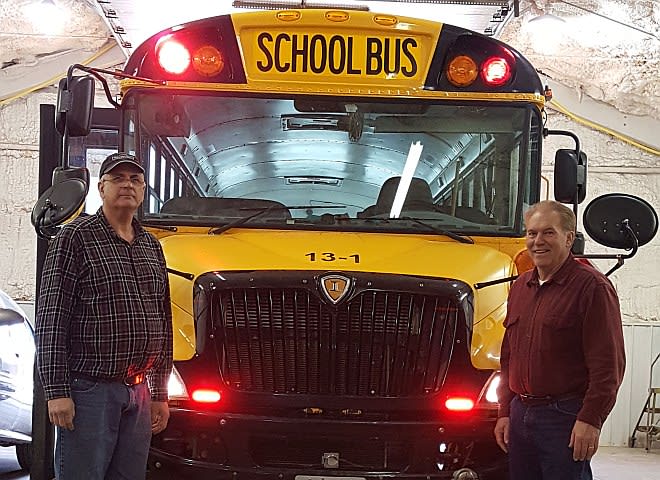
Red LEDs just above the bumper of a bus are framed by Ken Padget (left) and Dan Roberts of Davis County Community School District.
Red LEDs just above the bumper of a bus are framed by Ken Padget (left) and Dan Roberts of Davis County Community School District.
Several school districts in Iowa have seen a dramatic decrease in illegal school bus passing after installing extra warning lights on their buses.
The small-but-bright LED units are positioned just above the bumper, with two on the front of the bus and two on the rear. The supplemental lights are wired into the existing eight-way warning light system of the bus, so they flash red when the standard red lights flash, as students are boarding or exiting at bus stops.
The initial aim for the lights was to prevent rear-ending of school buses, which was the cause of a fatality near St. Ansgar, Iowa, in November 2011. Allison Smith, 17, was killed when she crashed her car into the back of a stopped school bus.
“The transportation director at that school district was completely broken up by it,” says Max Christensen, Iowa’s state director of pupil transportation. “He said, ‘Max, isn’t there something we could do to focus more attention on these buses when they’re stopped?’”
Piloting lights
With the St. Ansgar incident in mind, the Iowa Department of Education launched a pilot project to test supplemental warning lights just above the bumpers of school buses. The idea was that these lights would be closer to eye level for most motorists — and therefore more likely to attract their attention as they approach a stopped bus.
The pilot project ran from August 2014 to July 2016. The lights were installed on a total of 10 school buses in five Iowa school districts, at a cost of about $300 per bus.
While the primary goal of the project had been to prevent rear-ending of stopped school buses, the testing of the supplemental lights quickly uncovered another benefit: reducing illegal passing of stopped school buses. Christensen says the districts that participated in the pilot project have seen decreases of at least 50% in stop-arm violations.
Targeting violations
One of the participants was Davis County Community School District (CSD), which runs 17 school bus routes throughout an area of about 485 square miles in southern Iowa. For its part in the pilot project, the Bloomfield-based district put its two buses equipped with supplemental lights on routes that traverse the area’s two main highways.
“Those are our most dangerous bus routes,” says Dan Roberts, director of support services for Davis County CSD. “They have to stop on busy highways.”
On one of those routes, at least one violation had been occurring per week. With the introduction of the extra flashing lights, the violation rate dropped to about one every two months.
“Once we put those [lights] on, we immediately got results,” Roberts says. “It was like somebody waved a magic wand.”
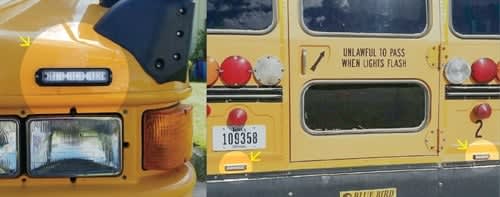
The small-but-bright LED units are positioned above the bumper, with two on the front of the bus and two on the rear.
Supporting evidence
The impact of the enhanced warning system was further confirmed at Davis County CSD a few months later, when the aforementioned bus was taken off duty for repairs for several weeks, and a substitute bus without the supplemental lights covered the route.
“We had a run-through [violation] that day, the first time the sub bus went through the route,” Roberts says. “That made a believer out of us.”
Among the believers is head mechanic Ken Padget, who has worked for Davis County CSD since 1977. Padget says that the supplemental lights are “one of the most effective additions to a school bus” that he has seen in his career.
Perry CSD, another participant in the pilot project, has also seen success with the supplemental lights. The district, about 40 miles northwest of Des Moines, ran a school bus with the extra lights on a route that travels along a major highway.
Troy Griffith, transportation director for Perry CSD, says that there had previously been one or two stop-arm violations per year on that route. With the addition of the supplemental lights, “We went down to none at all,” he says. “They have been successful.”
“Once we put those [lights] on, we immediately got results. It was like somebody waved a magic wand.”Dan Roberts, director of support services, Davis County Community School District, Bloomfield, Iowa
Gaining approval
With the positive results achieved in the two years of testing the supplemental lights, in October the Iowa Department of Education approved the use of the lights for all school districts in the state. Iowa joins Ohio as another state that has tested and approved this type of supplemental warning light. Columbus City Schools in Ohio has added them to its specifications for all new school bus purchases.
In the near future, these lights could become mandatory in Iowa: The state Maintenance and Inspection Advisory Council recommended that a supplemental warning light system be added as required equipment for new school buses in Iowa when the state next updates its minimum specifications.
Meanwhile, Christensen says that he is aware of at least five additional districts in Iowa that have opted to install the extra lights on buses. The models used in the pilot project were Weldon’s supplemental warning light system, but other brands of lights that meet the same specifications are also approved for use in Iowa.
Now, the state is launching a similar pilot project in which it will test LED rope lighting, supplied by a company called Allstop, on the exterior of school buses. Again, the goal will be to attract more motorists’ attention to stopped school buses, particularly in conditions that limit visibility, such as fog.
“We need to do as much as we can to prevent these accidents — the pass-bys and the rear-ending,” Christensen says. “I think extra lighting really helps, because the biggest cause is inattentive driving.”
More Safety
2 Killed, Dozens Injured in Florida School Bus Crash
A multi-vehicle collision caused a Polk County school bus carrying 37 students to overturn on its way to Winter Haven High School.
Read More →
Illegal School Bus Passing Drops 24% in New York Districts
With fewer than 5% of citations involving repeat offenders, Westchester County officials said enforcement, education, and community partnerships are helping change driver behavior.
Read More →
School's Back. Here's What Happened to Traffic, Speeding & Distraction
What happens to traffic when school resumes? New data analysis examines changes in distracted driving, congestion, and speeding around schools.
Read More →
Geotab Expands Fleet Safety Tools With Video Coaching, Risk Insights
New safety and video capabilities aim to help fleet managers assess risk, support drivers, and take targeted action through video coaching, red-light violation detection, and more.
Read More →
How to Build a Better School Bus Driver Training Program
Is it time to strengthen your driver training? Here’s how to pick the right talent and improve recruitment, retention, and safety. This video is brought to you by IC Bus.
Read More →
Recent School Bus Accidents Leave 2 Dead, 2 Injured
Four school bus crashes in Florida, Illinois, and Georgia highlight risks in transportation lots, at bus stops, and during student loading and unloading.
Read More →
When Every Second Matters, Clarity Keeps Routes Moving
From routine delays to urgent incidents, strong communication practices help drivers, dispatchers, schools, and families respond with confidence.
Read More →
What Happens When a School Bus Catches Fire — and What Can Help
School bus fires are rare but can be devastating. Learn how advances in fire suppression and asset protection help fleets detect fires earlier, reduce damage, and improve safety.
Read More →
Geotab Launches Tool to Help Fleets Investigate Road Incidents
Geotab Investigations combines telematics data, video, documents, and other evidence to help fleets reconstruct incidents, resolve claims, and determine what happened.
Read More →
Texas Sixth Grader Wins 2026 National School Bus Safety Poster Contest
Sai Darshana Yekolu of Moseley Middle School in Prosper, Texas, was named the newest winner for her artwork, bringing the theme of “Safe Rides, Everyday Heroes” to life.
Read More →