




NTSB Vice Chair Shares 7 Key Safety Takeaways in NAPT Webinar
Bruce Landsberg discusses recurring as well as new safety issues brought on by the COVID-19 pandemic and the agency’s recommendations.

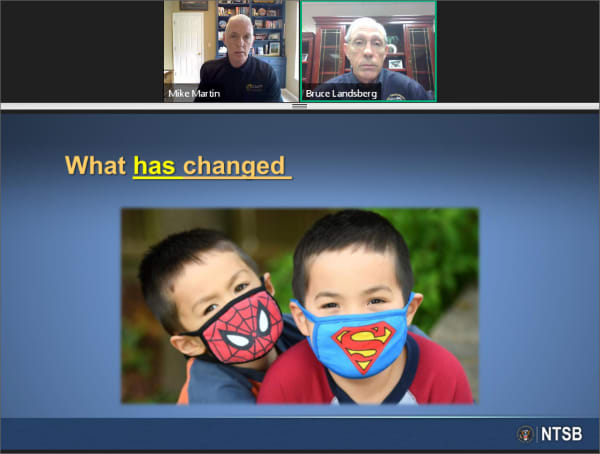
National Transportation Safety Board Vice Chair Bruce Landsberg detailed recurring as well as new safety issues brought on by the COVID-19 pandemic and the agency’s recommendations.
Screenshot from National Association for Pupil Transportation's webinar
Bruce Landsberg, the National Transportation Safety Board’s (NTSB’s) vice chairman, shared updates on new safety issues brought about by the COVID-19 pandemic as well as reminders of those that persist in a webinar on Thursday.
The webinar, held by the National Association for Pupil Transportation (NAPT), was facilitated by Mike Martin, the association’s executive director. Martin reminded attendees that Landsberg spoke at NAPT’s annual conference in November 2019 in Columbus, Ohio.
Landsberg began a five-year appointment as an NTSB board member Aug. 7, 2018, and on that same day began a two-year term as the NTSB’s vice chairman. As previously reported, President Donald Trump designated Landsberg as the NTSB’s vice chairman on Aug. 21.
Landsberg offered some takeaways on what safety issues remain even as we struggle with the pandemic and what new problems pupil transporters should be aware of:
1. Impaired driving is still a problem. Many motorists are still driving not only while under the influence of alcohol but also while impaired by over-the-counter, prescription, and recreational drugs. Several states now have laws allowing consumption of marijuana for medical and/or recreational purposes, but, he reminded attendees, federal law supersedes state legislation in this case, and marijuana use is prohibited for commercial driver’s license (CDL) holders.
2. Driver fitness testing strongly recommended. Landsberg briefly reviewed the tragic details of a fatal school bus fire in Iowa in December 2017. A bus driver, who suffered from chronic back pain that impeded his ability to walk, was unable to escape the bus or help the student on board once the engine caught fire.
As a result, the NTSB recommended all drivers undergo fitness testing to confirm they can exit the bus as well as help students through any available exit.
Landsberg added that physical and emotional fitness should also be tested annually, given how much stress people are dealing with due to the pandemic.
Driver Fitness, Fire Suppression Hot Topics at NASDPTS Conference
3. The need for recurring training continues — and is even more important now. Safety training is possibly more critical now because many bus drivers have been out of practice due to in-person learning being on hold across much of the U.S. for about eight months and need refreshers. Students also need training and retraining on issues such as evacuation since it will have been a while for them, too.
4. Distractions still abound. Landsberg mentioned that all forms of motorist distraction — food, pets, personal grooming, phones — are still out there. Additionally, school bus drivers now need to deal with wearing masks and being the enforcers of students and other passengers on their buses wearing them. This prompts a recommendation for collision avoidance systems, he added.
5. Additional technological developments still recommended for safety enhancement. In addition to collision avoidance technology, Landsberg highlighted interior and exterior cameras, engine data monitors, fire suppression systems, and three-point seat belts as being recommended by the NTSB.
“Before the pandemic, we were having one [school bus] fire per day,” Landsberg said. “Make the investment [in fire suppression systems].”
Regarding seat belts, Landsberg noted that the NTSB has found that compartmentalization works in front- or rear-impact collisions but not in lateral crashes.
Additionally, vehicle-to-vehicle technology and autonomous vehicle technology such as braking assistance is in development and may be available for retrofit in school buses.
6. Fewer buses are on the road, but more motorists are speeding, driving recklessly. Last year when he prepared to speak to NAPT members at the conference in Ohio, Landsberg said he was “floored” by the number of stop-arm violations recorded in 2018: nearly 84,000 daily. What has changed since last year, when that number was even higher, at more than 95,000, is that significantly fewer school buses are on the road.
However, there have been increases in speeding and reckless driving, making enforcement tools even more important, Landsberg said.
“We hear more jurisdictions are going with stop-arm cameras,” he added. “That makes sense, because if you have a law but can’t enforce it, that’s a problem.”
7. Tracking, discussing near-miss incidents is vital. When bus drivers experience incidents that did not result in a crash, Landsberg said it is still important to have a system in place for discussing, tracking, and analyzing such events, not to assign blame, but to fix the problem.
“Have a methodical way of doing it,” he said. “Even something simple like a checklist is helpful.”
Although we may not know what’s next with the pandemic, some things never change, and the industry needs to continue being proactive on the recurring safety issues and adapt to new developments, Landsberg said.
“Safety isn’t everything; it’s the only thing,” he added. “Because when there is a fatality or injury, nothing else matters.”
More Safety

How to Build a Better School Bus Driver Training Program
Is it time to strengthen your driver training? Here’s how to pick the right talent and improve recruitment, retention, and safety. This video is brought to you by IC Bus.
Read More →
Recent School Bus Accidents Leave 2 Dead, 2 Injured
Four school bus crashes in Florida, Illinois, and Georgia highlight risks in transportation lots, at bus stops, and during student loading and unloading.
Read More →
When Every Second Matters, Clarity Keeps Routes Moving
From routine delays to urgent incidents, strong communication practices help drivers, dispatchers, schools, and families respond with confidence.
Read More →

What Happens When a School Bus Catches Fire — and What Can Help
School bus fires are rare but can be devastating. Learn how advances in fire suppression and asset protection help fleets detect fires earlier, reduce damage, and improve safety.
Read More →
Geotab Launches Tool to Help Fleets Investigate Road Incidents
Geotab Investigations combines telematics data, video, documents, and other evidence to help fleets reconstruct incidents, resolve claims, and determine what happened.
Read More →
Texas Sixth Grader Wins 2026 National School Bus Safety Poster Contest
Sai Darshana Yekolu of Moseley Middle School in Prosper, Texas, was named the newest winner for her artwork, bringing the theme of “Safe Rides, Everyday Heroes” to life.
Read More →
Doing More With Less: How Transportation Directors Can Prioritize Safety Amid Budget Uncertainty
With diesel prices soaring and nearly one-third of transportation directors expecting budget cuts, maintaining student safety has never been more challenging. Download this guide to learn how leading districts are prioritizing risk, funding critical safety technology, and building stronger budget cases with data.
Read More →
Walton County Schools Adds Gatekeeper Stop-Arm Enforcement System
The Florida district will deploy Gatekeeper’s updated Student Protector technology, which now incorporates AI to improve video evidence.
Read More →
How To Build a More Secure School Bus Yard During and After Hours
As thefts and overnight security threats continue, school transportation leaders are combining stronger operational practices with AI-enabled surveillance to better protect buses, facilities, and staff.
Read More →
FMCSA Names New Chief Safety Officer: What School Bus Operators Should Know
Steve Dowling is set to lead the federal agency's efforts to advance commercial motor vehicle safety and reduce crashes, fatalities, and injuries on the nation's roadways.
Read More →