




NTSB: School Bus Driver in Baltimore Crash Had History of Seizures
A preliminary report finds that Glenn Chappell had hypertension, diabetes, and seizures, and in the past five years had been involved in at least 12 crashes or incidents while driving a school bus or personal vehicle.

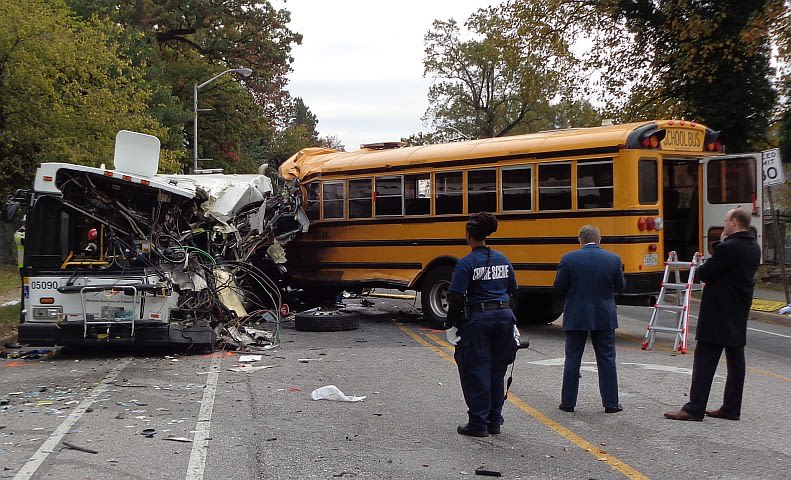
A preliminary NTSB report on the Nov. 1 school bus and transit bus crash in Baltimore found that school bus driver Glenn Chappell had a history of hypertension, diabetes, and seizures. Photo courtesy Maryland Transportation Authority Police
A preliminary NTSB report on the Nov. 1 school bus and transit bus crash in Baltimore found that school bus driver Glenn Chappell had a history of hypertension, diabetes, and seizures. Photo courtesy Maryland Transportation Authority Police
BALTIMORE — The National Transportation Safety Board’s (NTSB’s) preliminary report, released on Wednesday, has found that the school bus driver in the November crash of a school bus and a transit bus here had a history of seizures, diabetes, and hypertension.
The school bus driver, Glenn Chappell, was driving for AA Affordable Transportation on a contracted route for Baltimore City Public Schools. Chappell was driving east on Frederick Ave. when he struck a Ford Mustang, according to a news release from the NTSB. Chappell continued traveling east, and entered the westbound travel lane, where the school bus collided with a Maryland Transit Administration (MTA) bus. The impact continued along the left side of the transit bus and terminated near its rear axle.
The school bus was occupied only by Chappell and an aide. The MTA bus was occupied by the driver and 13 passengers. The drivers of both buses and four transit bus passengers were killed, and seven other passengers were seriously injured. The aide and two MTA bus passengers sustained minor injuries, as did the driver of the Mustang.
The preliminary report states that video from area surveillance cameras and the MTA bus’ onboard video system indicate that Chappell was traveling approximately 57 mph just before he struck the Mustang. The onboard video system captured the crash sequence. The airbag control module on the Mustang recorded that it was traveling approximately 16 mph when it was struck from behind.
After colliding with the Mustang, the school bus continued more than 800 feet and was traveling about 45 mph before impacting the MTA bus, which was traveling about 39 mph. The posted speed limit in the area was 30 mph.
Preliminary information suggests neither bus driver was using a cell phone at the time of the crash, according to the NTSB news release. Both bus drivers reported for work earlier that day and were not operating beyond hours-of-service regulations. Mechanical inspections were completed on both buses and no mechanical defects were found.
Investigators found that Chappell had a history of hypertension, diabetes, and seizures, and in the past five years, had been involved in at least 12 crashes or incidents while operating a school bus or personal vehicle. Reports from a number of these cases described seizure-like episodes. Paramedics were called to AA Affordable Transportation one week before the crash because Chappell experienced a medical emergency that witnesses described as a seizure, The Baltimore Sun reports.
As previously reported, Chappell held a current medical certificate at the time of the crash, but it was not on file with the Maryland Motor Vehicle Administration (MMVA). As a result, the MMVA notified Chappell about two months before the crash that he was no longer authorized to drive a school bus, and could lose his license unless he provided documentation that a doctor had cleared him to drive. However, the MMVA hadn’t informed the school system that Chappell had lost his driving privileges, and he continued to transport students. The state did not revoke Chappell’s CDL until the day after the crash, which is when school officials found out about the revocation.
All aspects of the crash remain under investigation by the NTSB and the Baltimore Police as the NTSB works to determine the probable cause of the crash. Analysis of the accident facts, along with conclusions and a determination of probable cause, will come at a later date when the final report on the investigation is completed.
View the NTSB's preliminary report here.
More Safety
2 Killed, Dozens Injured in Florida School Bus Crash
A multi-vehicle collision caused a Polk County school bus carrying 37 students to overturn on its way to Winter Haven High School.
Read More →
Illegal School Bus Passing Drops 24% in New York Districts
With fewer than 5% of citations involving repeat offenders, Westchester County officials said enforcement, education, and community partnerships are helping change driver behavior.
Read More →
School's Back. Here's What Happened to Traffic, Speeding & Distraction
What happens to traffic when school resumes? New data analysis examines changes in distracted driving, congestion, and speeding around schools.
Read More →
Geotab Expands Fleet Safety Tools With Video Coaching, Risk Insights
New safety and video capabilities aim to help fleet managers assess risk, support drivers, and take targeted action through video coaching, red-light violation detection, and more.
Read More →
How to Build a Better School Bus Driver Training Program
Is it time to strengthen your driver training? Here’s how to pick the right talent and improve recruitment, retention, and safety. This video is brought to you by IC Bus.
Read More →
Recent School Bus Accidents Leave 2 Dead, 2 Injured
Four school bus crashes in Florida, Illinois, and Georgia highlight risks in transportation lots, at bus stops, and during student loading and unloading.
Read More →
When Every Second Matters, Clarity Keeps Routes Moving
From routine delays to urgent incidents, strong communication practices help drivers, dispatchers, schools, and families respond with confidence.
Read More →
What Happens When a School Bus Catches Fire — and What Can Help
School bus fires are rare but can be devastating. Learn how advances in fire suppression and asset protection help fleets detect fires earlier, reduce damage, and improve safety.
Read More →
Geotab Launches Tool to Help Fleets Investigate Road Incidents
Geotab Investigations combines telematics data, video, documents, and other evidence to help fleets reconstruct incidents, resolve claims, and determine what happened.
Read More →
Texas Sixth Grader Wins 2026 National School Bus Safety Poster Contest
Sai Darshana Yekolu of Moseley Middle School in Prosper, Texas, was named the newest winner for her artwork, bringing the theme of “Safe Rides, Everyday Heroes” to life.
Read More →