




NTSB: Driver Medical Event Caused Fatal Alabama Charter Bus Crash
A National Transportation Safety Board report states that the fatal 2018 crash that killed the bus driver and injured several passengers was caused by the driver suffering from an unknown medical event.

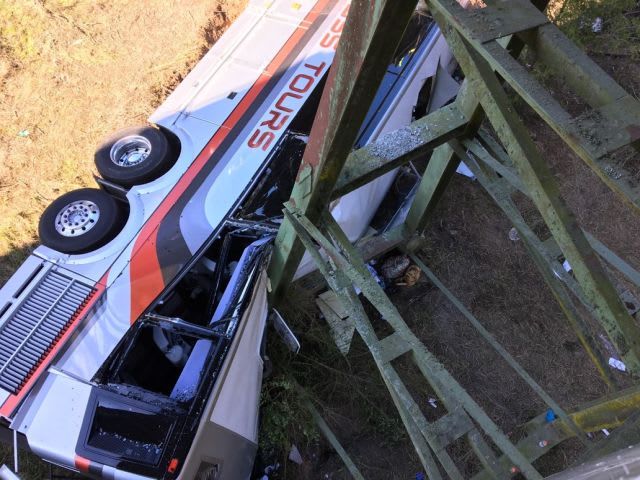
An NTSB report states that a fatal 2018 Alabama charter bus crash that killed the bus driver and injured several passengers was caused by the driver suffering from an unknown medical event. Photo courtesy Alabama DOT
An NTSB report states that a fatal 2018 Alabama charter bus crash that killed the bus driver and injured several passengers was caused by the driver suffering from an unknown medical event. Photo courtesy Alabama DOT
WASHINGTON, D.C. — A recent report from the National Transportation Safety Board (NTSB)
has revealed that a fatal charter bus crash in Alabama in 2018 was caused by the driver suffering from a medical event.
As SBF previously reported, the bus was one of two that were transporting Texas students home from a trip to Walt Disney World in Orlando, Florida, on March 13. It drove into the median and then off the road and plunged 50 feet into a ravine, killing the bus driver, Harry Caligone, and injuring several students and other passengers. One person suffered critical injuries. A total of 46 people were aboard the bus.
The buses, operated by Houston-based charter bus company First Class Tours, were carrying students from Channelview High School, who had given a band performance at the amusement park.
According to the NTSB’s report, Caligone, 65, was driving westbound on Interstate 10 near Loxley, Alabama. At the crash location, I-10 is a four-lane divided highway with a posted speed limit of 70 mph. The eastbound and westbound lanes are divided by an earthen center median. The weather conditions were reported as dry and clear, states the report, which was released on May 19.
The crash event began when the 2018 Prevost motorcoach departed the westbound lanes at an angle of about 5 degrees, crossed the center median, traveled across the opposing eastbound travel lanes and onto the far eastbound shoulder. It struck the guardrail adjacent to the south shoulder of the roadway, according to the report. The guardrail redirected the motorcoach, which went back across the eastbound travel lanes and returned to the center median.
NTSB investigators confirmed through interviews that the driver was unresponsive when the charter bus departed the westbound roadway and first entered the center median and that he remained unresponsive throughout the crash sequence, according to the report.
The report also points to Caligone's history of high blood pressure as a possible factor, and notes that after his most recent CDL medical exam, his medical certificate was restricted to three months.
The NTSB has determined that the probable cause of the bus’s departure from the roadway and crash into the ravine was Caligone's incapacitation due to an unknown medical event, according to its report.
"Although the circumstances of the crash are consistent with sudden driver incapacitation due to a medical event, the exact cause of the driver’s incapacitation could not be determined from the available evidence," the report states.
More Safety

How to Build a Better School Bus Driver Training Program
Is it time to strengthen your driver training? Here’s how to pick the right talent and improve recruitment, retention, and safety. This video is brought to you by IC Bus.
Read More →
Recent School Bus Accidents Leave 2 Dead, 2 Injured
Four school bus crashes in Florida, Illinois, and Georgia highlight risks in transportation lots, at bus stops, and during student loading and unloading.
Read More →
When Every Second Matters, Clarity Keeps Routes Moving
From routine delays to urgent incidents, strong communication practices help drivers, dispatchers, schools, and families respond with confidence.
Read More →

What Happens When a School Bus Catches Fire — and What Can Help
School bus fires are rare but can be devastating. Learn how advances in fire suppression and asset protection help fleets detect fires earlier, reduce damage, and improve safety.
Read More →
Geotab Launches Tool to Help Fleets Investigate Road Incidents
Geotab Investigations combines telematics data, video, documents, and other evidence to help fleets reconstruct incidents, resolve claims, and determine what happened.
Read More →
Texas Sixth Grader Wins 2026 National School Bus Safety Poster Contest
Sai Darshana Yekolu of Moseley Middle School in Prosper, Texas, was named the newest winner for her artwork, bringing the theme of “Safe Rides, Everyday Heroes” to life.
Read More →
Doing More With Less: How Transportation Directors Can Prioritize Safety Amid Budget Uncertainty
With diesel prices soaring and nearly one-third of transportation directors expecting budget cuts, maintaining student safety has never been more challenging. Download this guide to learn how leading districts are prioritizing risk, funding critical safety technology, and building stronger budget cases with data.
Read More →
Walton County Schools Adds Gatekeeper Stop-Arm Enforcement System
The Florida district will deploy Gatekeeper’s updated Student Protector technology, which now incorporates AI to improve video evidence.
Read More →
How To Build a More Secure School Bus Yard During and After Hours
As thefts and overnight security threats continue, school transportation leaders are combining stronger operational practices with AI-enabled surveillance to better protect buses, facilities, and staff.
Read More →
FMCSA Names New Chief Safety Officer: What School Bus Operators Should Know
Steve Dowling is set to lead the federal agency's efforts to advance commercial motor vehicle safety and reduce crashes, fatalities, and injuries on the nation's roadways.
Read More →