




NTSB Cites Driver Oversight Issues in 2 Fatal School Bus Crashes
After investigating the 2016 crashes in Baltimore and Chattanooga, NTSB recommends improvements in school bus driver oversight and calls on states to mandate lap-shoulder belts.

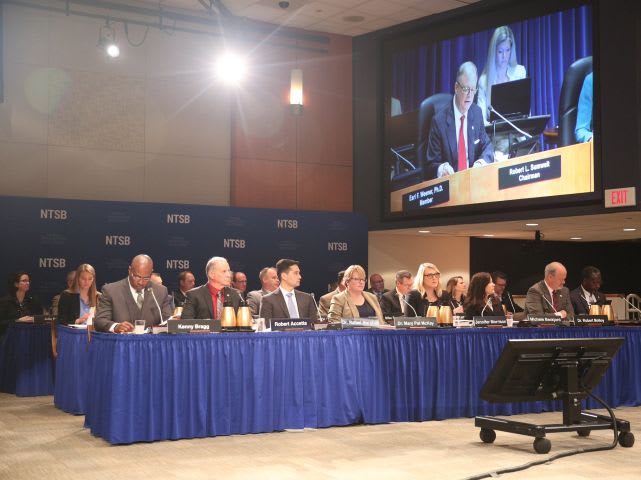
The National Transportation Safety Board (NTSB) held a meeting on Tuesday to address findings from the November 2016 school bus crashes in Baltimore, Maryland, and Chattanooga, Tennessee. Photo courtesy NTSB
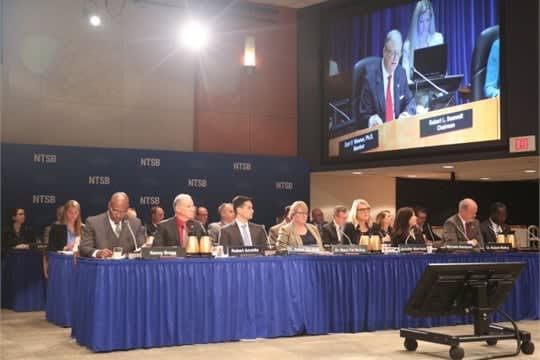
The National Transportation Safety Board (NTSB) held a meeting on Tuesday to address findings from the November 2016 school bus crashes in Baltimore, Maryland, and Chattanooga, Tennessee. Photo courtesy NTSB
WASHINGTON, D.C. — The National Transportation Safety Board (NTSB) on Tuesday highlighted shortcomings in driver oversight while calling for lap-shoulder belts and other added safety features on school buses — both in response to a pair of fatal crashes in 2016.
NTSB’s three current board members held a meeting with agency staff to consider a special investigation report that examines the November 2016 school bus crashes in Baltimore, Maryland, and Chattanooga, Tennessee. Six people were killed in each of those incidents.
In opening the meeting, NTSB Chairman Robert Sumwalt pointed to a prominent theme of the discussion: “In both crashes, we saw poor driver oversight both by the school districts and by the contracted motor carriers that provided student transportation services. … In concrete terms, neither of these drivers should have been behind the wheel.”
Driver Issues in Baltimore Crash
In the Baltimore crash, a school bus struck a car and a pillar, entered oncoming traffic, and hit the driver’s side of a transit bus. The drivers of both buses and four transit bus passengers were killed. No students were aboard the school bus at the time.
In its investigation of the Baltimore crash, NTSB uncovered multiple red flags with school bus driver Glenn Chappell that the agency said should have sidelined him. For example, he had a history of seizures, which were witnessed at work on several occasions.
In fact, investigators learned that Chappell had a seizure on Oct. 24, 2016, at AAAfordable Transportation, his employer at the time, but the company allowed him to drive for five consecutive days afterward, leading up to and including the day of the crash. According to NTSB, AAAfordable Transportation asked Chappell for a doctor’s release to duty after the seizure, but he had not furnished such a release and the company continued to let him drive.
In the Nov. 1 fatal crash, NTSB determined that Chappell lost control of the school bus because he was incapacitated by a seizure.
Also, NTSB found that Chappell was convicted of second-degree assault in 2011, which the agency said should have prohibited him from driving a school bus, but ambiguity in the term “crime of violence” in Maryland state code left school bus operations to define the term for themselves. (The Maryland State Board of Education is slated to vote on new language for that code in June, NTSB noted in the meeting.)
Meanwhile, NTSB found that Chappell also had a history of license fraud. The agency said that his license had been repeatedly revoked and suspended, but he repeatedly obtained a new license by using a different name, a different spelling of his name, or a different date of birth. NTSB said that facial recognition systems for driver licensing — which Maryland is currently piloting — can prevent such fraud if their use is expanded.
Driver Issues in Chattanooga Crash
In the Chattanooga crash, investigators determined that the school bus departed the roadway to the right, took out a mailbox, veered to the left, struck a utility pole, and then crashed on its side into a tree. Six students were killed and more than 30 were injured.
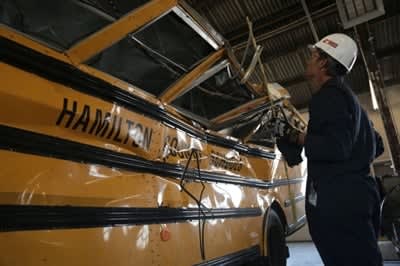
NTSB said that its investigation of the Chattanooga school bus crash found shortcomings in driver oversight, among other issues. Photo courtesy NTSB
NTSB found that driver Johnthony Walker — who had been on the job for just a few months — had been the subject of numerous complaints for speeding and improper handling of student behavior. The agency said that the complaints went to the school, the Hamilton County Department of Education, and to school bus contractor Durham School Services, but there was no indication that they were resolved.
Since the crash, NTSB noted in the meeting on Tuesday, Durham parent company National Express has established a central repository to track and manage complaints about its school bus drivers.
Speeding was also highlighted as a key factor in the Chattanooga crash. Investigators estimated that the school bus was traveling at 52 mph in a 30 mph zone, with an advisory speed of 25 for curves.
Another finding discussed in the NTSB meeting was that Walker had taken a cell phone call while driving. According to the agency, he answered the incoming call at 3:17 p.m., the crash occurred at 3:20, and the call ended at 3:21. The caller then sent a text message to Walker, NTSB said. However, in Walker’s recent trial, his attorney argued that the driver and the caller weren’t talking at the time of the crash.
Crash Factors
In the Chattanooga crash sequence analysis, investigators found that the swerving of the bus threw passengers out of their seating compartments before the impact, and “compartmentalization was rendered ineffective,” NTSB’s Thomas Barth said during the meeting.
On that front, NTSB reiterated its assertion that lap-shoulder belts provide the best protection for school bus passengers.
The agency also said that crash avoidance technology, including electronic stability control, could have helped mitigate the severity of both the Chattanooga and Baltimore school bus crashes.
In 2015, the National Highway Traffic Safety Administration (NHTSA) issued a final rule that will require ESC systems on heavy trucks and some large buses, such as motorcoaches, but the agency exempted school buses.
In the NTSB meeting on Tuesday, agency staff also said that event data recorders on the buses would have provided critical data about the crashes that could be useful in improving commercial vehicle safety.
Crash Cause Findings
During the meeting, NTSB staff presented investigation findings, probable cause statements, and safety recommendations for review by board members Sumwalt, Bella Dinh-Zarr, and Earl Weener.
For both crashes, the board members made amendments that moved driver oversight issues into the primary cause, rather than relegating them to supporting factors.
Here are the probable cause statements as approved by the board:
• Baltimore crash: “The National Transportation Safety Board determines that the probable cause of the Baltimore, Maryland, school bus crash was (1) the loss of vehicle control due to incapacitation of the bus driver because of a seizure stemming from a long-standing seizure disorder; (2) the bus driver’s continued operation of a school bus with a disqualifying medical condition and a fraudulently obtained commercial driver’s license; and (3) the failure of AAAfordable Transportation and the Baltimore City Public Schools to provide adequate bus driver oversight, allowing the medically unfit driver to drive a commercial vehicle with a medical condition that they knew, or should have known, could lead to the unsafe operation of the school bus. Contributing to the severity of the crash was the lack of a collision avoidance system with automatic emergency braking on the school bus."
• Chattanooga crash: “The National Transportation Safety Board determines that the probable cause of the Chattanooga, Tennessee, crash was (1) the school bus driver’s excessive speed and cell phone use, which led to the loss of vehicle control; (2) Durham School Services’ failure to provide adequate bus driver oversight, allowing an inexperienced driver to operate a commercial vehicle with escalating risky driving behaviors that it knew, or should have known, could lead to the unsafe operation of the school bus; and (3) the Hamilton County Department of Education’s lack of followup to ensure that Durham had addressed a known driver safety issue. Contributing to the severity of the crash was the lack of passenger lap/shoulder belts on the school bus."
Agency’s Safety Recommendations
At the end of the meeting on Tuesday, NTSB approved 16 new safety recommendations. Several of those cover driver licensing, medical examinations, and other oversight issues. Other recommendations address school bus equipment.
Perhaps most notably, NTSB called on states to mandate lap-shoulder belts for all new large school buses. For the handful of states whose existing regulations only specify lap belts — Florida, Louisiana, New Jersey, and New York — NTSB recommended that they upgrade their requirements to lap-shoulder belts for new large school buses.
The agency also called on NHTSA to mandate that “all new school buses … be equipped with collision avoidance systems and automatic emergency braking technologies.” Also, NTSB reiterated a past recommendation that NHTSA “require the installation of stability control systems on all newly manufactured commercial vehicles with a gross vehicle weight rating greater than 10,000 pounds.”
NTSB’s final investigative report on the Baltimore and Chattanooga crashes was not yet available as of press time, but the agency has issued a synopsis that includes the full list of investigation findings and safety recommendations.
More Safety

How to Build a Better School Bus Driver Training Program
Is it time to strengthen your driver training? Here’s how to pick the right talent and improve recruitment, retention, and safety. This video is brought to you by IC Bus.
Read More →
Recent School Bus Accidents Leave 2 Dead, 2 Injured
Four school bus crashes in Florida, Illinois, and Georgia highlight risks in transportation lots, at bus stops, and during student loading and unloading.
Read More →
When Every Second Matters, Clarity Keeps Routes Moving
From routine delays to urgent incidents, strong communication practices help drivers, dispatchers, schools, and families respond with confidence.
Read More →

What Happens When a School Bus Catches Fire — and What Can Help
School bus fires are rare but can be devastating. Learn how advances in fire suppression and asset protection help fleets detect fires earlier, reduce damage, and improve safety.
Read More →
Geotab Launches Tool to Help Fleets Investigate Road Incidents
Geotab Investigations combines telematics data, video, documents, and other evidence to help fleets reconstruct incidents, resolve claims, and determine what happened.
Read More →
Texas Sixth Grader Wins 2026 National School Bus Safety Poster Contest
Sai Darshana Yekolu of Moseley Middle School in Prosper, Texas, was named the newest winner for her artwork, bringing the theme of “Safe Rides, Everyday Heroes” to life.
Read More →
Doing More With Less: How Transportation Directors Can Prioritize Safety Amid Budget Uncertainty
With diesel prices soaring and nearly one-third of transportation directors expecting budget cuts, maintaining student safety has never been more challenging. Download this guide to learn how leading districts are prioritizing risk, funding critical safety technology, and building stronger budget cases with data.
Read More →
Walton County Schools Adds Gatekeeper Stop-Arm Enforcement System
The Florida district will deploy Gatekeeper’s updated Student Protector technology, which now incorporates AI to improve video evidence.
Read More →
How To Build a More Secure School Bus Yard During and After Hours
As thefts and overnight security threats continue, school transportation leaders are combining stronger operational practices with AI-enabled surveillance to better protect buses, facilities, and staff.
Read More →
FMCSA Names New Chief Safety Officer: What School Bus Operators Should Know
Steve Dowling is set to lead the federal agency's efforts to advance commercial motor vehicle safety and reduce crashes, fatalities, and injuries on the nation's roadways.
Read More →