




See also: 3-Point Belts on Buses: Real-World Experience Mitigates Most Concerns
NHTSA chief: ‘School buses should have seat belts. Period’
Before a large crowd of pupil transportation officials, Administrator Mark Rosekind revealed the National Highway Traffic Safety Administration’s new stance, that “every child on every school bus should have a three-point seat belt.”

Thomas McMahon・Executive Editor
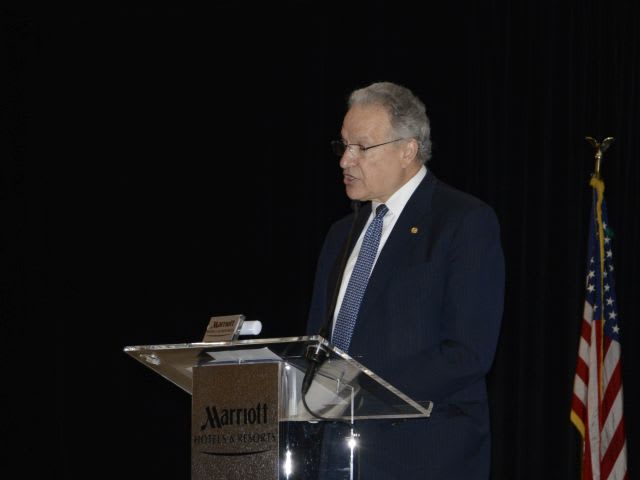
Before a large crowd of pupil transportation officials, Administrator Mark Rosekind revealed NHTSA’s new stance, that “every child on every school bus should have a three-point seat belt.”
3 min to read
RICHMOND, Va. — The National Highway Traffic Safety Administration (NHTSA) has adopted a new position on the yellow bus: “every child on every school bus should have a three-point seat belt.”
Before a large crowd of pupil transportation officials on Sunday, NHTSA Administrator Mark Rosekind spelled out his agency’s newly formed stance on the long-debated topic. While he admitted that it was a new position on the school bus front for NHTSA, he said that it is consistent with the agency’s broader push to increase seat belt use in other vehicles.
“Our position is that seat belts save lives,” Rosekind said. “That is true in a passenger car or a big, yellow bus.”
Still, the leader of NHTSA, which is responsible for regulating school buses, stopped short of announcing a rulemaking at this point. He said that the agency will now take “a series of steps to move this forward.”
Those steps will include further research into the issue — for example, studying jurisdictions that are currently using three-point belts on school buses — and trying to determine how to overcome the financial barriers — three-point belts currently add about $7,000 to $10,000 to the cost of a large school bus.
The administrator’s remarks came in a joint session of the National Association for Pupil Transportation (NAPT) and National Association of State Directors of Pupil Transportation Services conferences in Richmond.
NHTSA’s new school bus safety initiative isn’t limited to seat belts. Rosekind said that the agency’s public meeting in July identified the need to address the safety of students outside of the bus as well as inside.
To that end, Rosekind said that NHTSA will research the issue of motorists illegally passing school buses. That will include investigating the use of stop-arm cameras to catch and deter such violations.
The administrator said that his agency will also update the school bus safety materials on its website.
On the seat belt topic, sensing some resistance in the room, Rosekind acknowledged that he was presenting a challenge, but he suggested that it was time for the industry to get behind the notion that three-point restraints increase the safety of school bus passengers.
“What has to change is all of us,” he said. “Each of your organizations needs to ask a simple question: How can we not want every child who rides a school bus to have a three-point belt?”
NHTSA has been accused of being unclear in its policy on school bus seat belts in the past, but in his conference speech on Sunday, Rosekind didn’t mince words: “Concentrate on this simple, basic statement: School buses should have seat belts. Period."
In a response to Rosekind's remarks, NAPT officials thanked the administrator for "sharing his thoughts and speaking candidly about his opinions."
NAPT, like other industry associations, said that state and local officials are best able to make decisions about equipping school buses with seat belts.
"Absent a federal requirement for belts, NAPT continues to agree with NHTSA that it is most appropriate if the decision to order seat belts on large school buses were left to the states and local jurisdictions," NAPT officials said. "Local officials are in the best position to decide whether to purchase seat belts, since these officials must weigh a multitude of unique considerations bearing on purchasing decisions, especially when faced with budgetary constraints."
To read NAPT's full statement, go here.
To read Rosekind's full speech, go here.
More Safety

How to Build a Better School Bus Driver Training Program
Is it time to strengthen your driver training? Here’s how to pick the right talent and improve recruitment, retention, and safety. This video is brought to you by IC Bus.
Read More →
Recent School Bus Accidents Leave 2 Dead, 2 Injured
Four school bus crashes in Florida, Illinois, and Georgia highlight risks in transportation lots, at bus stops, and during student loading and unloading.
Read More →
Sponsored•September 8, 2026
When Every Second Matters, Clarity Keeps Routes Moving
From routine delays to urgent incidents, strong communication practices help drivers, dispatchers, schools, and families respond with confidence.
Read More →

What Happens When a School Bus Catches Fire — and What Can Help
School bus fires are rare but can be devastating. Learn how advances in fire suppression and asset protection help fleets detect fires earlier, reduce damage, and improve safety.
Read More →
Geotab Launches Tool to Help Fleets Investigate Road Incidents
Geotab Investigations combines telematics data, video, documents, and other evidence to help fleets reconstruct incidents, resolve claims, and determine what happened.
Read More →
Texas Sixth Grader Wins 2026 National School Bus Safety Poster Contest
Sai Darshana Yekolu of Moseley Middle School in Prosper, Texas, was named the newest winner for her artwork, bringing the theme of “Safe Rides, Everyday Heroes” to life.
Read More →
Sponsored•August 27, 2026
Doing More With Less: How Transportation Directors Can Prioritize Safety Amid Budget Uncertainty
With diesel prices soaring and nearly one-third of transportation directors expecting budget cuts, maintaining student safety has never been more challenging. Download this guide to learn how leading districts are prioritizing risk, funding critical safety technology, and building stronger budget cases with data.
Read More →
Walton County Schools Adds Gatekeeper Stop-Arm Enforcement System
The Florida district will deploy Gatekeeper’s updated Student Protector technology, which now incorporates AI to improve video evidence.
Read More →
How To Build a More Secure School Bus Yard During and After Hours
As thefts and overnight security threats continue, school transportation leaders are combining stronger operational practices with AI-enabled surveillance to better protect buses, facilities, and staff.
Read More →
FMCSA Names New Chief Safety Officer: What School Bus Operators Should Know
Steve Dowling is set to lead the federal agency's efforts to advance commercial motor vehicle safety and reduce crashes, fatalities, and injuries on the nation's roadways.
Read More →