




Seat belts, student behavior discussed at NHTSA meeting
The agency's public meeting looks at the barriers and benefits of seat belts on large school buses, as well as other approaches aimed at increasing safety.

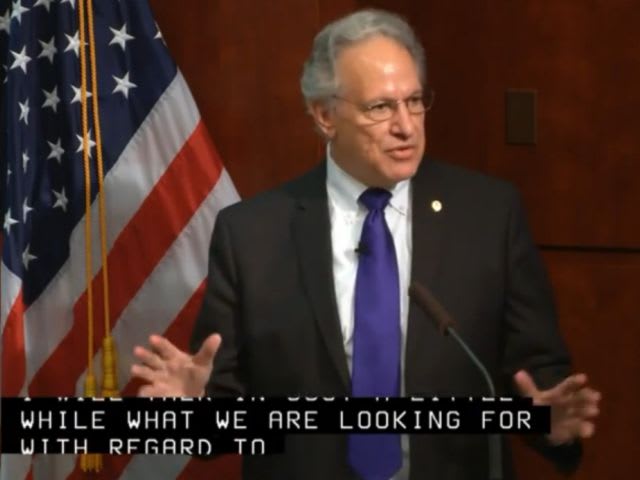
NHTSA Administrator Mark Rosekind introduces the agency's meeting on school bus seat belts. The event was available to watch via webcast, as seen here.
WASHINGTON, D.C. — The barriers and benefits of seat belts on large school buses were the key points of discussion in a public meeting held by the National Highway Traffic Safety Administration (NHTSA) on Thursday.
While acknowledging that school buses are much safer than other modes of transportation for students, NHTSA Administrator Mark Rosekind expressed his desire to explore innovative ways to enhance safety in and around the yellow bus.
"I don't care how good you are, we are. ... The reality is, you can always do it better," Rosekind said in kicking off the meeting. "Our focus is on coming up with some new solutions."
Federal agency staff, school bus association officials and school district transportation directors gave presentations during the meeting, and many attendees added to the discussion.
Dr. Kristin Poland, a senior biomechanical engineer at the National Transportation Safety Board (NTSB), shared the findings from NTSB’s investigations of the 2012 Chesterfield, New Jersey, and Port St. Lucie, Florida, school bus crashes, both of which involved buses equipped with lap belts. Poland played crash simulations that showed an unrestrained passenger being thrown across the aisle into the side of the bus, a lap belt keeping an occupant in the seating compartment but with significant upper body flailing, and a lap-shoulder belt keeping a passenger in the seat while reducing upper body motion.
Two of the speakers selected for the meeting represented school districts that have voluntarily adopted lap-shoulder belts for the buses that transport their students.
Several years ago, Helena (Mont.) Public Schools decided to include lap-shoulder belts in its bid for a new busing contract. The three-point restraints were implemented in 2012.

Federal agency staff, association officials and district transportation directors gave presentations. At the podium is Dr. Kristin Poland of NTSB.
At the NHTSA meeting, Helena's transportation manager, Tom Cohn, presented common concerns about seat belts on school buses and then explained the district's real-world experience. Examples: Students do not use the lap-shoulder belts as weapons, and "99% of the kids on the bus put their seat belts on," Cohn said.
Bartholomew Consolidated School Corp. in Columbus, Indiana, is another district that has voluntarily begun equipping its new school buses with lap-shoulder belts.
Bob Downin, a school transportation veteran who previously worked for the Bartholomew district, emphasized the positive impact of the belts on student behavior. The district has seen drastic reductions in disciplinary write-ups on buses equipped with lap-shoulder belts.
"To me, that's one of the best safety features of the lap-shoulder belts," Downin said.
Leon Langley, president of the National Association of State Directors of Pupil Transportation Services (NASDPTS), shared points from his group's position paper on the topic. In that paper, NASDPTS expresses its full support for the installation and use of lap-shoulder belts in school buses — without advocating that they be required. The state directors association recommends leaving the decision up to local needs and resources.
Ronna Weber, executive director of the National School Transportation Association (NSTA), reiterated the contractor group's position that, as NASDPTS advocated, the decision should be a local one. Weber also noted that the danger zone around school buses is a greater safety problem and that a focus by NHSTA to address that area could have a greater effect on safety.
"Our kids are the most precious thing that we have to help make safe, and we will find a way — not just with seat belts — to make this safer going to and from school."
— Mark Rosekind, NHTSA administrator
During the meeting, at least one participant commented that NHTSA should be clearer about its stance on seat belts for large school buses.
Mike Martin, executive director of the National Association for Pupil Transportation, was not present at the meeting but expressed a similar stance in a letter that he wrote to Rosekind.
"It is critically important to states, communities and school bus professionals that NHTSA explain with unambiguous language how the agency believes school transportation service providers 'could take safety to a new level,'" Martin wrote, referring to language from NHTSA's Federal Register notice about the meeting. "Respectfully, if NHTSA believes there should be lap-shoulder belts on all school buses then NHTSA should plainly say that, unequivocally."
Clearer guidance from NHTSA on the issue may be coming soon. At the conclusion of the meeting, Rosekind said that a task force will review the information presented in the meeting and comments submitted to the docket. According to Rosekind, NHTSA will then determine its role on the issue and will come out with a plan of action by the fall. That plan will likely not be limited to the seat belt topic.
"We've got to get beyond seat belts, frankly," Rosekind said. "School buses — which are the safest way for your kids to get to school — can we make them safer? Can we make the environment around it safer?"
The administrator also noted that a rulemaking is a possibility.
"I have no issue for us coming forward with any kind of regulatory action if we think it's going to make a difference," Rosekind said. "But I would say if we do anything like that, it's going to be in the context of a larger program that really is to protect this cargo. Our kids are the most precious thing that we have to help make safe, and we will find a way — not just with seat belts — to make this safer going to and from school."
For additional information and video footage of the meeting, go here.
More Safety

How to Build a Better School Bus Driver Training Program
Is it time to strengthen your driver training? Here’s how to pick the right talent and improve recruitment, retention, and safety. This video is brought to you by IC Bus.
Read More →
Recent School Bus Accidents Leave 2 Dead, 2 Injured
Four school bus crashes in Florida, Illinois, and Georgia highlight risks in transportation lots, at bus stops, and during student loading and unloading.
Read More →
When Every Second Matters, Clarity Keeps Routes Moving
From routine delays to urgent incidents, strong communication practices help drivers, dispatchers, schools, and families respond with confidence.
Read More →

What Happens When a School Bus Catches Fire — and What Can Help
School bus fires are rare but can be devastating. Learn how advances in fire suppression and asset protection help fleets detect fires earlier, reduce damage, and improve safety.
Read More →
Geotab Launches Tool to Help Fleets Investigate Road Incidents
Geotab Investigations combines telematics data, video, documents, and other evidence to help fleets reconstruct incidents, resolve claims, and determine what happened.
Read More →
Texas Sixth Grader Wins 2026 National School Bus Safety Poster Contest
Sai Darshana Yekolu of Moseley Middle School in Prosper, Texas, was named the newest winner for her artwork, bringing the theme of “Safe Rides, Everyday Heroes” to life.
Read More →
Doing More With Less: How Transportation Directors Can Prioritize Safety Amid Budget Uncertainty
With diesel prices soaring and nearly one-third of transportation directors expecting budget cuts, maintaining student safety has never been more challenging. Download this guide to learn how leading districts are prioritizing risk, funding critical safety technology, and building stronger budget cases with data.
Read More →
Walton County Schools Adds Gatekeeper Stop-Arm Enforcement System
The Florida district will deploy Gatekeeper’s updated Student Protector technology, which now incorporates AI to improve video evidence.
Read More →
How To Build a More Secure School Bus Yard During and After Hours
As thefts and overnight security threats continue, school transportation leaders are combining stronger operational practices with AI-enabled surveillance to better protect buses, facilities, and staff.
Read More →
FMCSA Names New Chief Safety Officer: What School Bus Operators Should Know
Steve Dowling is set to lead the federal agency's efforts to advance commercial motor vehicle safety and reduce crashes, fatalities, and injuries on the nation's roadways.
Read More →