





When the Smoke Clears: Tackling Vaping Where Cameras Can't See
Make the Most of National School Bus Safety Week With These Resources
Check out these resources you can use to create a campaign that reminds students, parents, and motorists in your community to prioritize school bus safety.
October 16, 2025
Across the industry, organizations and vendors are rolling out new tools, campaigns, and educational initiatives to strengthen school bus safety.
Photo: School Bus Fleet/Ingevity
6 min to read
2025 is flying by, which means National School Bus Safety Week is just around the corner. Annually held during the third week of October, National School Bus Safety Week brings together school districts, public safety officials, and others to highlight the ever-growing importance of school bus safety.
This year, National School Bus Safety Week runs Oct. 20-24, 2025, and is united under the theme: Safe Stops. Stronger Communities.
School Bus Fleet has gathered tools to help you prepare a social safety campaign with your transportation department and school district for annual safety week.
Teaching Safe Habits On and Around the School Bus
As school transportation leaders, you know that school buses are the most heavily regulated vehicles on the road, making them among the "safest passenger vehicles in preventing crashes and injuries," according to the National Highway Traffic Safety Administration.
That said, accidents still happen, with the most dangerous part of riding a school bus being the loading and unloading zones. This annual safety week, consider the following resources to share with students, or create flyers with safety tips for parents/guardians to go over with their children.
NHTSA encourages the SAFE method:
Stay at least 10 ft. — or five giant steps — away from the curb.
Always wait until the bus comes to a complete stop and the bus driver signals for you to board.
Face forward after finding a seat on the bus.
Exit the bus after it stops and look left-right-left for cars before crossing a street.
Don't forget — additional safety methods should be shared for bicyclists, pedestrians, and car riders. Just because a student isn't on the bus doesn't mean they aren't near a loading zone as they arrive and depart from school.
Best-practice safety methods are also necessary for other motorists on the road, as the National Coalition for Safer Roads (NCSR) and National Association of State Directors of Pupil Transportation Services (NASDTPS) estimate, 39.3 million illegal stop-arm violations were recorded in 2024–2025 across the U.S., down from 45.2 million the previous year.
Although state laws may differ on when it is or isn't safe to pass a stopped school bus, passing while the red lights are flashing is generally illegal in all 50 states. Learn more from NHTSA.
What else can you do this week? Share the message, advocate, and educate others! NCSR offers downloadable graphics to help spread the word.
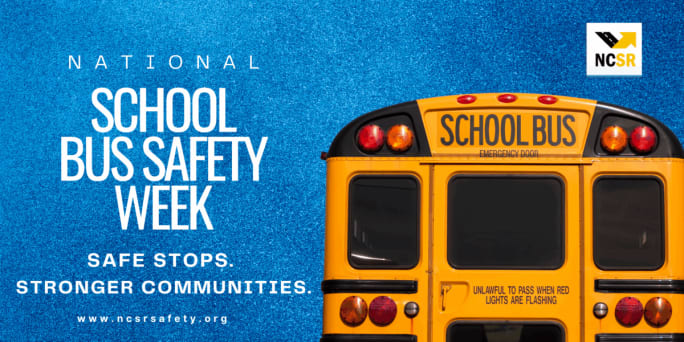
What else can you do this week? Share the message, advocate, and educate others!
Photo: National Coalition for Safer Roads
Industry Resources Supporting School Bus Safety
Across the industry, organizations and vendors are rolling out new tools, campaigns, and educational initiatives to strengthen school bus safety. From awareness programs to hands-on training, these resources help fleets, drivers, and communities stay informed and proactive.
Verra Mobility Continues National School Bus Safety Initiative
Verra Mobility is highlighting illegal school bus passings and providing a toolkit promoting safe school transportation to communities nationwide.
The free resource includes social media posts, digital collateral, educational messaging, and statistics to raise awareness about the importance of safe driving behavior around school buses.
Beyond awareness campaigns, Verra Mobility's school bus stop arm program uses AI-powered cameras to automatically detect vehicles that illegally pass a stopped bus. Any vehicle that illegally passes the bus is recorded on video, capturing the license plate and the extended stop arm.
Verra Mobility reports a 98% reduction in repeat violations, and some programs see a 70% decrease in citations issued over the course of a school year.
NASDPTS Supports Shared Responsibility Among Drivers
This year, the National Association of State Directors of Pupil Transportation Services (NASDPTS) sponsored a video campaign featuring RFK Racing driver Ryan Preece who proclaimed, “even professional drivers stop for school bus.”
Additional National School Bus Safety Week resources can be found here.
NYAPT and Partners Urge Drivers to Stop for School Buses
The New York Association for Pupil Transportation (NYAPT) is calling on all drivers to stop for school buses when red lights are flashing as part of Operation Safe Stop Day, taking place Wednesday, October 22.
Under New York State Vehicle and Traffic Law, drivers must come to a complete stop when approaching a stopped school bus with flashing red lights — whether traveling in the same or opposite direction, even on multi-lane or divided highways.
Operation Safe Stop is a statewide education and enforcement initiative that promotes school bus safety and raises awareness about the dangers of illegally passing stopped school buses.
“Stop on red, our kids are ahead – that’s the Operation Safe Stop motto,” said David Christopher, Executive Director of NYAPT. “Operation Safe Stop is an annual reminder to motorists to be aware of school buses as they travel the highways transporting our nation’s most precious cargo."
NAPT Highlights Poster Contest as Core of Safety Week
For the National Association of Pupil Transportation (NAPT), the centerpiece of National School Bus Safety Week is its poster contest.
According to NAPT, the poster contest has thousands of school districts in over 40 states participating in local and state-level competitions to select artwork depicting school bus safety themes and promoting school bus safety. Although they are separate events, the poster theme becomes the theme for the following year's National School Bus Safety Week.
Want to get a head start? The 2025-26 National School Bus Safety Week Poster Contest theme: Safe Rides, Everyday Heroes. The creation period runs from Nov. 2 to April 3, 2026.
Past and present poster contest winners can be found here.
Bendix Offers Free Safety Tech Training Resources for Fleets
As school bus safety systems grow more sophisticated and policies evolve, keeping drivers and technicians informed and prepared is paramount, according to Bendix.
Bendix supports fleets and drivers through hands-on demonstrations, continuous education, and a variety of resources designed to sharpen skills and deepen understanding of how these technologies work in real-world conditions.
Resources include the Bendix YouTube channel and the brake-school.com training portal (offering no-charge access to a wide range of technical courses).
Best of School Bus Fleet: Top Safety Highlights
From emergency response to emerging technologies, these stories spotlight the people, tools, and strategies keeping students safe every day. Explore some of School Bus Fleet's top safety features and insights from across the industry.
When Seconds Save Lives: Active Threat Response & The School Bus [Video]
Traffic Control & School Bus Stops: 9 Keys to Keeping Students Safe
The Illegal Passing Problem: Reducing School Bus Stop-Arm Violations
What To Do When Natural Disaster Strikes: Tips & Stories from School Transportation Teams
When Seconds Save Lives: Active Threat Response & The School Bus [Video]
From Minor Injuries to Major Events: Building a School Bus Medical Response Plan
More Safety

How to Build a Better School Bus Driver Training Program
Is it time to strengthen your driver training? Here’s how to pick the right talent and improve recruitment, retention, and safety. This video is brought to you by IC Bus.
Read More →
Recent School Bus Accidents Leave 2 Dead, 2 Injured
Four school bus crashes in Florida, Illinois, and Georgia highlight risks in transportation lots, at bus stops, and during student loading and unloading.
Read More →
Sponsored•September 8, 2026
When Every Second Matters, Clarity Keeps Routes Moving
From routine delays to urgent incidents, strong communication practices help drivers, dispatchers, schools, and families respond with confidence.
Read More →

What Happens When a School Bus Catches Fire — and What Can Help
School bus fires are rare but can be devastating. Learn how advances in fire suppression and asset protection help fleets detect fires earlier, reduce damage, and improve safety.
Read More →
Geotab Launches Tool to Help Fleets Investigate Road Incidents
Geotab Investigations combines telematics data, video, documents, and other evidence to help fleets reconstruct incidents, resolve claims, and determine what happened.
Read More →
Texas Sixth Grader Wins 2026 National School Bus Safety Poster Contest
Sai Darshana Yekolu of Moseley Middle School in Prosper, Texas, was named the newest winner for her artwork, bringing the theme of “Safe Rides, Everyday Heroes” to life.
Read More →
Sponsored•August 27, 2026
Doing More With Less: How Transportation Directors Can Prioritize Safety Amid Budget Uncertainty
With diesel prices soaring and nearly one-third of transportation directors expecting budget cuts, maintaining student safety has never been more challenging. Download this guide to learn how leading districts are prioritizing risk, funding critical safety technology, and building stronger budget cases with data.
Read More →
Walton County Schools Adds Gatekeeper Stop-Arm Enforcement System
The Florida district will deploy Gatekeeper’s updated Student Protector technology, which now incorporates AI to improve video evidence.
Read More →
How To Build a More Secure School Bus Yard During and After Hours
As thefts and overnight security threats continue, school transportation leaders are combining stronger operational practices with AI-enabled surveillance to better protect buses, facilities, and staff.
Read More →
FMCSA Names New Chief Safety Officer: What School Bus Operators Should Know
Steve Dowling is set to lead the federal agency's efforts to advance commercial motor vehicle safety and reduce crashes, fatalities, and injuries on the nation's roadways.
Read More →