




Maine’s Kevin Mallory honored for ‘green’ bus efforts
The transportation director for Portland Public Schools has won a Lifetime Achievement Award from the EPA, which will be presented to him on June 26. The award is in recognition of his work to reduce pollution from the school system’s bus fleet and raise awareness about the benefits of “greener” transportation.


Kevin Mallory, transportation director for Portland (Maine) Public Schools, has won a Lifetime Achievement Award from the U.S. EPA.
PORTLAND, Maine — Kevin Mallory, the transportation director for Portland Public Schools, will be honored for his work to reduce pollution from the school system’s bus fleet and raise awareness about the benefits of “greener” transportation.
Mallory has won a U.S. EPA Lifetime Achievement Award, which will be presented to him on June 26 in a ceremony at the agency’s Boston office.
More than a decade ago, Mallory began working to reduce exposure to school bus diesel emissions that can accumulate in and around idling buses.
“Kevin Mallory has been a leader in Maine and the country in addressing the problem of diesel emissions,” Portland Superintendent Emmanuel Caulk said. “His efforts have helped the Portland Public Schools create a healthier environment for our students and staff. The district’s bus fleet reflects our commitment to create a ‘green’ school district.”
In 2001, Portland Public Schools was the first school district in Maine to establish and enforce a no-idling policy for school buses, officials said. The ban on idling was expanded to include private vehicles around school buildings. The district worked with the city of Portland to designate the city as a “Clean Air Zone” and to extend the reduced idling policies beyond the schools.
In 2004, the district was one of the first in the country to retrofit its buses with pollution-control equipment provided by the EPA.
Two years later, the district replaced three diesel buses with buses running on compressed natural gas (CNG) that were purchased with money from a Clean Cities grant. Since then, the district has replaced seven more diesel buses with CNG buses purchased with assistance from Maine Department of Environmental Protection (DEP) grants.
The district has obtained DEP grants to buy three more CNG buses as well, which officials said will make Portland’s CNG fleet the largest of any school district in New England.
For the past five years, the district has used a blend of biodiesel and ultra-low sulfur diesel fuel in its diesel buses.
The district’s initiatives to reduce pollution have received state and national honors, including the 2005 Governor's Award for Environmental Excellence. In 2009, the district was named one of SBF’s Green Fleets Across America.
Maine Clean Communities nominated Mallory for the EPA’s Lifetime Achievement Award. He has worked in management positions in the transportation sector since 1973, and he became Portland Public Schools’ transportation director in 1996.
Mallory is one of three transportation directors in Maine to obtain certified director of pupil transportation status from the National Association for Pupil Transportation. Additionally, he has served as president and treasurer of the Maine Association for Pupil Transportation, and he is currently a board member at large of the association.
More Alternative Fuels

CALSTART and Forth Combine to Form Catalyst Mobility
The new name represents a renewed vision for the nonprofit focused on advancing clean, equitable, and affordable transportation solutions that move people and goods.
Read More →
Alt-Fuel Moves: New Buses, Charging Hubs & Real-World EV Testing
Propane and electric school bus deployments continue to grow as districts add new vehicles, expand charging infrastructure, and gather more real-world operating data.
Read More →
Fewer Electric School Bus Models Reshape the U.S. Market
WRI’s latest buyer’s guide points to a consolidating electric school bus market, but fewer options may reflect a maturing industry rather than fewer meaningful choices for school bus operators.
Read More →
The Fuel Budget You Can Actually Predict: How Propane Autogas Keeps Money in the Classroom
Learn how propane autogas helps school districts manage fuel costs with predictable pricing, lower maintenance, and reduced emissions from former transportation director Joel Stutheit.
Read More →
Hendrickson, Driventic Introduce New Electric Powertrain for School Buses
ELECTRAAX, the electrified, lightweight drive axle offers integrated ePowertrain efficiency and modular flexibility for Class 6–7 school bus use.
Read More →
The Mobility House Joins PowerFlex in Fleet Electrification Deal
The acquisition combines intelligent charging software, bidirectional charging expertise, and fleet electrification services to support the growing adoption of electric school buses across North America.
Read More →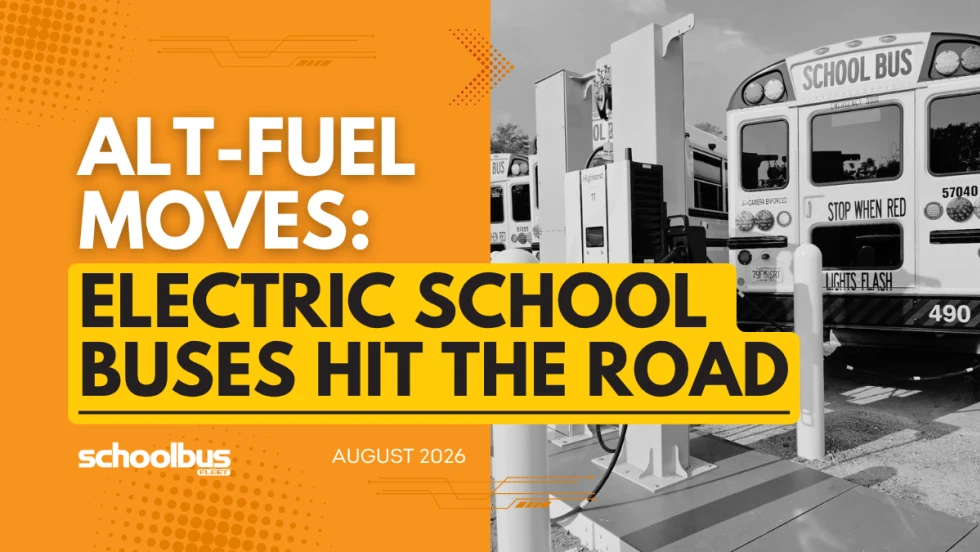
Alt-Fuel Moves: Electric School Bus Investments Hit the Road
See which districts across the U.S. are putting electric school buses into service, expanding charging infrastructure, and planning the next phase of fleet electrification.
Read More →
With Fuel Volatility Ahead, School Districts Turn to Propane
While diesel prices peaked above $5 this spring, districts with propane autogas-powered fleets paid under $2 per gallon, according to PERC.
Read More →
EPA Unveils Proposed Changes to 2027 Heavy-Duty Engine Rules
The federal agency has proposed changes to next year’s targets that would eliminate DEF derates, ease warranty requirements, and retain current NOx emissions standards.
Read More →
Alt-Fuel Moves: EV Charging & Infrastructure Projects Gain Momentum
The latest developments include new funding, charging infrastructure, utility investments, and fleet technologies designed to support the transition to electric school buses nationwide.
Read More →