




Green Fleets Across America 2009
For pupil transporters, “going green” not only benefits the environment and yields cost savings, it provides a healthier ride and an educational experience for students. Here, we showcase practices in place at school districts and contractors throughout the country.
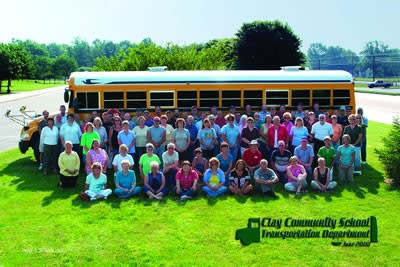
For more than 10 years, Clay Community Schools’ transportation department has recycled the old oil from routine oil changes performed on its school buses to heat its bus garage.
Green efforts reap savings
Clay Community Schools, Brazil, Ind.
For Clay Community Schools’ transportation staff, implementing environmentally-friendly practices has not only reduced fuel consumption and the amount of exhaust their school buses emit, it has resulted in substantial cost savings.
For more than 10 years, the department has saved used oil and recycles it to heat the bus garage in the winter. “We have natural gas, but if we used that to heat the building, it would cost a ton,” Transportation Director Frank Misner says. “This practice is probably cutting our heating bill by 80 percent.”
In addition, 15 of the district’s 75 buses were retrofitted with particulate filters several years ago and Chris McVay, lead technician, says the department will receive 10 more over the next few years.
The department implemented an anti-idling policy more than three years ago. Drivers only idle their buses in cold weather, and even then, McVay says the department has cut back on the amount of idle time allotted for each bus. It has reduced the time by 20 to 30 minutes, which, in addition to decreasing emissions output, saves around one gallon of fuel per bus. Clay Community Schools operates 56 school bus routes daily.
The department’s green efforts extend to its office practices as well. The staff has been using VersaTrans routing software for more than 15 years. Switching to an automated system has cut down on the amount of paper used and waste generated. For instance, Misner says he prints route information for substitute drivers, but they are required to bring back the pages when they have completed filling in for a regular driver so that the routes do not have to be printed multiple times.
The staff also makes it a point to perform simple acts to conserve energy, such as turning off the lights when leaving the facility. “It’s really just common sense,” Misner says.
— KELLY ROHER
Fleet Facts
School buses: 75
Students transported daily: 4,400
Schools served: 10
Transportation staff: 90
Area of service: Western central Indiana
Bus retrofits, decentralized parking, fuel cards and streamlined routes have helped Clayton County’s transportation department to be more efficient and more green.
Many reasons to go green
Clayton County Public Schools, Jonesboro, Ga.
Protecting the environment and saving money are some of the key reasons for going green. Clayton County (Ga.) Public Schools cites another important reason.
“We wanted to ensure that our vehicles are as clean as can possibly be to protect our most valuable resource, which is our students,” explains John Lyles, director of transportation for the school district. “We believe that transportation is an integral part of student achievement.”
To reduce its fleet’s emissions, Clayton County has retrofitted its buses with particulate matter filters, decentralized parking (dividing the county into four zones), expanded fueling options (with fleet fuel cards) and streamlined bus routes through GPS and routing software, among other initiatives.
As a result, the county has saved $250,000 annually, based on reduced fuel and maintenance costs. Lyles says that dead-head miles have been reduced more than 30 percent. “[Before,] our buses averaged about 19 miles round-trip to fuel at the transportation campus, and then they returned to their proper location. Now, the average distance from park to fuel locations, now that they’re decentralized, is about six miles.
“The drivers also see the benefit,” Lyles says, pointing to the alleviated stress by mapping their routes and staggering bell times to avoid the severe Atlanta traffic. Newly implemented anti-idling standards have seen appreciation as well. Principals have received calls from parents praising them for the practice, Lyles said.
The transportation department’s green efforts aren’t limited to the fleet itself. “We reduced paper and ink usages by networking everyone to one central copier,” Lyles said. “There was some concern initially because people were now having to get up and walk.”
He chuckles. “We actually saw a decrease in the items being printed.”
— JOE CROSBY
Fleet Facts
School buses: 525
Students transported daily: 32,000
Schools served: 61
Transportation staff: 650
Area of service: 143 sq. miles
{+PAGEBREAK+}
Colton Joint Unified School District’s 50 route buses are all powered by CNG.
A remarkable transformation
Colton Joint Unified School District, Colton, Calif.
Back in 1996, Colton (Calif.) Joint Unified School District ordered three compressed natural gas (CNG) school buses — the district’s first powered by the alternative fuel. Now, all 50 of the district’s route buses are CNG. The conversion was achieved with more than $6 million in grants, most of which was from the local and state air quality agencies.
Colton’s transportation manager, Rick Feinstein, says that the CNG fleet reduces pollution and saves money at the same time. The South Coast Air Quality Management District estimated that Colton has cut annual emissions by 26,000 pounds of nitrous oxides and 2,000 pounds of particulate matter.
Regarding financial savings, the average price of CNG in the 2007-08 school year was about $1.09, and that’s before a 50-cent per gallon federal rebate for the alternative fuel.
Feinstein says that CNG also reduces labor costs in the fueling process. Instead of drivers having to wait in line to fill their bus at a pump, they connect the bus to a fuel hose at their parking stall, and the bus is filled overnight. This saves the district about 50 hours of labor per week, Feinstein says.
Colton follows the California Air Resources Board’s bus idling rules, which require school bus drivers to turn off their engines immediately at schools and to not idle more than five minutes at other locations.
To help in enforcing the rules, the district recently began using a GPS system to monitor bus idling and speed.
“Our veteran drivers are very aware of the benefits of our green fleet,” Feinstein says. “Our GPS system helps us reinforce green management behaviors not only training new drivers but among our entire staff.
“The most important fact is that we’re transporting children, and studies show that their lungs are more affected by pollution,” he adds. “It’s also a good example for students, who are now learning about living greener.”
— THOMAS MCMAHON
Fleet Facts
School buses: 60
Students transported daily: 6,600
Schools served: 27
Transportation staff: 70
Area of service: 48 sq. miles
Madeline Ruggiero (front row, right), contract manager at First Student’s operation in Hamden, Conn., and her employees use energy-efficient fluorescent light bulbs in their offices.
Operation targets retrofits
First Student Inc., Hamden, Conn.
First Student Inc.’s Hamden, Conn., branch has made great progress in its effort to “green” its fleet and facility.
Last year, the operation’s school buses were retrofitted with emissions-control equipment through the city of Hamden’s partnership with ICLEI — Local Governments for Sustainability USA.
ICLEI worked with five local governments in the Northeast on an initiative to reduce school bus emissions in the region. The city was one of the five communities to receive funding from the EPA’s Clean School Bus USA program. Hamden received a $20,000 grant, which, after partnering with First Student’s Hamden operation, was used to retrofit 25 of the branch’s school buses with diesel oxidation catalysts. Employees at the Hamden branch donated the labor to install the equipment.
Moreover, based on the success of the ICLEI initiative, the Connecticut Department of Environmental Protection provided First Student’s Hamden branch with a grant to retrofit the remaining 32 active buses in its fleet.
The green practices at First Student’s Hamden facility are not only evident in its retrofit efforts. Madeline Ruggiero, contract manager, says the operation uses a vehicle wash system from TransClean Inc. to clean its buses. All TransClean systems include specially-formulated detergents that are environmentally friendly, and the systems themselves are designed to help protect the environment as well. “Our buses are put on a pad that recycles the water and filters the soap so that it doesn’t go into the drain,” Ruggiero explains.
The staff has increased energy efficiency in their offices by using fluorescent light bulbs, she adds. The operation has also been utilizing EDULOG routing software for more than a decade to cut down on paper usage and waste accumulation.
— KELLY ROHER
Fleet Facts
School buses: 110
Students transported daily: 6,700
Schools served: 1
Transportation staff: 115
Area of service: 33.1 sq. miles
{+PAGEBREAK+}
As FCBMRDD buses drop off students, signs remind drivers: “No Idling — Children Breathing.”
Green is only way to grow
Franklin County Board of Mental Retardation and Developmental Disabilities, Columbus, Ohio
The Franklin County (Ohio) Board of Mental Retardation and Development Disabilities (FCBMRDD) is proof positive that going with the fl ow can have a big payoff.
“We weren’t fighting this,” Paul Chenderlin, the board’s director of transportation, says about the decision to go green in 2003.
In addition to switching all of its vehicles to biodiesel, the organization created a “Green Team,” which is responsible for everything from overseeing the recycling of materials — including office computers — to utilizing energy-efficient light bulbs and installing bike racks for employees.
FCBMRDD Superintendent Jed W. Morison credits Mary Jo Kilroy, former county commissioner and now a U.S. congresswoman, with encouraging the board to apply for funds and move in the green direction.
In 2005, the board received a grant that assisted in the purchase of new, cleaner-burning vehicles and in making conversions of many of the existing buses in its fleet. The grant also helped subsidize the board’s fuel costs.
Currently, 80 percent of the FCBMRDD’s fleet has been equipped with some type of green initiative. Looking ahead, the board plans to heavily research other alternative fuel vehicles.
“We will really investigate what is going to be cost effective and, primarily, what is best for our riders,” Chenderlin says.
With the EPA’s mandate for further reduction in emissions on all newly manufactured diesel vehicles by 2010, Chenderlin is excited about growing toward a greener fleet. The FCBMRDD, he says, is willing to take the incremental steps necessary to become more eco-friendly. “I hope our experience will encourage others to be more green,” Chenderlin says.
— CAMELLA LOBO
Fleet Facts
School buses: 99
Students transported daily: 2,800
Schools served: 22
Transportation staff: 306
Area of service: 540 sq. miles
Kip’s Bus Service installed solar panels on the office roof to power the facility’s cordless phones, two-way radio and computers.
Company makes great strides
Kip’s Bus Service Inc., Curwensville, Pa.
Kip’s Bus Service was started by current owner Bill Gourley’s father, Clifford “Kip” Gourley, more than 50 years ago. Over the decades, the company has remained well-connected with the surrounding community, as most of the employees attended the schools they now serve in the Curwensville (Pa.) Area School District.
The “greening” of Kip’s began 10 years ago when the company had a power failure and lost radio communication with the buses out on the road. The office phones also lost power because the handsets are cordless. Bill Gourley decided to install solar panels on the roof of the office to power the telephones, two-way radio and computers.
Gourley also makes biodiesel from used vegetable oil collected from local restaurants. “I have been experimenting with biodiesel for about seven years,” he says. Although he appreciates the fuel’s environmental benefits, “in reality it was the out-of-control diesel fuel prices that was the driving force,” he explains. The company blends the homemade biodiesel with regular diesel in varying amounts according to outdoor temperatures.
When temperatures are cold, the garage is heated by a waste oil burner. “The waste oil burner was a natural response to a problem we have of trying to find a responsible manner of disposing of our waste oil from oil changes and get some heat in our garage in the bargain,” Gourley says.
Kip’s has also had an anti-idling policy in place for several years, which limits idling to a five-minute warm up in the morning, or up to 15 minutes in extremely cold weather. Drivers also shut the engines off when dropping off and picking up students at school.
Lastly, as the company is located in a rural area of Pennsylvania, the idea of keeping farm animals is not a foreign concept. Gourley raises chickens at the bus lot for the fresh eggs, which he shares with the drivers and other employees. Handily, all paper waste from the office is shredded and reused as nesting in the chicken coop.
— CLAIRE ATKINSON
Fleet Facts
School buses: 17
Students transported daily: 1,100
Schools served: 3
Transportation staff: 27
{+PAGEBREAK+}
Portland Public Schools runs most of its fleet on biodiesel but has also begun acquiring CNG buses like this one.
Putting children first
Portland Public Schools, Portland, Maine
The “going green” issue was just a blip on the radar in 2002 when Kevin Mallory, transportation director of Portland (Maine) Public Schools (PPS), was the first in the state, he says, to enact a no-idling policy for school buses servicing the district.
Since then, PPS has been consistently recognized by the EPA for its role as a leader in the state’s green bus initiative. In addition to its success in emissions reduction, the district worked with the city of Portland to designate the city as a “Clean Air Zone.”
“This was primarily aimed at the health of the children we transport,” Mallory says. He says 15 percent of the bus riders have asthma or other respiratory conditions.
In addition to eliminating idling while loading and unloading students, the policy also focuses on utilizing the shortest routes in order to limit students’ exposure to fumes.
Having retrofitted its older buses and after completing the transition to biodiesel in its fleet, it is no surprise that PPS is homing in on further technology in clean-burning vehicles — the compressed natural gas (CNG) bus. The district has had three CNG buses since 2006 and plans on purchasing more in the next couple of years. “But I know we can go way beyond that,” Mallory says. “CNG technology is just a bridge to the future of bus transportation.”
PPS was able to strike a deal with Portland’s public transit system that allows the district to fuel and service its school buses at the transit system’s natural gas station. “We were very lucky,” Mallory says. “Portland is very supportive of the green movement.”
Mallory stresses the importance of providing a reliable infrastructure to support the transportation industry’s clean energy efforts, such as funding to invest in CNG technology and creating more fueling stations. “Because grants are not enough,” he says.
— CAMELLA LOBO
Fleet Facts
School buses: 27
Students transported daily: 2,700
Schools served: 15
Transportation staff: 31
Area of service: 20 sq. miles
Red Lion Bus Co. has made great strides in the efficiency and environmental friendliness of its facilities, resulting in significant cost savings.
Green office and shop
Red Lion Bus Co., Red Lion, Pa.
With 98 school buses in daily operation, Red Lion Bus Co. President Dennis Warner saw an opportunity in implementing green practices. “There’s significant potential there for conserving and limiting fuel consumption,” Warner says.
Although the company already has an anti-idling policy in place, Warner says they recently put out a notice to staff about a state law going into effect in February that limits idle time to five minutes. “It fits right in with what our idling policies have been for some time,” he says. “Before, we said drivers can start up a bus and idle while they do their pre-trip inspection, which they should be able to complete in five minutes, more or less.”
In addition, engine block heaters at all three bus facilities are temperature- and timer-controlled, saving power and fuel. Similarly, the company is in the process of adjusting all engine governors to a lower top-end speed.
Maintenance Fleet Supervisor Bill Svoboda reports that the 10,000-sq. ft. maintenance facility is heated entirely with waste oil generated by the fleet, representing an annual savings of $8,000 to $10,000. “The addition of a second waste oil furnace and a 50-percent increase in our storage capacity have eliminated the need to haul any waste oil from our facility,” he says. The company was able to offset some of the cost of the system with a state small business grant for reducing energy costs.
Red Lion Bus has also installed a parts-cleaning system that recycles the solvent using a distillation system, eliminating the hazardous waste associated with a solvent-based parts cleaner and the cost of waste disposal.
Lastly, all waste paper from the office is shredded, bagged and sent home with one of the company’s part-time school bus drivers, who is also a farmer.
“He and a neighbor farmer use it for bedding in animal stalls,” Warner explains. “Apparently, it’s pretty comfortable to the cows and horses.”
— CLAIRE ATKINSON
Fleet Facts
School buses: 98
Students transported daily: 8,700
Schools served: 3
Transportation staff: 146
Area of service: 250 sq. miles
{+PAGEBREAK+}
San Jose drivers (from left) Karla Villareal, Roberta Lopez and Madeleine Bettencourt pose next to a CNG bus. At the top of the photo are some of the district’s solar panels.
Worth the extra effort
San Jose Unified School District, San Jose, Calif.
Some liken the “green” movement to a fad. But for others, green isn’t en vogue — it’s standard operating procedure. Enter the San Jose (Calif.) Unified School District.
“It is part of doing business,” says Corrin Reynolds, the district’s transportation supervisor. “It’s what we do.”
Reynolds has been with the district nearly continuously since 1982, beginning as a driver. It was about 10 years ago that the district started making real efforts to clean up the fleet and increase recycling efforts. It was then that the transportation department began using grant money to purchase 32 compressed natural gas (CNG) buses to replace older, high-polluting buses.
Reynolds admits that maintenance on the CNG buses is more time-exhaustive for the mechanics, citing the complexity of their electrical systems versus the older, simpler diesel vehicles. But, “when the diesel prices were up so high, the CNG prices were considerably cheaper,” he says. “So there were some operational savings by using the CNG buses.”
Ten years ago, the district started reusing and recycling bus wash water, and the steam-cleaning residue is now collected and sent to a hazardous materials site. As with the CNG maintenance, there is an increased effort. “It’s more work to do [these things] rather than letting the contaminated water run off into the bay and harm the environment,” Reynolds says.
The district has continued to work on reducing emissions with the recent addition of particulate traps on all 18 diesel buses.
San Jose follows California’s anti-idling rules and has adjusted bus routes and bell times to avoid congestion. Many bus stops have been moved to strategically centralized areas to service more students at one pickup without requiring students to walk long distances or causing time- and fuel-consuming detours into neighborhoods.
Again, “there are drawbacks for being green,” Reynolds says, “but being green, being good for the kids and reducing emissions, is a benefit overall.”
— JOE CROSBY
Fleet Facts
School buses: 42
Students transported daily: 2,600
Schools served: 39
Transportation staff: 40
Area of service: 60 sq. miles
Staff from Manatee’s vehicle maintenance and recycling and energy departments display the cord of one of the district’s plug-in hybrid buses.
Green at every branch
School District of Manatee County, Bradenton, Fla.
In Manatee County (Fla.), the “commitment to green” extends to every branch of the school district.
For the transportation and vehicle maintenance departments, efficiency is a key factor in going green.
In the 2007-08 school year, the district was able to eliminate eight bus routes through district-wide bell time adjustment and route consolidation. The result was a reduction of 235,000 miles traveled compared to the previous school year.
The vehicle maintenance department has also reduced mileage and fuel use by refining its roadside response system and improving communication with drivers, resulting in fewer road calls.
Another green effort is the district’s anti-idling policy, which reduces students’ exposure to pollutants and cuts fuel consumption and engine wear. Reducing staff’s exposure to pollutants is also important. To that end, the vehicle maintenance department completed an indoor air quality test to confirm the adequacy of its exhaust ventilation system.
The department has also made recycling a priority, from lubricants and coolants to brake shoes to office paper.
Manatee runs all of its school buses on B20 biodiesel. In 2007, the district became the first in the nation to receive IC Bus’ plug-in hybrid school bus.
The school district created an energy and recycling department, which is charged with maximizing conservation and reuse opportunities. Through district-wide training and audits, the department was able to reduce energy costs by more than $1 million in its first year.
Manatee’s students also get involved in green efforts, volunteering for such activities as planting native flora.
“All these departments are really an extension of the classroom,” says Don Ross, associate director of vehicle maintenance. “The kids ride the bus, they see the recycling, they see all these things that we do. These are our future leaders, and hopefully we’re setting a good example.”
— THOMAS MCMAHON
Fleet Facts
School buses: 230
Students transported daily: 16,000
Schools served: 63
Area of service: 714 sq. miles
More Alternative Fuels
Fewer Electric School Bus Models Reshape the U.S. Market
WRI’s latest buyer’s guide points to a consolidating electric school bus market, but fewer options may reflect a maturing industry rather than fewer meaningful choices for school bus operators.
Read More →
The Fuel Budget You Can Actually Predict: How Propane Autogas Keeps Money in the Classroom
Learn how propane autogas helps school districts manage fuel costs with predictable pricing, lower maintenance, and reduced emissions from former transportation director Joel Stutheit.
Read More →
Hendrickson, Driventic Introduce New Electric Powertrain for School Buses
ELECTRAAX, the electrified, lightweight drive axle offers integrated ePowertrain efficiency and modular flexibility for Class 6–7 school bus use.
Read More →
The Mobility House Joins PowerFlex in Fleet Electrification Deal
The acquisition combines intelligent charging software, bidirectional charging expertise, and fleet electrification services to support the growing adoption of electric school buses across North America.
Read More →
Alt-Fuel Moves: Electric School Bus Investments Hit the Road
See which districts across the U.S. are putting electric school buses into service, expanding charging infrastructure, and planning the next phase of fleet electrification.
Read More →
With Fuel Volatility Ahead, School Districts Turn to Propane
While diesel prices peaked above $5 this spring, districts with propane autogas-powered fleets paid under $2 per gallon, according to PERC.
Read More →
EPA Unveils Proposed Changes to 2027 Heavy-Duty Engine Rules
The federal agency has proposed changes to next year’s targets that would eliminate DEF derates, ease warranty requirements, and retain current NOx emissions standards.
Read More →
Alt-Fuel Moves: EV Charging & Infrastructure Projects Gain Momentum
The latest developments include new funding, charging infrastructure, utility investments, and fleet technologies designed to support the transition to electric school buses nationwide.
Read More →
Alt-Fuel Moves: Fleets Power Up Beyond the Bus
See how districts are pairing electric buses with charging, solar, and V2G technology to cut costs, boost resilience, and unlock new fleet value.
Read More →
What the EPA’s Updated Clean School Bus Program Means for Fleet Electrification in 2026 and Beyond
A guide to the EPA’s evolving school bus grants, including how the Trump administration changed funding priorities and how school districts can prepare for future bus purchases.
Read More →