




Related: School Bus Sales Show Growing Demand for Type As, Electric
Maine Bill Seeks to Transition State to Electric School Buses
L.D. No. 1894 would set a goal for the state Department of Education to develop rules on bids, specifications, charging stations, and a maintenance training program, and to complete the transition by 2040.

Nicole Schlosser・Former Executive Editor

L.D. No. 1894 would require the Maine Department of Education to transition of all of the state’s public school buses to electric. Shown here is one of Chico (Calif.) Unified School District's Blue Bird Electric Vision school buses. File photo courtesy Blue Bird
2 min to read
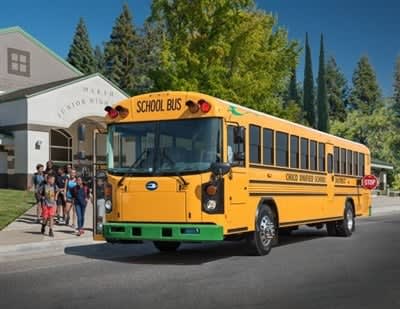
L.D. No. 1894 would require the Maine Department of Education to transition of all of the state’s public school buses to electric. Shown here is one of Chico (Calif.) Unified School District's Blue Bird Electric Vision school buses. File photo courtesy Blue Bird
AUGUSTA, Maine — A bill here seeks to facilitate the transition of all of Maine’s public school buses to electric school buses beginning this year.
L.D. No. 1894, sponsored by Sen. Eloise Vitelli, would set a goal for the Maine Department of Education (DOE) to make the transition by 2040; develop rules governing electric bus bids, specifications, and charging stations, as well as a maintenance training program; and begin the process this year. The bill requires the DOE to put aside a percentage of available resources for "small" electric school buses “with a gross vehicle weight rating of 10,000 pounds or less, as replacements in or additions to the school bus fleet in the 2020 request for proposals.”
Kelli Deveaux, the director of communications for the Maine DOE, told School Bus Fleet that the agency and administration “supports the concept and vision of and encourages the initial conversations about the bill.”
Pat Hinckley, the facilities, safety and transportation administrator for the DOE, was among more than a dozen people who submitted testimony for a hearing on the bill on Jan. 15. In her testimony, Hinckley stated that the agency has concerns with L.D. No. 1894 as it is currently written. The concerns, Hinckley stated, are related to an expected need for more funding as well as creating and facilitating technical training sessions.
“The expenses associated with these efforts would be shared by the [DOE] and local municipalities,” Hinckley added in her testimony.
The bill was submitted to the state Senate on Dec. 20 and referred to the Committee on Education and Cultural Affairs, according to the Maine Legislature’s website. It includes an emergency clause that refers to the “substantial and immediate” threat from climate change “to the economy, natural resources, and public health of the state.” The clause would spur the legislation to take effect as soon as the bill is approved.
Approximately 3,156 yellow school buses run in the state, according to recent research conducted by School Bus Fleet.
This bill follows a piece of legislation in Virginia that would establish a grant program to help schools to replace all their diesel buses with electric buses by 2030 and would help recipients share information about their experiences with the alternative-fuel vehicles.
Meanwhile, as SBF previously reported, nearby Vermont selected three school districts and one transit agency for an electric bus pilot program that is supported by Volkswagen (VW) settlement funds in December. The two-year pilot program will be administered by the Vermont Energy Investment Corp. to evaluate electric school and transit bus operations in the state.
More Alternative Fuels
Bipartisan Bill Seeks to Extend Clean School Bus Program Through 2031
The proposed legislation would renew federal support for cleaner school buses as districts navigate funding uncertainty, rising fuel and infrastructure costs, and fleet replacement needs.
Read More →
Alt-Fuel Moves: Electric Bus Rollouts, Bidirectional Charging & Propane Growth
See which fleets are adding electric and propane school buses as districts and operators invest in charging infrastructure, bidirectional technology, and alternative-fuel expansion.
Read More →
Nobody Told Diesel Prices They Were Supposed to Come Down
With diesel prices surging, school bus fleets have new reason to stress-test fuel costs, consider diversification, and calculate what each route really costs to operate.
Read More →
Why Gasoline School Buses Are Making a Comeback
Gasoline is gaining ground in full-size school buses. See how today’s options stack up against diesel on cost, maintenance, emissions, performance, and more.
Read More →
EPA Opens $180M DERA Funding Round for Diesel Upgrades
The 2026 Diesel Emissions Reduction Act program seeks applications from eligible organizations to accelerate the retirement of legacy diesel vehicles.
Read More →
The Secret Life of an Electric School Bus Battery
Batteries change throughout years of daily routes, but degradation doesn’t necessarily mean the end. Here’s what operators should know about performance, safety, and second life.
Read More →
CALSTART and Forth Combine to Form Catalyst Mobility
The new name represents a renewed vision for the nonprofit focused on advancing clean, equitable, and affordable transportation solutions that move people and goods.
Read More →
Alt-Fuel Moves: New Buses, Charging Hubs & Real-World EV Testing
Propane and electric school bus deployments continue to grow as districts add new vehicles, expand charging infrastructure, and gather more real-world operating data.
Read More →
Fewer Electric School Bus Models Reshape the U.S. Market
WRI’s latest buyer’s guide points to a consolidating electric school bus market, but fewer options may reflect a maturing industry rather than fewer meaningful choices for school bus operators.
Read More →
The Fuel Budget You Can Actually Predict: How Propane Autogas Keeps Money in the Classroom
Learn how propane autogas helps school districts manage fuel costs with predictable pricing, lower maintenance, and reduced emissions from former transportation director Joel Stutheit.
Read More →