





Green Means Go: How to Find Funding for Alt-Fuel School Buses
Georgia District Claims Connected School Bus First
The pilot program in the Fulton County Schools equipped two school buses with connected technology that prioritized the vehicles for green lights at intersections along routes in Alpharetta.
October 12, 2022
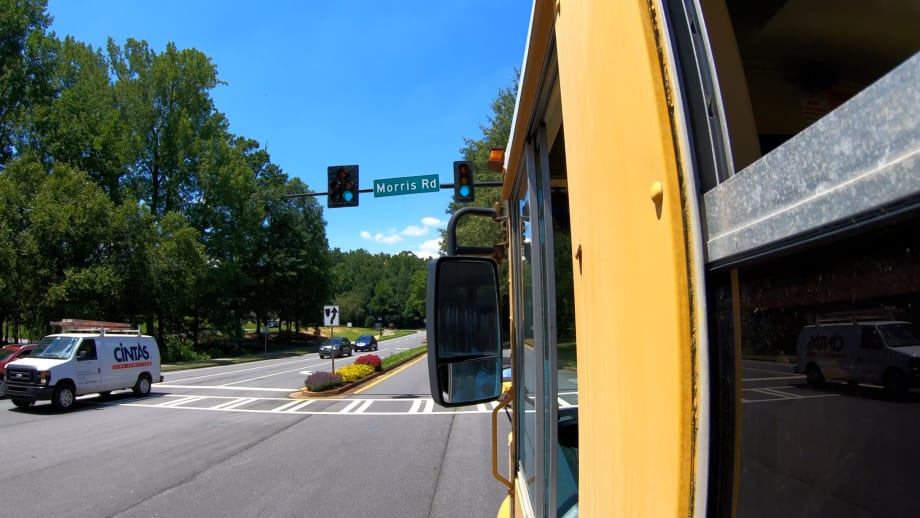
The study tracked a diesel IC Bus school bus and a propane Blue Bird bus as they followed routes through 62 connected intersections.
Photo: Applied Information
3 min to read
A first-of-its-kind test of school buses using connected technology to optimize traffic signals in a Georgia school district is being hailed as a success by its participants.
Fulton County Schools equipped two school buses – a diesel IC Bus and a propane Blue Bird – with connected vehicle-to-everything (C-V2X) transmitters supplied by Applied Information this spring and tracked performance at 62 intersections in the community of Alpharetta where buses could be flagged for priority to get green lights.
Passing Test with Changing Colors
During a webinar, participants in the study reported findings that included:
Enhanced on-board safety of students and bus drivers.
Improved route reliability and on-time performance.
More student participation in a breakfast program.
Reduced fuel consumption and harmful emissions.
The technology could also help ameliorate problems stemming from the national school bus driver shortage, according to a report based on the study.
“With about 86% of the nation’s school districts experiencing a driver shortage, improving the safety and efficiency of the fleet is critical,” said Trey Stow, director of transportation operations for Fulton County Schools. “The pilot showed we can use this technology to make our fleet more efficient and serve more students safely in a shorter amount of time, all while reducing our fuel bill and helping the environment.”
The report about the program, prepared by Kimley-Horn, stated that the experiment “demonstrated a clear and measurable reduction in route travel time for both school buses because of the decrease in total number of unscheduled stops and an increase in average speed of the bus along the route. Less time on the road and fewer bus stops equates to direct safety and mobility benefits for the bus driver, students, parents, nearby motorists, and the (Fulton County Schools). The pilot program enabled bus drivers to more frequently arrive at school on time and allow students to eat breakfast before going to class and starting their day.”
Said Bryan Mulligan, president of Applied Information: “The pilot program demonstrates the ability of the public and private sectors to work together and develop new and creative solutions for improving school transportation safety and efficiency. These solutions applied across the national fleet of approximately 500,000 school buses would prove significant time and fuel savings, as well as substantial reductions in CO2 emissions.”
Benefits for School Bus Drivers, Students, and Community
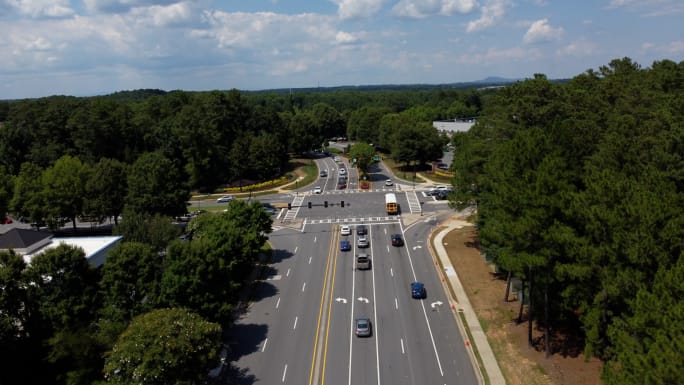
Bryan Mulligan, president of Applied Information, estimated a fleet of 900 school buses would cost about $4.5 million to refit with connected vehicle-to-everything transmitters.
Photo: Applied Information
Michael Ruelle of Kimley-Horn told webinar viewers that “better on-time performance led to less driver stress and more time to focus on student behavior and safe driving habits.”
Sean Slyman, director of connected services for IC Bus parent company Navistar, said his company is committed to safe and on-time transport of students.
“Partnerships and pilot programs such as this one … demonstrate our support of technologies that enhance school bus safety and efficiency,” he said.
Stow indicated that he would like to see the program expanded to include Fulton County’s entire fleet of 930 school buses, but that largely would depend on available funding. Mulligan estimated that it would cost about $4.5 million to complete aftermarket refits of a 900-bus fleet and about that much to equip intersections with the connected technology.
“It’s quite affordable within the scale of grants and investments, compared to the cost of building a bridge,” Mulligan said. “In principle, technology deployments are effective and inexpensive compared to the cost of concrete and asphalt.”
And, he said, it’s deployable today with that current technology.
More Safety

How to Build a Better School Bus Driver Training Program
Is it time to strengthen your driver training? Here’s how to pick the right talent and improve recruitment, retention, and safety. This video is brought to you by IC Bus.
Read More →
Recent School Bus Accidents Leave 2 Dead, 2 Injured
Four school bus crashes in Florida, Illinois, and Georgia highlight risks in transportation lots, at bus stops, and during student loading and unloading.
Read More →
Sponsored•September 8, 2026
When Every Second Matters, Clarity Keeps Routes Moving
From routine delays to urgent incidents, strong communication practices help drivers, dispatchers, schools, and families respond with confidence.
Read More →

What Happens When a School Bus Catches Fire — and What Can Help
School bus fires are rare but can be devastating. Learn how advances in fire suppression and asset protection help fleets detect fires earlier, reduce damage, and improve safety.
Read More →
Geotab Launches Tool to Help Fleets Investigate Road Incidents
Geotab Investigations combines telematics data, video, documents, and other evidence to help fleets reconstruct incidents, resolve claims, and determine what happened.
Read More →
Texas Sixth Grader Wins 2026 National School Bus Safety Poster Contest
Sai Darshana Yekolu of Moseley Middle School in Prosper, Texas, was named the newest winner for her artwork, bringing the theme of “Safe Rides, Everyday Heroes” to life.
Read More →
Sponsored•August 27, 2026
Doing More With Less: How Transportation Directors Can Prioritize Safety Amid Budget Uncertainty
With diesel prices soaring and nearly one-third of transportation directors expecting budget cuts, maintaining student safety has never been more challenging. Download this guide to learn how leading districts are prioritizing risk, funding critical safety technology, and building stronger budget cases with data.
Read More →
Walton County Schools Adds Gatekeeper Stop-Arm Enforcement System
The Florida district will deploy Gatekeeper’s updated Student Protector technology, which now incorporates AI to improve video evidence.
Read More →
How To Build a More Secure School Bus Yard During and After Hours
As thefts and overnight security threats continue, school transportation leaders are combining stronger operational practices with AI-enabled surveillance to better protect buses, facilities, and staff.
Read More →
FMCSA Names New Chief Safety Officer: What School Bus Operators Should Know
Steve Dowling is set to lead the federal agency's efforts to advance commercial motor vehicle safety and reduce crashes, fatalities, and injuries on the nation's roadways.
Read More →