




Florida targets grade crossing accidents
In the past five years, there have been more than 500 highway-rail grade crossing accidents, with 90 injuries and 80 fatalities, throughout Florida.

TALLAHASSEE, Fla. — In the past five years, there have been more than 500 highway-rail grade crossing accidents, with 90 injuries and 80 fatalities, throughout Florida.
In an effort to publicize the hazard and cut down on these accidents, Gov. Charlie Crist has proclaimed the state’s fourth annual Train Safety Awareness Week, which will begin on Sunday.
During the week, law enforcement personnel will join train agency and Operation Lifesaver staff to distribute information on the topic.
Police will enforce a zero-tolerance policy during the week, issuing tickets to motorists, pedestrians and bicyclists who violate state statutes at railroad crossings. Fines for violations range from $190 to $1,000.
Crashes with school buses
School bus-train crashes are rare, but they can be deadly. In 2000, three children were killed and four were severely injured when their school bus was struck by a freight train near Conasauga, Tenn.
A preliminary investigation indicated that the driver, Rhonda Cloer, did not stop at the railroad crossing as school buses are required by law to do. Additionally, an on-board recording revealed that the radio was playing loudly at the time of the accident.
Before she was set to go on trial, Cloer pleaded guilty to three counts of criminally negligent homicide and four counts of reckless aggravated assault.
Last month, a train at a rail crossing in Dexter, N.M., hit the back end of a school bus. Police said that all of the children on board were sitting toward the front of the bus. Three of them were slightly injured.
Efforts to improve safety
In 2002, the National Transportation Safety Board (NTSB) issued a recommendation to reduce the risks that passive grade crossings — those not equipped with warning lights or an audible warning system — pose for school buses.
The NTSB asked state governments to install stop signs at crossings, require the installation of noise-reducing switches on newly purchased school buses (to mute the radio, heater and air conditioner) and enhance driver training.
As of September 2007, 33 states had enhanced driver training, while 16 states had begun requiring the noise-reducing switches on new school buses. More generally, 21 states had taken actions that satisfied the recommendation.
As a result, the NTSB removed the issue from its Most Wanted List, but it said it would continue to work with the remaining states to implement its recommendation.
More Safety
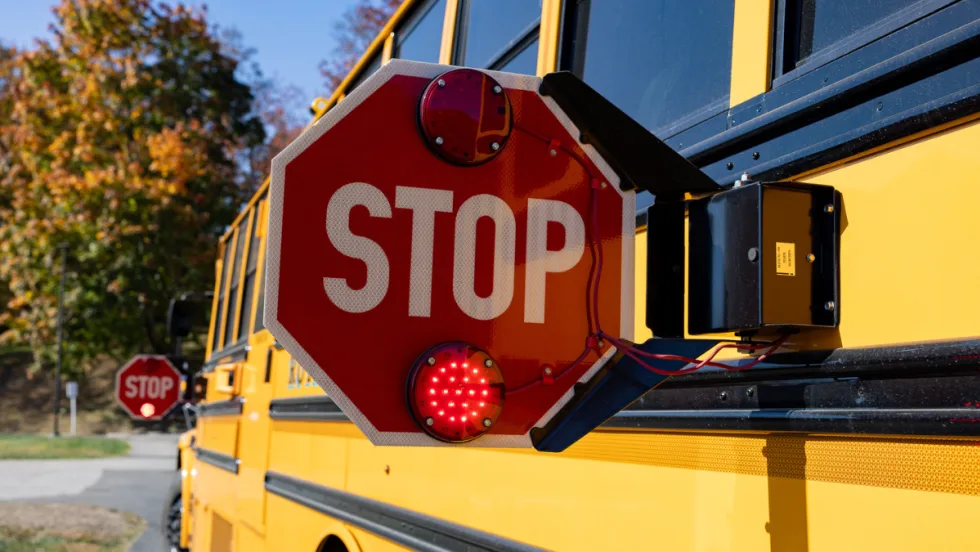
Illegal School Bus Passing Drops 24% in New York Districts
With fewer than 5% of citations involving repeat offenders, Westchester County officials said enforcement, education, and community partnerships are helping change driver behavior.
Read More →
School's Back. Here's What Happened to Traffic, Speeding & Distraction
What happens to traffic when school resumes? New data analysis examines changes in distracted driving, congestion, and speeding around schools.
Read More →
Geotab Expands Fleet Safety Tools With Video Coaching, Risk Insights
New safety and video capabilities aim to help fleet managers assess risk, support drivers, and take targeted action through video coaching, red-light violation detection, and more.
Read More →
How to Build a Better School Bus Driver Training Program
Is it time to strengthen your driver training? Here’s how to pick the right talent and improve recruitment, retention, and safety. This video is brought to you by IC Bus.
Read More →
Recent School Bus Accidents Leave 2 Dead, 2 Injured
Four school bus crashes in Florida, Illinois, and Georgia highlight risks in transportation lots, at bus stops, and during student loading and unloading.
Read More →
When Every Second Matters, Clarity Keeps Routes Moving
From routine delays to urgent incidents, strong communication practices help drivers, dispatchers, schools, and families respond with confidence.
Read More →
What Happens When a School Bus Catches Fire — and What Can Help
School bus fires are rare but can be devastating. Learn how advances in fire suppression and asset protection help fleets detect fires earlier, reduce damage, and improve safety.
Read More →
Geotab Launches Tool to Help Fleets Investigate Road Incidents
Geotab Investigations combines telematics data, video, documents, and other evidence to help fleets reconstruct incidents, resolve claims, and determine what happened.
Read More →
Texas Sixth Grader Wins 2026 National School Bus Safety Poster Contest
Sai Darshana Yekolu of Moseley Middle School in Prosper, Texas, was named the newest winner for her artwork, bringing the theme of “Safe Rides, Everyday Heroes” to life.
Read More →
Doing More With Less: How Transportation Directors Can Prioritize Safety Amid Budget Uncertainty
With diesel prices soaring and nearly one-third of transportation directors expecting budget cuts, maintaining student safety has never been more challenging. Download this guide to learn how leading districts are prioritizing risk, funding critical safety technology, and building stronger budget cases with data.
Read More →