




Despite Pandemic, Pupil Transporters Inform, Honor During National School Bus Safety Week
Activities of note included a briefing with law enforcement, distributing illuminated wristbands, and events recognizing bus drivers and monitors.

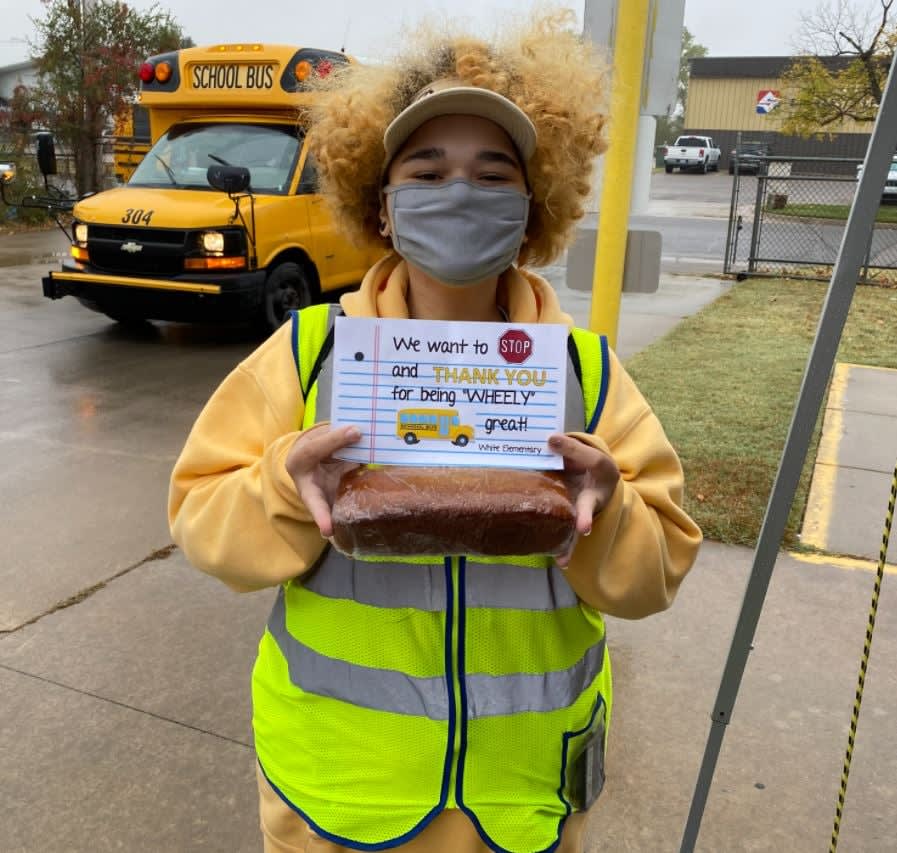
First Student hosted appreciation events at its locations across the U.S. Shown here is bus monitor Aryanna Hess, who participated in an event hosted by the school bus company's Wichita, Kan., location.
Photo courtesy Wichita Public Schools
Despite the COVID-19 pandemic, pupil transportation providers and suppliers nationwide still got the word out on student safety and recognized staff from Oct. 19 to 23 in honor of National Association for Pupil Transportation’s (NAPT’s) National School Bus Safety Week.
The theme for NAPT’s annual campaign this year was “Red Lights Mean STOP!”
School districts nationwide held school bus safety and evacuation drills, and, along with students, gave special recognition and shout-outs to drivers.
School bus contractors marked the occasion with activities that included a safety briefing with local law enforcement; new websites outlining COVID-19 safety measures and thanking school bus drivers and monitors; educational coloring sheets and books for students; an infographic on illegal passing statistics; posting bus safety trivia on Facebook; and distributing reflective wristbands to students.
On Oct. 19, First Student held a public safety briefing in Kansas with the Wichita Police Department. Renee Boydo, the training program manager of First Student; Nathan Emory, City of Wichita Transit senior communications specialist; and Sgt. Jesse Hancock, a commander of the Wichita Police Department Traffic Section; spoke at the event.
Boydo emphasized the importance of motorists remembering their role in keeping students safe, and reminded attendees that it is a community effort, as shown in a Facebook Live video of the event.
“Thousands of students here in Wichita begin and end their school day on one of those big yellow buses. Despite the size and the bright yellow color, they are often missed by distracted motorists,” she said. “When you see the yellow lights flashing and buses slowing down to stop to unload children and you see the red lights, that means that there are students actively loading and unloading.”
Boydo also asked parents to review school bus safety practices with their children.
“Talk about the 10-feet danger zone around that school bus and what they can do to be safe while loading and unloading from the bus,” Boydo said.
Emory discussed Wichita Transit's partnership program with local schools to transport students, and mentioned that all their bus stops are curbside so that students don’t have to cross the street to get to the bus.
Hancock told attendees that officers would be out on the roads looking for school bus safety violations and reminded motorists that the bus’s red lights and extended stop arms are a signal to stop in both directions on a roadway.
“We can’t control what the kids do, but we can control what the cars do,” Hancock said. “Stop for the bus, slow down when you see the yellow lights.”
Even with the COVID-19 pandemic, there are hundreds of elementary school students and special-needs students back in school, he added.
“Kids are out and they’re riding the buses, and we need to keep them safe,” he said.
First Student locations across North America also hosted driver appreciation events and featured five days of bus safety trivia on its Facebook page.
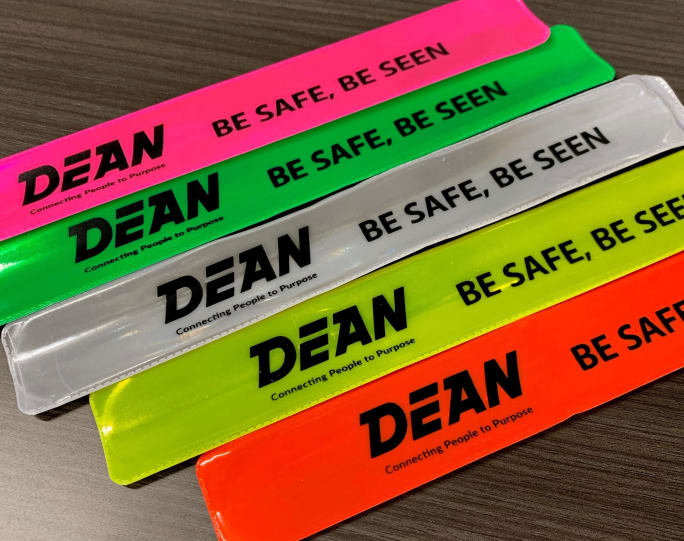
Lansing, Mich.-based Dean Transportation supplied a total of 5,000 reflective wristbands to 11 school districts to help make students more visible at bus stops.
Photo courtesy Dean Transportation
Meanwhile, Lansing, Mich.-based Dean Transportation distributed a total of 5,000 reflective wristbands to 11 school districts to make students more visible at bus stops.
The company also shared a flyer on the school bus danger zone and safety stickers as well as safety information with schools, staff, and the community on its website and Facebook page. In addition, Dean Transportation directed its Facebook page users to a website it created that encourages thanking bus drivers and monitors with personalized notes.
Student Transportation Inc. (STA) also launched a new website in honor of National School Bus Safety Week: “Working Together to Stay Safe.”
The site, according to a news release from STA, is dedicated to providing customers and students with timely COVID-19 resources to help promote the necessary teamwork for safe and reliable student transportation.
Resources include student-focused information for classrooms and school hallways, and bus-focused information and resources to help students become familiar with the new bus environment and changes needed to ensure everyone is safe in response to the pandemic. The website also offers fun and engaging printoutsfor students that encourage everyone to “work together to stay safe.”
Additionally, smart fleet management technology supplier Zonar created a downloadable infographic that shares data on stop-arm violations and school bus safety during the COVID-19 pandemic.
Also, as School Bus Fleet previously reported, the three major school transportation associations that comprise the American School Bus Council (ASBC) — the National Association for Pupil Transportation (NAPT), the National Association of State Directors of Pupil Transportation Services (NASDPTS), and the National School Transportation Association (NSTA) — detailed school bus safety benefits and COVID-19 precautions taken by pupil transporters. The ASBC also chose Bryan Torres-Tavarez, a 12th grader at Stars Academy in Paterson, N.J., as the winner of its annual National School Bus Safety Week poster contest.
More Safety

How to Build a Better School Bus Driver Training Program
Is it time to strengthen your driver training? Here’s how to pick the right talent and improve recruitment, retention, and safety. This video is brought to you by IC Bus.
Read More →
Recent School Bus Accidents Leave 2 Dead, 2 Injured
Four school bus crashes in Florida, Illinois, and Georgia highlight risks in transportation lots, at bus stops, and during student loading and unloading.
Read More →
When Every Second Matters, Clarity Keeps Routes Moving
From routine delays to urgent incidents, strong communication practices help drivers, dispatchers, schools, and families respond with confidence.
Read More →

What Happens When a School Bus Catches Fire — and What Can Help
School bus fires are rare but can be devastating. Learn how advances in fire suppression and asset protection help fleets detect fires earlier, reduce damage, and improve safety.
Read More →
Geotab Launches Tool to Help Fleets Investigate Road Incidents
Geotab Investigations combines telematics data, video, documents, and other evidence to help fleets reconstruct incidents, resolve claims, and determine what happened.
Read More →
Texas Sixth Grader Wins 2026 National School Bus Safety Poster Contest
Sai Darshana Yekolu of Moseley Middle School in Prosper, Texas, was named the newest winner for her artwork, bringing the theme of “Safe Rides, Everyday Heroes” to life.
Read More →
Doing More With Less: How Transportation Directors Can Prioritize Safety Amid Budget Uncertainty
With diesel prices soaring and nearly one-third of transportation directors expecting budget cuts, maintaining student safety has never been more challenging. Download this guide to learn how leading districts are prioritizing risk, funding critical safety technology, and building stronger budget cases with data.
Read More →
Walton County Schools Adds Gatekeeper Stop-Arm Enforcement System
The Florida district will deploy Gatekeeper’s updated Student Protector technology, which now incorporates AI to improve video evidence.
Read More →
How To Build a More Secure School Bus Yard During and After Hours
As thefts and overnight security threats continue, school transportation leaders are combining stronger operational practices with AI-enabled surveillance to better protect buses, facilities, and staff.
Read More →
FMCSA Names New Chief Safety Officer: What School Bus Operators Should Know
Steve Dowling is set to lead the federal agency's efforts to advance commercial motor vehicle safety and reduce crashes, fatalities, and injuries on the nation's roadways.
Read More →