




Cummins receives EPA certification for 2010 engines
Several of the company’s heavy- and medium-duty engines, including the ISB6.7 and ISC8.3, which are used for school bus applications, meet the agency’s near-zero emissions level requirement. Cummins has utilized selective catalytic reduction technology to meet the EPA’s 2010 standards.

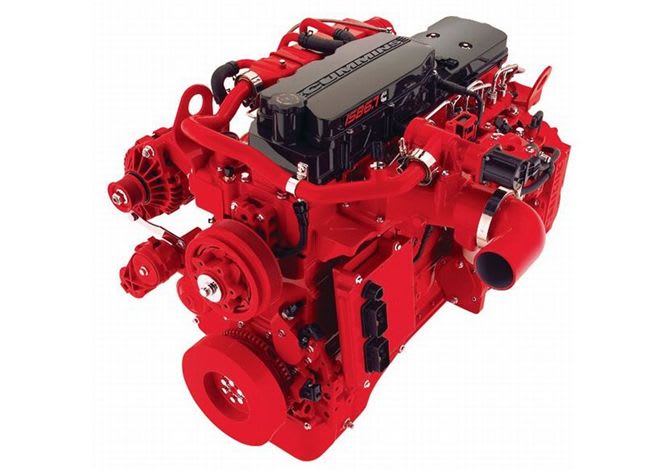
COLUMBUS, Ind. — Cummins Inc. has received EPA certification for its 2010 heavy-duty big-bore ISX15 and MidRange ISB6.7, ISC8.3 and ISL9 engines.
The certification signifies that the Cummins 2010 engine lineup for on-highway applications meets the near zero-emissions levels required for all engines manufactured this year.
The ISB6.7 (pictured) and ISC8.3 models are used for school bus applications.
"Receiving the formal certificates is an important step in the process as we enter 2010 with customer-ready products," said Jim Kelly, president of engine business for Cummins. "This confirms that customers can be confident in the technology choice we've made to meet the new, more stringent emissions standards."
Cummins will utilize selective catalytic reduction (SCR) technology to meet the 2010 EPA standards. Cummins said it committed to using SCR technology because of a change in performance that provides a significant increase in efficiency and durability. Kelly said that the company expects to see an at least 5-percent fuel economy improvement for the ISX15 and up to 3-percent improvement for the MidRange products.
Cummins 2010 engines will include an enhanced cooled EGR system and a single VGT (TM) Turbocharger. The ISX15, ISL9 and ISC8.3 feature the Cummins XPI fuel system, and the ISB6.7 features an improved High Pressure Common Rail fuel system. A Cummins particulate filter is included along with the new SCR catalyst. Incorporating SCR technology will also require the use of Diesel Exhaust Fluid.
More Alternative Fuels
Bipartisan Bill Seeks to Extend Clean School Bus Program Through 2031
The proposed legislation would renew federal support for cleaner school buses as districts navigate funding uncertainty, rising fuel and infrastructure costs, and fleet replacement needs.
Read More →
Alt-Fuel Moves: Electric Bus Rollouts, Bidirectional Charging & Propane Growth
See which fleets are adding electric and propane school buses as districts and operators invest in charging infrastructure, bidirectional technology, and alternative-fuel expansion.
Read More →
Nobody Told Diesel Prices They Were Supposed to Come Down
With diesel prices surging, school bus fleets have new reason to stress-test fuel costs, consider diversification, and calculate what each route really costs to operate.
Read More →
Why Gasoline School Buses Are Making a Comeback
Gasoline is gaining ground in full-size school buses. See how today’s options stack up against diesel on cost, maintenance, emissions, performance, and more.
Read More →
EPA Opens $180M DERA Funding Round for Diesel Upgrades
The 2026 Diesel Emissions Reduction Act program seeks applications from eligible organizations to accelerate the retirement of legacy diesel vehicles.
Read More →
The Secret Life of an Electric School Bus Battery
Batteries change throughout years of daily routes, but degradation doesn’t necessarily mean the end. Here’s what operators should know about performance, safety, and second life.
Read More →
CALSTART and Forth Combine to Form Catalyst Mobility
The new name represents a renewed vision for the nonprofit focused on advancing clean, equitable, and affordable transportation solutions that move people and goods.
Read More →
Alt-Fuel Moves: New Buses, Charging Hubs & Real-World EV Testing
Propane and electric school bus deployments continue to grow as districts add new vehicles, expand charging infrastructure, and gather more real-world operating data.
Read More →
Fewer Electric School Bus Models Reshape the U.S. Market
WRI’s latest buyer’s guide points to a consolidating electric school bus market, but fewer options may reflect a maturing industry rather than fewer meaningful choices for school bus operators.
Read More →
The Fuel Budget You Can Actually Predict: How Propane Autogas Keeps Money in the Classroom
Learn how propane autogas helps school districts manage fuel costs with predictable pricing, lower maintenance, and reduced emissions from former transportation director Joel Stutheit.
Read More →