





ACT Expo 2026 convened May 4–7 at the Las Vegas Convention Center, drawing about 12,000 attendees and hundreds of exhibitors to showcase the newest fleet vehicles and technology.
Key Trends Shaping The Future of School Transportation: ACT Expo Analysis
What’s next for the school bus market? We walked the show floor in Vegas to find out. From AI and V2G to battery breakthroughs and cutting-edge software, here’s what stood out.
May 14, 2026

From software-defined vehicles to scalable V2G deployments, ACT Expo 2026 showed how quickly technology is changing the future of school transportation.
Credit:
School Bus Fleet
9 min to read
AI, EV, V2G, oh my. These buzzwords have dominated industry circles lately, and the buzz was even more heightened at last week’s ACT Expo.
I got to attend my first-ever ACT this year, and going in, I had no idea what to expect. What I thought was a mostly truck show turned out to have more school bus tools and technology on display than I ever would have guessed.
Vendors I hadn’t even heard of before are actively working in this space to advance alt-fuel adoption with lower-emission solutions and expertise. My eyes are open, and I’m excited to share the highlights with you!
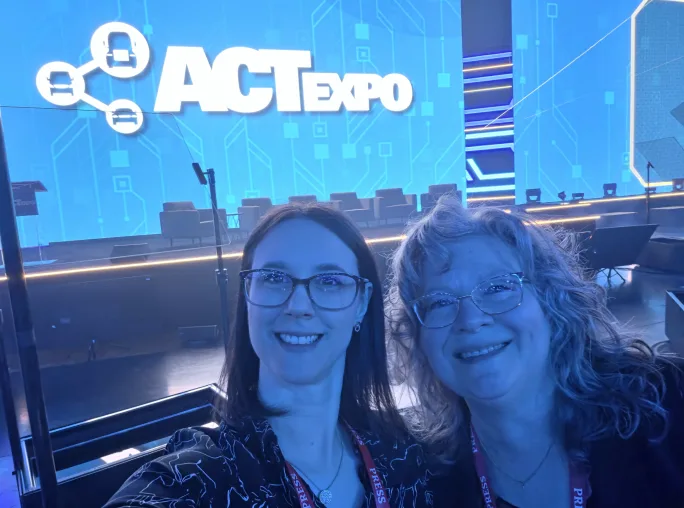
I was happy to join Deborah Lockridge of SBF's sister magazine, Heavy Duty Trucking, at ACT Expo to cover the highlights affecting both truck and bus fleets.
Credit:
Amanda Huggett
What dominated most of the discussions at ACT Expo? There were a few hot topics:
- Advancements in AI, including for both in-vehicle technology and tools like ChatGPT.
- Battery technology improvements and the capabilities of bi-directional charging.
- V2G and grid connectivity.
- Autonomous trucks (but not school buses, thankfully!).
- Fuel cost volatility.
- EPA 2027 regulations.
- The geopolitical climate and federal deregulation/shift from electrification projects, funding, and mandates.
- Other clean technologies complementing EVs, such as propane, hydrogen, and solar.
3 Trends Shaping the Future of School Transportation
1. Electrification still has some kinks, and continues to advance.
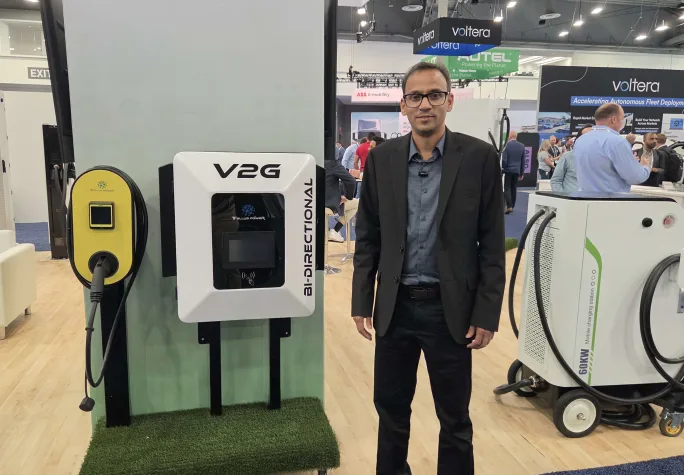
Bidirectional chargers was a big talking point at ACT. Tellus Power’s Srikanth Kanaparthi said that its latest project with Zum in Oakland with 74 V2G chargers provided about 2.7 megawatts of power. “[This has] given a hope for the industry that this can happen at scale,” he said.
Credit:
Amanda Huggett
In general, the U.S. EV market is behind global adopters like China and Europe, and the school bus market is even more behind automotive and truck fleet adoption.
Manufacturers of electric buses maintain that electric isn’t going anywhere. All four school bus OEMs at ACT — Blue Bird, Thomas, IC, and RIDE — say that interest in EVs remains, and that they will be valuable parts of their product portfolios in the future. Blue Bird predicts we’ll soon be seeing more charger availability and reliability and reduced energy costs. RIDE’s Frank Girardot says there is so much demand that they’ve had to hire more employees for the U.S. assembly line.
Srikanth Kanaparthi, Tellus Power’s senior VP of technology, is pleased with how the EV market and battery development have evolved in the past 10 years. As bidirectional charging continues to catch on and V2G projects advance, it presents hope that this can happen at scale. He believes we will see 3 to 5x growth for electrified school buses in the next three to five years.
Sasha Pejcic, BetterFleet managing partner for North America, agrees there's still strong interest in electrification, evaluating where V2G makes sense, and in utilities being ready to receive electricity. “A lot of times there's a desire for V2G, but there's no G to accept the electricity,” he said. “That's part of the equation that still needs to be solved.”
Dion van Leeve, VP of engineering at Triz Engineering, acknowledged there is work left to do, like increasing battery density, for EVs to gain a foothold in the market.
While the upfront cost of an EV bus without grants is still exorbitant compared to diesel, many tout its lower cost of maintenance and TCO as worth it in the long run. The more the price comes down, the better the ROI with alt-fueled vehicles.
Meanwhile, V2G has moved from pilots into full-fledged deployments. Bidirectional chargers can now serve as a lifeline in the event of a natural disaster. Smaller, mobile units can even serve as temporary solutions while permanent infrastructure is put in place.
One anecdotal observation from repeat ACT attendees was that there were fewer infrastructure providers this year, likely due to industry consolidation and alignment on megawatt standards, signaling a maturing market.
Now, the question mark is what the future of federal funding for clean school buses will look like, as well as future EPA emissions targets. Most of the OEMs submitted comments to the administration and are waiting to see what unfolds next.
With pockets of the U.S. working through state electrification mandates, electric buses are still increasing market share. As more states add funding, it may have slowed as federal priorities have changed, but it will remain a viable option for fleets looking to operate with fewer emissions.
2. Non-electrifiers have plenty of options.
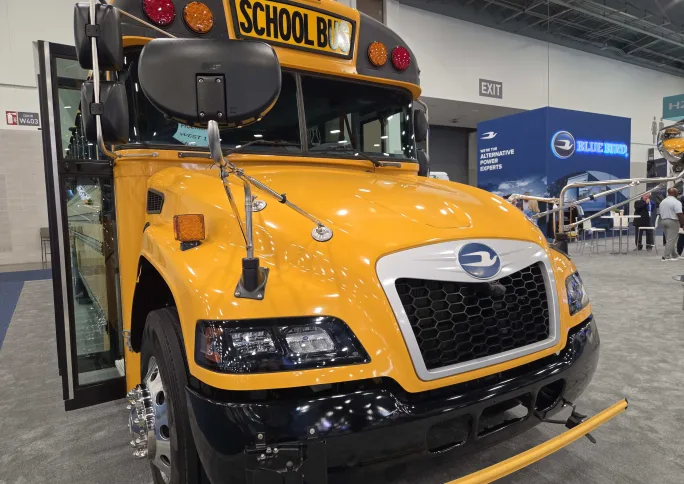
Blue Bird offers a school bus powered by diesel, gasoline, propane, or electric, offering fleets choice in what works best for them. Thomas Built Buses and IC Bus also have options in diesel, gasoline, or electric for full-size school buses.
Credit:
Amanda Huggett
We know that some states have rigorous electrification mandates, and that some districts want to be early adopters. We also know that some fleets are not ready to roll with electric yet, and they have plenty of other options.
Propane has seen a resurgence in popularity recently, and gasoline is growing in use as well (despite recent fuel increases, which we’ll keep monitoring), as evidenced by recent SBF survey data and Cummins’ new engine powering even more full-size gas buses soon.
What emerges is a picture of a diverse fleet: an operator employing multiple powertrains to match the right bus to each route without relying solely on a single fuel type or technology.
Mabel Feng, director of product management at battery provider Proterra, said that the need for multiple solutions is key for a strong future. And, with changing geopolitical views, she believes infrastructure and the industry supply chains are likely to be viewed as matters of national security.
At ACT, there were multiple hydrogen fuel cell vehicles for the truck and transit industry showcased. We know that there’s been very little traction for hydrogen vehicles in the U.S. school bus market. A little momentum from Pegasus years ago has since ceased. Will it pick up anytime soon? According to Van Leeve, “there may be an opportunity.” However, as with emerging technologies in new vehicle applications, development will come down to cost.
3. AI will guide proactive decision-making and refine operations for the foreseeable future.
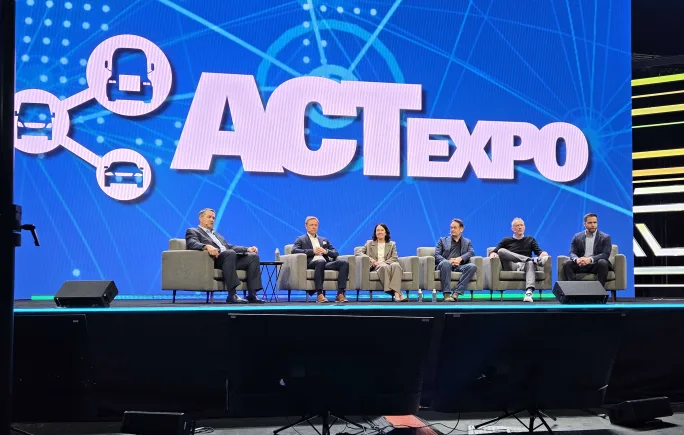
“Everything is powered by AI,” Erik Neandross (left), president of TRC, said from the ACT Expo main stage. He acknowledged that it’s still confusing, however, as this panel sought to dismantle hype from reality.
Credit:
Amanda Huggett
One thing became clear in many conversations: AI is no longer here to play; it’s here to stay, as tech advances and fleets adopt data-driven mentalities.
So many sessions talked about AI, and so many suppliers are offering AI-powered tools that make life easier, from route optimization to predictive maintenance.
For fleets integrating AI or LLMs into their everyday work, however, there must be safeguards in place.
“Know your purpose in using AI,” Sherry Sanger, EVP, strategy and marketing, Penske Transportation Solutions, said at Tuesday’s opening panel. “Don’t just say I have to use AI; focus on something you’re trying to get done.”
Jack Kennedy, CEO of Platform Science, encouraged attendees to evaluate what they are already good at and how it can be further enhanced by AI. He outlined the three key challenges as:
- Understanding your business.
- Picking the right tools.
- Figuring out where and how to implement them.
One of AI’s best use cases is its ability to quickly evaluate large data sets to identify trends and areas of improvement. But it always, always, always needs to be augmented by human judgment. Over-reliance without proper governance could lead to risks that we can’t afford to take.
Closing Thoughts
The transportation industry is in a constant state of transition. We must stay adept at change management to pivot appropriately as regulations change and new tech emerges, while keeping student and community safety top of mind.
State of Sustainable Fleets Market Brief
This year’s State of Sustainable Fleets report, unveiled at the expo, details an industry-building resilience through powertrain and fuel diversification amid an extended period of uncertainty.
Fleets across various industries are navigating a complex environment made up of federal policy reversals, tariff-driven cost increases, geopolitical volatility, the rollback of federal greenhouse gas vehicle standards, and changing federal funding.
“Yet across all this disruption, the data reveals a picture of an industry in structural adaptation rather than retreat,” the report authored by TRC, a WSP company, stated.
Key outcomes from the report include:
- Half of the fleets surveyed report using AI for route optimization, dispatching, predictive maintenance, and maintenance diagnostics, with users reporting measurable cost savings, greater vehicle uptime, and improved fleet utilization.
- Fleet AI adoption is expected to accelerate rapidly: survey respondents project that 35% of their fleets will be AI-enabled by 2027, nearly doubling from an estimated 20% across the fleet in 2025.
- Despite federal cuts, available funding for clean fleet projects remains well above pre-2022 levels: more than $5 billion in state, local, and utility programs is estimated annually through 2028. Low-carbon fuel standards (LCFS) in California, Oregon, Washington, and New Mexico continue generating meaningful revenue streams supporting multiple clean technology pathways.
- Renewable diesel (RD) and biodiesel (BD) — drop-in fuels that work in existing diesel engines and infrastructure — are displacing conventional diesel at scale: the two fuels combined to replace 74% of conventional diesel used in California transportation in 2024 and 71% in the first three quarters of 2025. More than half of annual fleet survey respondents now report using RD or BD, with near-100% B99 biodiesel adoption expanding in 2025.
- The propane vehicle fleet grew 3.1% in 2025, with school bus and upfitter markets continuing as key adoption sectors. The fuel delivered operational cost savings for 39% of propane fleet operators compared to the vehicles they replaced.
- Renewable propane use surged: 32% of propane-using fleets reported using it in 2025, up from just 10% in 2023 — a nearly threefold increase that reflects fleet demand for low-carbon, drop-in fuel options requiring no vehicle modifications.
- Propane is expanding into a new application as a power source for EV charging infrastructure, offering fleets an alternative or a temporary solution while awaiting utility grid connections with installation cost savings of up to 75% — a development that may accelerate BEV adoption in segments where grid access and utility timelines have been barriers to uptake at scale.
- Global market signals point to long-term BEV competitiveness in heavy-duty applications: BEVs now represent 22% of China’s HD truck market, and battery costs in that market have fallen to $90/kWh, a level widely cited as cost-competitive with conventional powertrains. Battery costs have fallen below $100/kWh in some markets, a leading indicator for future U.S. fleet economics.
Referencing the EPA’s Clean School Bus Program stops and starts, funding from pre-2024 rounds is showing results. As reported in the 2025 Market Brief, grant-funded projects were likely to drive a surge in electric school bus production over the next few years, and the 2025 data confirmed that trajectory. In total, 2,289 new electric school buses were registered in 2025, up 59% from the previous year, according to S&P Global Mobility.
In addition to the federally funded surge, states and utilities are supporting electric school bus deployments through new and updated grant programs that help reduce procurement costs. Illinois, Michigan, New Jersey, and New Mexico all provided state funds for electric school bus projects in 2025. Illinois’ ComEd awarded nearly $1 million for one local school district to add 27 electric buses and 28 chargers to its fleet.
Blue Bird reported an all-time record revenue and profit for the fourth fiscal quarter and year in 2025. The company delivered 901 electric-powered buses in FY 2025, and, by the end of the fiscal year, had about 680 EV buses in its firm order backlog, which supports its EV sales target for 2026. The unionization of Blue Bird’s Georgia plant in 2024 enabled the company to access an $80 million Domestic Manufacturing Conversion Grant specifically to expand electric school bus production and improve union jobs, which has also contributed to its successful year.
Thomas Built announced its first electric Type D school bus in October 2025, available for order with deliveries scheduled for early 2026.
International continues its CE Series electric bus success, offering bundled consulting, financing, and maintenance services.
After filing for bankruptcy protection in the United States and seeking creditor protection in Quebec in late 2024, Lion Electric shut down its Illinois manufacturing plant and auctioned off its equipment in May 2025. That same month, a group of investors acquired the company and rebranded it as LION. The company now produces electric school buses in Quebec. It continues to honor warranties for Quebec customers, but U.S. school districts that had previously purchased its buses were left without warranty coverage or ongoing support.
Subscribe to Our Newsletter
More Blog Posts
5 Video Interviews That Stuck With Me
After more than 100 episodes of The Route, SBF’s editor looks back at the unforgettable conversations and the school transportation lessons that we won’t forget.
Read More →
Leading with Compassion & Curiosity
What if the story you're telling yourself isn't true? Learning about emotional intelligence can improve communication and culture in school transportation and beyond.
Read More →
Suffering from Imposter Syndrome? You’re Not the Only One
Tips on fearing less instead of being fearless, and a powerful lesson from a group activity inspired by the 2025 NAPT keynote.
Read More →
My Own Trailblazers (and Why We Need More Women in Leadership)
From family influences to industry leaders, SBF’s editor reflects on the women who shaped her path and why representation in school transportation leadership matters.
Read More →
18 Ways to Support Your Transportation Team Beyond Thank-You Notes
Love the Bus Month is about more than thank-you notes. Learn how supporting the entire transportation team builds trust, culture, and retention year-round.
Read More →
When Home Is the Headline: Finding Our Way Forward in Minneapolis [Op/Ed]
In this season of uncertainty, leadership means empathy, critical thinking, and showing up. Here, our editor’s personal reflection on what matters most when times are tough.
Read More →
Seventy Years on the Road Together
School Bus Fleet’s editor reflects on the magazine and the industry’s legacy, change, and what endures.
Read More →
Through Change and Choice: Key Insights from 2025 and the Road Ahead
The school bus industry navigated big changes in 2025. Here’s how we adapted, what the data reveals, and what lies ahead in 2026.
Read More →
The Hidden Risks on the Road
Even the best school bus drivers can’t prevent every danger. As technology races and tempers rise behind the wheel, transportation pros face new challenges beyond the driver’s control.
Read More →
40 Things I Learned in My First Year as SBF Editor
Twelve months, almost 100 interviews and articles later, and countless lessons learned. Here are 40 key takeaways SBF’s editor learned about school buses, safety, and the people who keep students moving.
Read More →