




The Latest in Emission-Control Technology
From diesel particulate filters to diesel oxidation catalysts to crankcase filtration systems to a hybrid system, there are numerous products available to the industry. Their emission-reduction capabilities range from 20 to more than 90 percent, and they can be applied to a variety of engines and school buses.

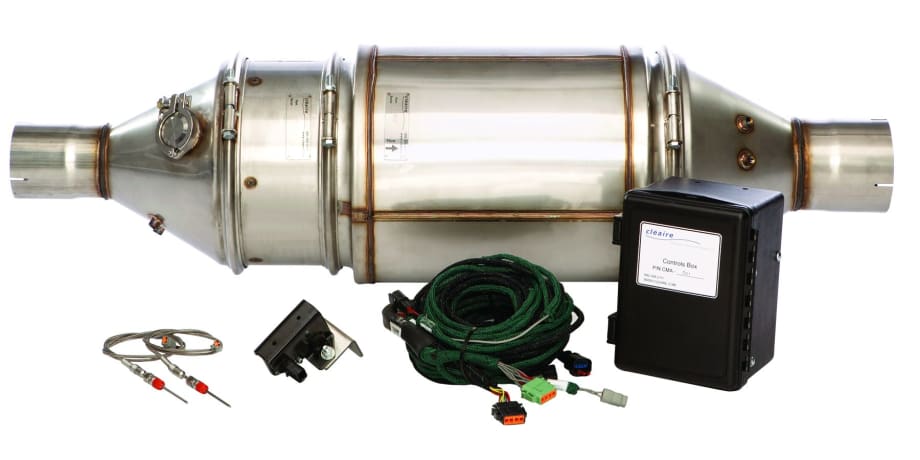
Cleaire Advanced Emission Controls’ Long-
Mile diesel particulate filter can reduce
particulate matter by more than 85 percent. Its
low exhaust temperature requirement makes
it compatible with lighter duty cycles.
In conjunction with transporting students to and from school safely, many pupil transporters are passionate about working to ensure that the air students breathe around buses is clean.
From diesel particulate filters (DPF) to diesel oxidation catalysts to crankcase filtration systems to a hybrid system for school buses, there are numerous products available to the industry that reduce buses’ particulate matter and emissions output.
SBF spoke with officials from four companies about their products’ features and specifications.
Cleaire Advanced Emission Controls LLC
Cleaire Advanced Emission Controls offers four DPFs that can be used as a retrofit solution for school buses: the LongMile®, the Horizon®, the Vista™ and the Longview.
Kevin Harris, business development manager, says the Horizon is the most popular model, but the company believes the LongMile will soon become the more popular option.
Both DPFs have been verified by the California Air Resources Board (CARB) to reduce particulate matter by more than 85 percent, and they have a modular design that facilitates service and de-ashing.
The Horizon is an active DPF with electric heater regeneration. It is verified for use in engine model years 1960 to 2006, but it cannot be used in two-stroke engines.
The LongMile DPF is a passive system that uses an exclusive sintered metal filter. It is verified for use in engine model years 1993 to 2006.
Harris says there are several features that differentiate the LongMile from other passive DPFs.
“For passive systems, you need to have a certain exhaust temperature profile, and typically it can be 260 degrees Celsius for 25 percent of the time. With the LongMile, it’s 260 degrees Celsius for only 7 percent of the time,” he explains. “This low exhaust temperature requirement provides broader engine coverage and greater operating flexibility for the fleet.”
In addition, the LongMile’s low backpressure makes it compatible with many engine applications, especially those with exhaust gas recirculation (EGR) technology. Finally, its high ash capacity extends filter deashing/cleaning by three times compared to channel wall-flow filters.
Harris notes that a school bus equipped with a well maintained and properly working engine will enable all of the DPFs to work more effectively and reduce maintenance.
“With a poorly tuned engine, the filter is going to fill up more quickly than with a well maintained engine. This means that you’re going to have to regenerate more often or clean out the filter more often,” he says.
[PAGEBREAK]
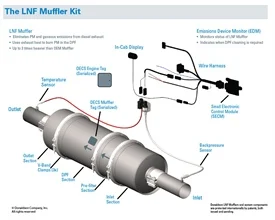
Donaldson Co. Inc.’s LNF
muffler system is designed for model year
1993 to 2006 high nitrogen oxide engines.
It can reduce particulate
matter emissions by more than 90 percent.
Donaldson Co. Inc.
Sales Manager Todd Lewis says Donaldson’s newest products for school buses are the LNF and LXF mufflers as well as the SEF Muffler System.
The LNF and LXF products reduce particulate matter emissions by more than 90 percent. The LNF muffler is designed for model year 1993 to 2006 high nitrogen oxide engines, while the LXF muffler is designed for model year 2002 to 2006 low nitrogen oxide engines. Both muffler kits are equipped with an Emissions Device Monitor that indicates when DPF cleaning is required. The monitor also sends alerts to the vehicle operator through an in-cab display when abnormal or undesirable operating conditions are detected.
Finally, the LNF and LXF mufflers are passive systems. The exhaust gas temperature profile for the LNF is: greater than 235 degrees Celsius for at least 40 percent of the time or greater than 300 degrees Celsius for at least 10 percent of the time. The temperature profile for the LXF muffler is: greater than 245 degrees Celsius for at least 40 percent of the time or greater than 310 degrees Celsius for at least 10 percent of the time.
Donaldson’s SEF Muffler System uses semi-active DPF technology and is designed for on-road, non-EGR model year 1991 to 2006 engines.
“The SEF requires a regeneration station. Depending on the duty cycle, they usually go two to three weeks before you have to plug them in,” Lewis says, adding that the SEF system is easy to install.
In addition to reducing diesel particulate matter by more than 90 percent, the SEF muffler is effective at reducing hydrocarbon and carbon monoxide emissions.
The junction box that comes with the SEF system houses the connections for the DPF regeneration station. The station can control up to two DPF regeneration cycles consecutively.
“One of the other new products we have is a closed crankcase filter system. It improves in-cab air quality by reducing the interior particulate concentration by about 20 percent,” Lewis says.
Donaldson’s Plastic Spiracle Crankcase Filtration Systems are CARB- and EPA-verified when combined with the company’s diesel oxidation catalysts.
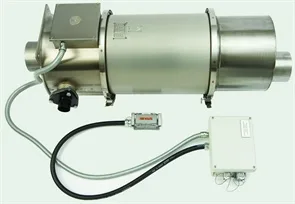
Engine Control Systems’ Purifilter Plus diesel
particulate filter is a hybrid — it’s not a completely active system. It works in a passive manner when the temperature of the exhaust is sufficient, meaning that it requires less plug-in intervals for regeneration.
Engine Control Systems
Engine Control Systems offers the Purifilter Plus and Purifilter DPFs for school buses, which are verified by CARB and the EPA. Sonya Clark, regional sales manager for Southern California, says they reduce particulate matter emissions by 85 percent.
She adds that the Purifiliter Plus, which can be used on school buses outfitted with 1994 to 2006 model year HD engines, including those with EGR technology, is the most commonly used between the two DPFs.
“The Purifilter Plus is a hybrid, so it’s not a completely active system. It works in a passive manner when the temperature [of the exhaust] is sufficient, requiring less plug-in intervals for regeneration — it’s not a daily plug-in interval,” Clark explains.
The Purifilter is a passively regenerating DPF that requires no operator interaction. Clark says this filter would benefit pupil transporters whose buses travel on a lot of rural routes.
[PAGEBREAK]
Engine Control Systems also offers AZ Purifier and AZ Purimuffler diesel oxidation catalysts for school buses. They are certified by CARB and the EPA for two- and four-stroke diesel engines, and they reduce particulate emissions up to 40 percent.
The AZ Purifier is contained in a separate converter that is installed upstream of the vehicle’s original muffler. The AZ Purimuffl er incorporates the catalyst into a direct-fit muffler that replaces the original vehicle muffler.
Dana Brewster, central east regional sales manager, says the Purimuffler is the more popular option between the two. It is made of stainless steel, which enables it to withstand harsh weather and road salt, and Brewster says Engine Control Systems builds a replica of the original equipment muffler that the Purimuffler will replace.
“If we need a muffler that’s a certain size and shape and we don’t have it in our system, our engineering team creates a new part so that we can spec it to match,” he explains, adding that he feels the company’s ability to provide a replica of the original equipment muffler is one of its strengths.
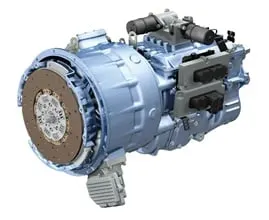
Pictured is the Hybrid Drive Unit for
Eaton’s hybrid system. It comprises the transmission and the motor/generator. The system can reduce emissions by more than 30 percent.
Eaton hybrid system reduces emissions, fuel consumption
Diesel particulate filters, diesel oxidation catalysts and crankcase filtration systems are not the only types of technology available to help school buses run cleaner. Another option to consider is operating buses powered by a hybrid system.
James Parks, manager of global communications for Eaton Vehicle Group, says the company’s hybrid system is available through IC Bus with its CE Series unit and through Thomas Built Buses with its Saf-T-Liner C2e unit.
IC Bus’ hybrid bus combines the Advanced EGR-equipped MaxxForce DT and an electric motor with a peak power output of 44 kilowatts.
Thomas Built’s hybrid bus is powered by a Cummins diesel engine, an Eaton transmission and an electric motor developed jointly by Thomas Built, Eaton and Freightliner Custom Chassis Corp.
“We use the electric motor to help launch and drive the bus from a stop, and then through regenerative braking we slow the bus down and recharge the batteries so there is always energy to launch and drive the bus,” Parks explains.
He adds that the hybrid system reduces fuel consumption and there is less wear and tear on the drivetrain, which can provide maintenance cost savings.
“The system is also quieter than a traditional bus, which is an added benefit,” Parks says.
Thomas Built’s hybrid Saf-T-Liner C2e can reportedly reduce emissions and improve fuel economy by 30 percent or more, while the IC Bus CE Series hybrid unit can reportedly provide up to a 30-percent improvement in fuel economy, up to a 35-percent reduction of NOx emissions and up to an 85-percent reduction of diesel particulates.
“School districts across the country are looking for ways to reduce their fuel costs and provide a greener footprint for their community without compromising passenger or driver comfort, and we think we’ve given them a pretty compelling story with the IC Bus and Thomas bus options. Customers of our hybrid systems have gone well over 100 million miles with reliable service,” Parks says.
More Alternative Fuels

CALSTART and Forth Combine to Form Catalyst Mobility
The new name represents a renewed vision for the nonprofit focused on advancing clean, equitable, and affordable transportation solutions that move people and goods.
Read More →
Alt-Fuel Moves: New Buses, Charging Hubs & Real-World EV Testing
Propane and electric school bus deployments continue to grow as districts add new vehicles, expand charging infrastructure, and gather more real-world operating data.
Read More →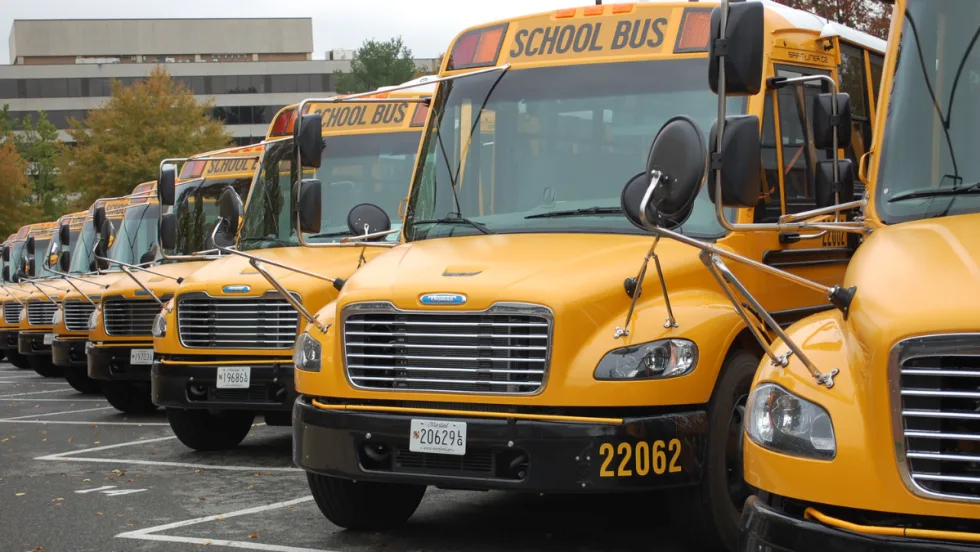
Fewer Electric School Bus Models Reshape the U.S. Market
WRI’s latest buyer’s guide points to a consolidating electric school bus market, but fewer options may reflect a maturing industry rather than fewer meaningful choices for school bus operators.
Read More →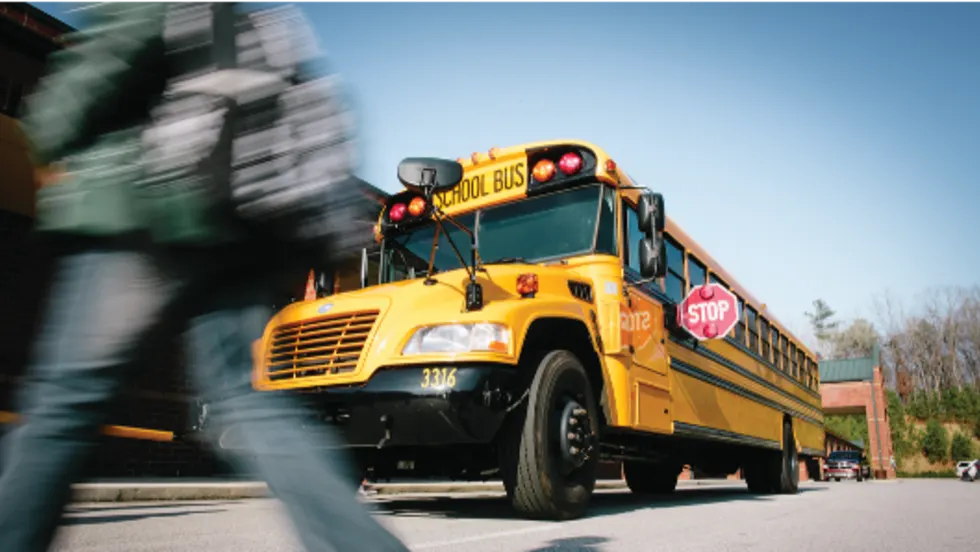
The Fuel Budget You Can Actually Predict: How Propane Autogas Keeps Money in the Classroom
Learn how propane autogas helps school districts manage fuel costs with predictable pricing, lower maintenance, and reduced emissions from former transportation director Joel Stutheit.
Read More →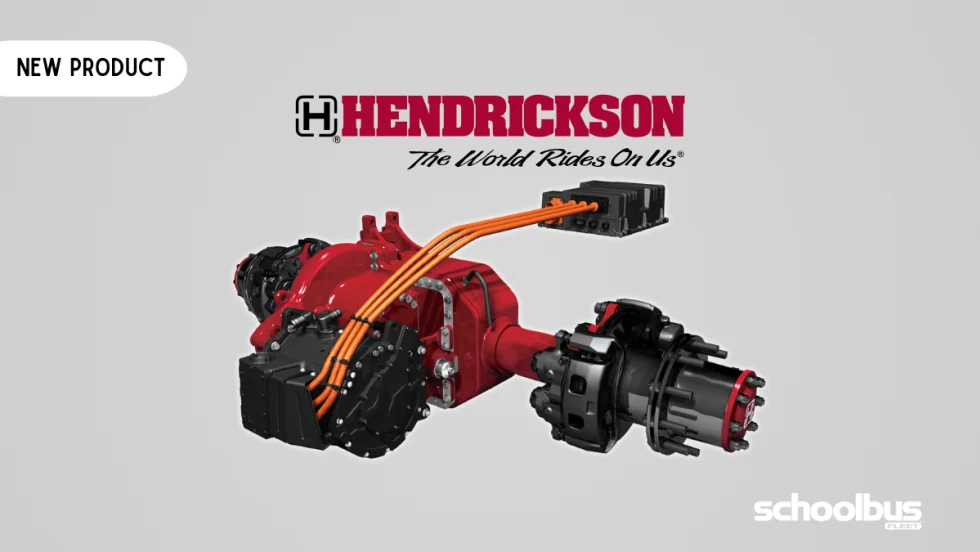
Hendrickson, Driventic Introduce New Electric Powertrain for School Buses
ELECTRAAX, the electrified, lightweight drive axle offers integrated ePowertrain efficiency and modular flexibility for Class 6–7 school bus use.
Read More →
The Mobility House Joins PowerFlex in Fleet Electrification Deal
The acquisition combines intelligent charging software, bidirectional charging expertise, and fleet electrification services to support the growing adoption of electric school buses across North America.
Read More →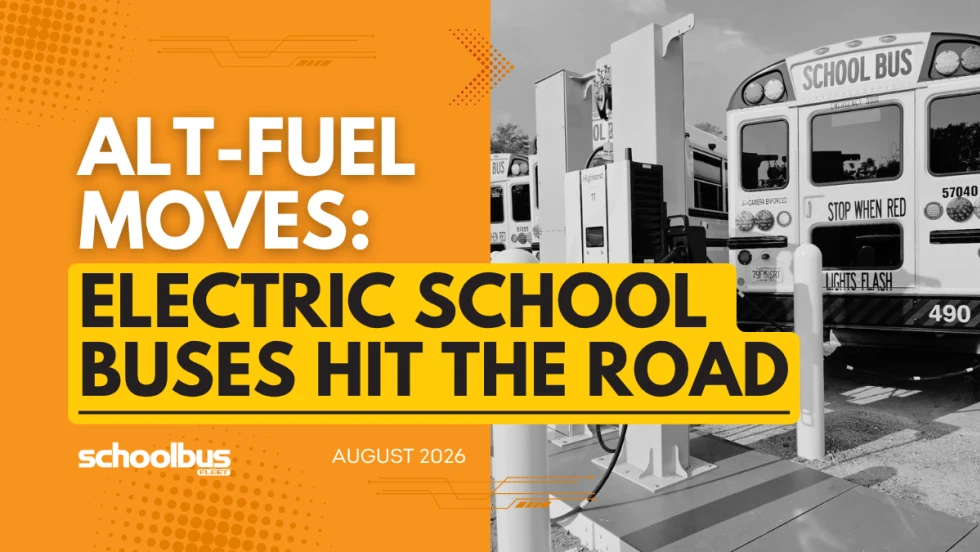
Alt-Fuel Moves: Electric School Bus Investments Hit the Road
See which districts across the U.S. are putting electric school buses into service, expanding charging infrastructure, and planning the next phase of fleet electrification.
Read More →
With Fuel Volatility Ahead, School Districts Turn to Propane
While diesel prices peaked above $5 this spring, districts with propane autogas-powered fleets paid under $2 per gallon, according to PERC.
Read More →
EPA Unveils Proposed Changes to 2027 Heavy-Duty Engine Rules
The federal agency has proposed changes to next year’s targets that would eliminate DEF derates, ease warranty requirements, and retain current NOx emissions standards.
Read More →
Alt-Fuel Moves: EV Charging & Infrastructure Projects Gain Momentum
The latest developments include new funding, charging infrastructure, utility investments, and fleet technologies designed to support the transition to electric school buses nationwide.
Read More →