




NAPT News & Views — Keeping NCST effective, relevant
For the work of the NCST to be relevant and to serve as a model of the school transportation industry’s best practices, interim amendments of the recommendations are essential.

Mike Martin is executive director of NAPT.
The 16th National Congress on School Transportation (NCST) will be held in Des Moines, Iowa, in May.
Chairman Murrell Martin and local host Max Christensen report that the congress will take place in a brand new, state-of-the-art conference center that is attached to a 250-room Holiday Inn. The hotel and conference center are directly across the street from Des Moines International Airport.
The last time I went to an NCST, I had to fly into Kansas City, Missouri, take a shuttle to the rental car center, pick out a car that fit me (which is no easy task when you are 6 feet 6 inches tall with a 36-inch inseam and a pumpkin-sized head), negotiate a reasonable price to rent it for a week, and then drive more than 80 miles to the University of Central Missouri in Warrensburg. Now, the conference site is directly across the street from the airport? I might just walk, even if it’s a bit of a hike, simply because I can. Seriously, how cool is that?
Murrell and the rest of the NCST Steering Committee decided to begin the congress for state delegations and other interested parties on Sunday, May 17, and end it on Wednesday, May 20. Start to finish, everything included, that’s four days total. That’s change for the better.
Congratulations to Murrell, Max and the others who helped resuscitate and rescue this historic event, which has been held 15 times since 1939 and is, to my knowledge, among only a handful of voluntary, sincere and legitimate efforts to self-regulate in any industry.
I’d also like to congratulate and thank NAPT’s representatives on the Steering Committee: Bill Tousley, the longtime and now retired transportation supervisor of Farmington (Mich.) Public Schools, former NAPT president and one of the most inventive thinkers I know; and indefatigable industry stalwart Ron Kinney from Sacramento, California, who has been an NAPT member for more than 35 years and graciously agreed to replace former NAPT President Don Carnahan on the NCST Steering Committee after Don’s untimely death last October. These guys are smart, experienced, politically savvy and collaborative, and they are not afraid to tackle challenges and solve problems. NAPT could not be better served, nor can the industry at large.
The goal of every NCST is progress. Here’s a brief history:
• The first conference, in 1939, was organized by New York’s Dr. Frank Cyr to formulate a set of recommended standards for school buses of 20 or more passengers.
• The 1945 conference revised the 1939 recommendations and added standards for small vehicles with capacities of 10 to 18 passengers. Both standards were further revised by the 1948 conference.
• There were additional revisions in 1959, and the 1964 conference added standards for school buses to be used in transporting students with disabilities.
• Delegates at the 1970 conference promulgated standards for school bus operation.
• The 1980 conference updated the standards for school bus chassis and bodies, rewrote the complete standards for the specially equipped school bus, and included definitions for Types A, B, C and D buses.
• The 1985 conference resulted in a uniform school bus accident reporting form, designed to standardize accident data reporting throughout the industry. It’s too bad that hasn’t happened.
• It seems to me that the 1990 conference was one of the most important. In addition to the usual array of technical issues, there were also a variety of procedural changes.
Between congresses, things happen and issues arise, many of which are too important to delay until the next NCST. For example, in 2005, NCST delegates added a new section to the National School Transportation Specifications and Procedures document on security and emergency preparedness — almost five years after Sept. 11, 2001.
Many members of the Steering Committee, including NAPT’s representatives, have long believed that for the work of the NCST to be relevant and to serve as a model of the school transportation industry’s best practices, interim amendments of the recommendations are essential.
A detailed amendment process was added to the NCST manual of operating procedures in 2010. However, it was inadvertently left off of the floor vote for the state delegations to consider, so most people are not aware of it.
Here’s how it works: A request to add a section to the document (other than an interpretation) must be submitted to the Steering Committee through a state delegation chairman, an NCST sponsoring organization or a Supplier Council member. The request must describe the item(s) to be added, including the specific page number and paragraph reference if addressed in the current National School Transportation Specifications and Procedures document. It must include a rationale that describes how the item(s) will improve safety, security and/or efficiency of school transportation. All requests must also include a cost-benefit analysis and risk assessment.
The process includes extensive safeguards, including multiple reviews and votes. In fact, every state has a 30-day period to offer comments and an additional 30-day voting period. At the conclusion of the voting period, the final draft will either be rejected by the delegations or accepted and published by the Steering Committee. Once an interpretation or amendment has been finalized and approved by the Steering Committee, the chairperson of the Steering Committee, or designee, sends a request to publicize the changes to a panoply of government, association and media organizations.
Sadly, the NCST did not receive even one request for an interim amendment to the 2010 proceedings. Maybe the amendment process is too cumbersome; I am not sure. I am sure, however, that it is not well known. The result is that 2015 NCST delegates will start where the 2010 delegates left off. That’s too bad, because a lot has happened in the last five years.
I hope delegates at the 16th NCST are informed specifically of the interim amendment procedure. For that matter, I hope the NCST website will include it in a prominent place on the home page and that the Steering Committee, individually and collectively, encourages everyone to use it.
Who knows? If we publicize and encourage people to use the interim amendment procedure, maybe I won’t have to walk across the street in Des Moines again. To paraphrase the famous 1980s ad campaign for the Yellow Pages, maybe I will be able to simply let my fingers do the walking.
More Management

EverDriven Launches Route Consolidation Calculator to Estimate Diesel Savings
As diesel prices hit record highs, the largest alternative transportation provider says a 10% route consolidation could save a 120-route district more than $78,000 a year in fuel alone.
Read More →
Zum Secures Continued Financing Support for School Bus Expansion
Generate Private Credit has financed approximately $75 million in school bus deployments across three states, supporting more than 500 buses as Zum expands across the county.
Read More →
Beyond Discipline: A Different Approach to Student Behavior on the Bus
After implementing a dean of students program in Oregon, North Clackamas is seeing positive improvements. Here’s how it worked. The Route is brought to you by IC Bus.
Read More →
A Dean of Transportation's Different Approach to Student Behavior on the School Bus
After implementing a dean of students program in Oregon, North Clackamas is seeing positive improvements on the bus. Here’s how it worked.
Read More →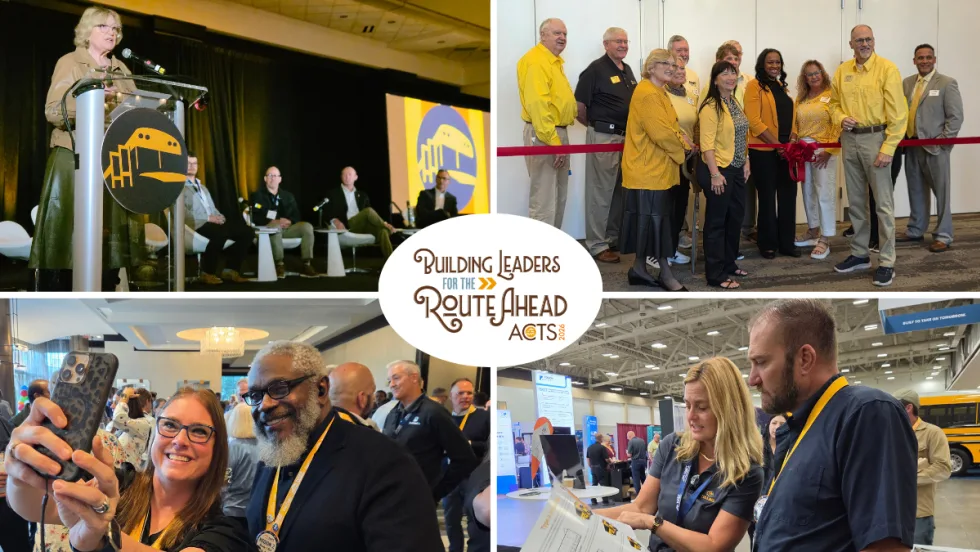
Inside NAPT ACTS 2026: Highlights from Louisville
From federal updates and student behavior strategies to new school bus technology and industry awards, see highlights from NAPT ACTS 2026 in Louisville.
Read More →
Meet the 2025 School Bus Driver Hero Winner: Annette Brown
We caught up with Wa-Nee Community Schools' Annette Brown on site at SBFX, where she was named the 2026 School Bus Driver Hero Award winner. Hear about her reaction, what she loves most about being a school bus driver, and more!
Read More →
Predictability Is Like Ketchup (According to 6-Year-Olds)
To students, a different school bus can feel like a full-blown crisis. One driver reflects on why familiar routines, showing up on time, and being reliably boring matter more than we think.
Read More →
Samsara Launches Free Driver Rewards Program
The new Driver Perks program gives eligible professional drivers access to discounts and offers without adding a cost for participating fleets.
Read More →
How Tax-Exempt Municipal Leases Can Help Finance School Buses
Let’s explore school bus financing options, including municipal leases, vendor payable accounts, and balloon payments, and how they can help stretch fleet budgets.
Read More →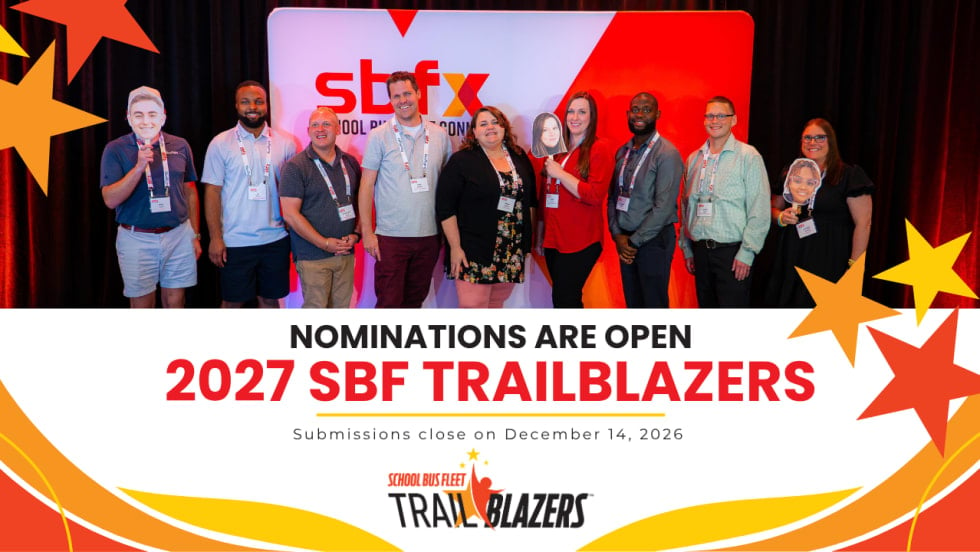
Nominate Rising School Transportation Pros Under 40!
We’re searching for the next generation of leaders making an impact across the K-12 student transportation industry to recognize as SBF’s 2027 Trailblazers. Nominations are open now!
Read More →