




Maximizing Clean Air, Surface Technologies for Safe School Bus Operations
Suppliers provide insight on the latest air filtration offerings to combat harmful bacteria and airborne viruses like COVID-19 on the bus and how the technology can supplement operators’ daily safety procedures.

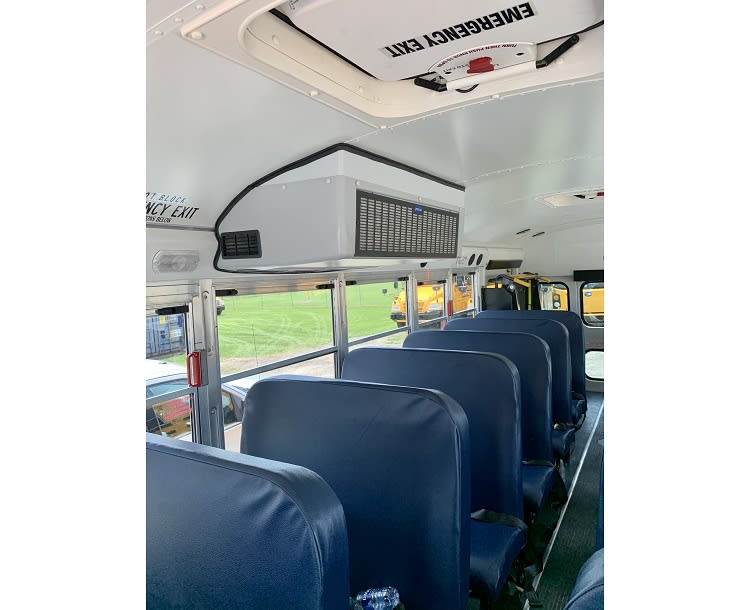
ProAir’s filtration systems, including the HEPA-6 model (shown here), are designed to deliver up to 99.99% effectiveness in removing airborne bacteria and viruses.
Photo courtesy ProAir
More than a year into the COVID-19 pandemic, school districts and bus companies are still ramping up their efforts to ensure the safety of students as they head back into the classroom and onto the school bus.
Deep cleaning buses and sanitizing surfaces have become standard practices for most operations, in addition to the use of air filtration technology to eliminate the presence of harmful bacteria and airborne viruses like COVID-19. While the technology continues to undergo developments for the school bus market, operators are increasingly looking to adopt air filtration units as more funding opportunities become available, specifically through the CARES Act and the Consolidated Appropriations Act of 2021.
With more funding and access to the technology, Dave Oberdorff, vice president of sales and business development for ProAir, a supplier of air filtration systems, says operators can restore confidence in their bus drivers and communities as more students get back on the bus.
School Bus Fleet spoke with Oberdorff and a representative from Webasto, another air filtration systems supplier, about their latest offerings for the school bus. They share how the systems work, best practices for use, and how the technology can supplement operators’ daily safety practices.
Filtration for Multiple Vehicle Applications
At the start of the pandemic in March 2020, the engineering team at ProAir went to work on researching how to effectively apply filtration technology to a full-size, 40-foot school bus, according to Oberdorff.
“With about 70% of the COVID virus being spread through the air attached to water particles and the other 30% potentially being spread through contact surfaces, we knew proper air filtration had to be part of the COVID-19 containment solution,” he added.
As part of the company’s research efforts, ProAir looked to the Centers for Disease Control and Prevention (CDC) guidelines on how many air turns per hour were recommended for a hospital room to minimize a viral load of COVID-19. The company also leveraged its experience in supplying the emergency vehicle market with air filtration and purification units utilizing HEPA filters and UV-C germicidal lamps for first responders. Together, these efforts ultimately helped determine the size of the blowers needed for school bus air filtration.
ProAir’s latest filtration systems — the HEPA-3, HEPA-4, and HEPA-6 models — feature high-capacity True HEPA filters that are designed to deliver up to 99.99% effectiveness in removing airborne mold spores, pollen, dust, bacteria, and viruses, including COVID-19, Oberdorff says. Each unit is equipped with a pre-filter to remove larger particulate matter from the air, helping to extend the lifecycle of the filter and allowing it to focus on eliminating the smaller airborne pathogens down to 0.3 microns in size. The ProAir units are also outfitted with germicidal virus killing UV-C lamps, which operate at a 254 nm wavelength for additional air purification.
Since the initial release of the HEPA-6 model, Oberdorff says ProAir has expanded its air filtration product line to include various-sized units to accommodate small vans; Type A, Type C, and Type D school buses; and transit style buses. He also says that the units have served as a great addition for operators looking to supplement their daily COVID-related safety measures, such as surface cleaning and sanitizing buses and requiring riders to wear masks.
“The good thing about the air filtration units is that they safeguard against when someone does come on the vehicle, has their mask down, and coughs — putting contaminants in the air and surrounding surfaces,” Oberdorff says. “Even though you can’t continually wipe down the [buses’] surfaces, you can continue to clean the air while the vehicle is being occupied.”
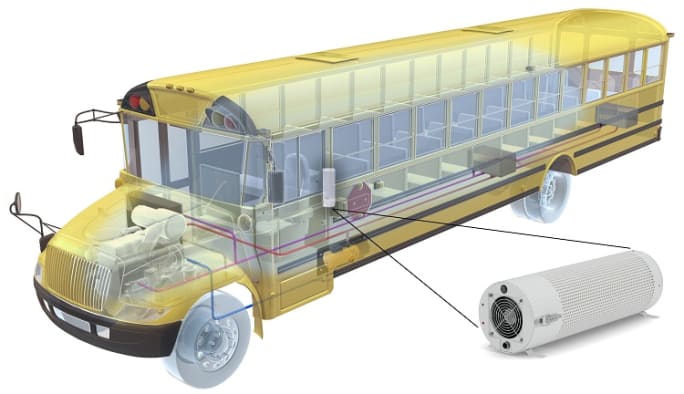
Equipped with medical-grade HEPA-14 air filtration media, Webasto North America’s HFT 300 system can eliminate airborne infections and contaminants more than 0.3 microns in size.
Photo courtesy Webasto
High-Volume, High-Pressure Filtration
Operating as a stand-alone system (separate from the vehicle’s HVAC system), Webasto North America’s HFT 300 air filtration system features medical-grade HEPA-14 filtration media and is designed to remove more than 99.995% (0.3 microns or larger) of airborne infections and contaminants like COVID-19.
“The unit moves a very high volume of air at a very high pressure drop,” says Paul Baczewski, Webasto’s national account manager for bus products. “Pressure drop [means] that a high volume of air is entering the filter, but a minimum amount is felt coming out, [so] somebody sitting in front of the filter is not going to feel a tremendous amount of air blowing on them.”
Baczewski adds that both a high volume of air and a high-pressure drop are required to remove a significant amount of viral contaminants, like COVID, in one pass on a school bus. Without a single pass removal, he says, operators could potentially be recirculating contaminated air in their vehicles.
The filter in Webasto’s HFT 300 connects to a 12-volt source and can be mounted in any direction — vertically or horizontally — on a school bus. The system is also equipped with an air pressure monitoring system that can continuously gauge the air flow and condition of the filter. (When a filter replacement is required, Baczewski says a red light will appear on the system, alerting operators.)
“It is estimated in a routine transportation environment that filter life is approximately eight to 10 months,” Baczewski points out. “The manufacturer of [Webasto’s] internal filter, Virgis Filter S.P.A, indicates not to exceed 12 months. Even when the filter requires replacement, the filtration rate remains at a greater than 99.995% level. The air flow level, however, is reduced.”
In November 2020, Prince George County (Va.) Public Schools became one of the first school districts in the state to outfit nearly its entire fleet with Webasto’s air filtration systems. (Prior to COVID, the district operated 119 bus routes, in addition to several bus and car routes for special-needs students.)
“We started researching other public transport apparatuses, like ambulances and fire units, to see how they were approaching things,” says Dustin Nase, the district’s transportation director. “That is how we came across Webasto and their air filtration system and their use inside ambulances.”
Prince George County Public Schools purchased the systems using approximately $60,000 of the district’s CARES Act funding. The systems were installed by the transportation department’s team of mechanics, who were trained by the district’s school bus dealer Sonny Merryman. (By using an in-house team for the installation process, the district experienced about $12,000 in cost savings, according to Nase.)
More Safety

2 Killed, Dozens Injured in Florida School Bus Crash
A multi-vehicle collision caused a Polk County school bus carrying 37 students to overturn on its way to Winter Haven High School.
Read More →
Illegal School Bus Passing Drops 24% in New York Districts
With fewer than 5% of citations involving repeat offenders, Westchester County officials said enforcement, education, and community partnerships are helping change driver behavior.
Read More →
School's Back. Here's What Happened to Traffic, Speeding & Distraction
What happens to traffic when school resumes? New data analysis examines changes in distracted driving, congestion, and speeding around schools.
Read More →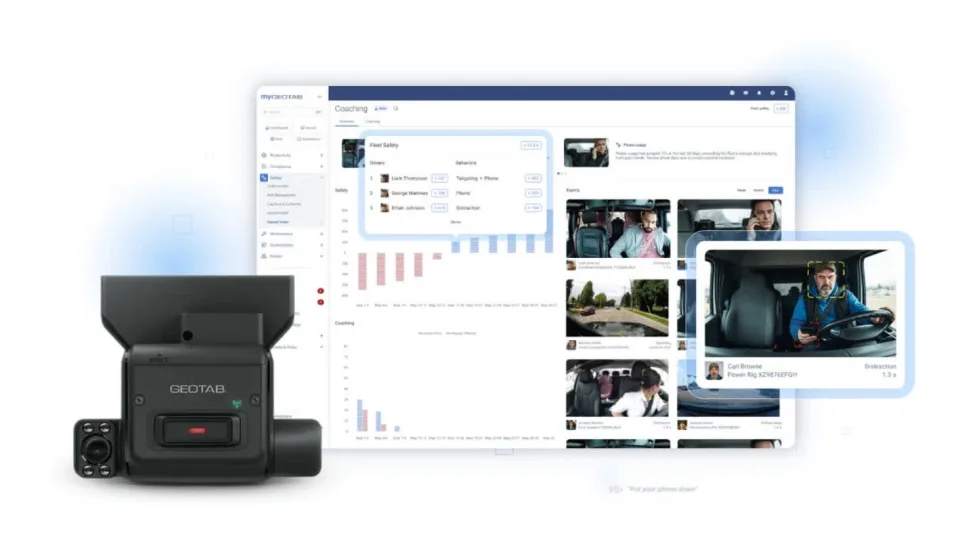
Geotab Expands Fleet Safety Tools With Video Coaching, Risk Insights
New safety and video capabilities aim to help fleet managers assess risk, support drivers, and take targeted action through video coaching, red-light violation detection, and more.
Read More →
How to Build a Better School Bus Driver Training Program
Is it time to strengthen your driver training? Here’s how to pick the right talent and improve recruitment, retention, and safety. This video is brought to you by IC Bus.
Read More →
Recent School Bus Accidents Leave 2 Dead, 2 Injured
Four school bus crashes in Florida, Illinois, and Georgia highlight risks in transportation lots, at bus stops, and during student loading and unloading.
Read More →
When Every Second Matters, Clarity Keeps Routes Moving
From routine delays to urgent incidents, strong communication practices help drivers, dispatchers, schools, and families respond with confidence.
Read More →
What Happens When a School Bus Catches Fire — and What Can Help
School bus fires are rare but can be devastating. Learn how advances in fire suppression and asset protection help fleets detect fires earlier, reduce damage, and improve safety.
Read More →
Geotab Launches Tool to Help Fleets Investigate Road Incidents
Geotab Investigations combines telematics data, video, documents, and other evidence to help fleets reconstruct incidents, resolve claims, and determine what happened.
Read More →
Texas Sixth Grader Wins 2026 National School Bus Safety Poster Contest
Sai Darshana Yekolu of Moseley Middle School in Prosper, Texas, was named the newest winner for her artwork, bringing the theme of “Safe Rides, Everyday Heroes” to life.
Read More →