




Large Bus Showcase 2010
Along with details on the latest Type C and D models, we spotlight three exemplary school bus dealerships. Read about their interesting histories, their commitment to the customer and their insights on the 2010 engine technology.

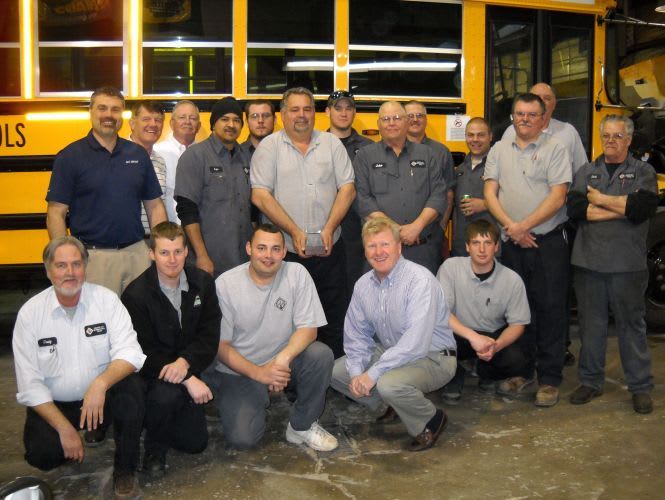
MVI Group won IC Bus’ Dealer of Year Award for 2009. Pictured here is the dealership’s Pataskala location team.
IC Bus
Dealer Spotlight: MVI Group
Columbus, Ohio
It’s not hard to see how MVI Group earned IC Bus’ 2009 North American Tom Cellitti Dealer of the Year Award. The dealership demonstrates its commitment to the customer in many ways.
Last year, MVI Group applied for stimulus funds for more than 112 buses for Ohio school districts that weren’t planning to apply. Some other districts took it upon themselves to apply, and the result was that the districts acquired 116 traditional diesel and seven hybrid IC Bus brand buses.
MVI Group has also strived to bolster tech education. Through the Ohio School Bus Mechanics Association, the dealership provides regional evening training sessions. Another opportunity, through IC Bus, is the IC Bus University program, a full week of training at the OEM’s Tulsa, Okla., plant.
Then there’s MVI University, which was introduced to Ohio bus techs this year with the same Web-based training provided to MVI’s own techs. And Bus ISIS from IC Bus, a free Web-based program, gives techs information on warranties, recall notices, chassis and suggested fixes based on field experiences across the country.
“We are not the first to provide training for the techs, but we have achieved a greater understanding in what to present and how to present the training,” says Dick Epp, MVI Group’s general manager of bus.
After realizing that it hadn’t demonstrated the value of Bus ISIS, the dealership began holding evening training sessions in high school computer classrooms.
“The attendance has been outstanding,” Epp says. “The techs that attend these training sessions are there because they care and not for the wages. They are up again at 4 a.m. to get the buses out safe and efficient for the kids.”
Going with EGR
IC Bus brand buses are using Advanced EGR (exhaust gas recirculation) to meet the EPA’s 2010 emissions standards, while other school bus manufacturers are using SCR (selective catalytic reduction).
Epp says he sees clear advantages in IC Bus’ choice of engine technology.
“I know EGR meets the standards at zero degrees during a winter start,” Epp says. “I know the responsibility to meet that standard is the engine manufacturer’s responsibility, not the operators’ due to their responsibility to add an SCR fluid and service another system.”
Statewide coverage
MVI Group comprises three IC Bus dealerships across Ohio that are under the common ownership of Dealer Principal Tim Reilly. Miami Valley International is based in Cincinnati and Dayton. Center City International has two locations, in Columbus and Pataskala. Power City International has two locations, in Akron and Cleveland.
Epp’s responsibility is to integrate the six IC Bus locations, providing a common parts, service and sales experience.
“Our parts and service personnel are dedicated and trained to provide a relationship that goes beyond just selling parts or service,” Epp says. “They have a common purpose: having a safer bus.”
Another interesting facet of MVI Group is that it has never had an inside person to prepare bids. Each salesperson is responsible for preparing and delivering the bid.
“I was confident that if each salesman had a hand in the specification writing and solving the district’s problems with solutions, they would support the bid and take ownership in the process,” Epp says. “The wrong spec or a missing option makes the 10- to 20-plus year bus life seem even longer and more expensive.”
[PAGEBREAK]
[IMAGE]513[/IMAGE]
Thomas Built Buses
Dealer Spotlight: Nelson's Bus Service
Whitewater, Wis.
Nelson’s Bus Service Inc. has a rare perspective in the pupil transportation industry: Not only is it a Thomas Built school bus dealer, it’s a school bus contractor as well.
Chris Arnett, president of the Whitewater, Wis.-based company, says that this dual nature provides a number of advantages.
“Every day, we have very similar experiences to those of our customers — we rely on those buses to be durable and safe,” Arnett says.
Another benefit is that the company has spare buses in its fleet that customers can use as loaner vehicles when needed. There are also opportunities for customers to try out a different type or configuration of bus from what they currently have.
If, for example, they have only Type C buses in their fleet, “they can get experience with a Type D,” Arnett says. “They can train with it, take it on a route, use it in the real world.”
Another key benefit that Nelson’s Bus Service provides customers is its knowledge and experience.
“We can offer some expertise as to how to apply certain contracting or operational principles,” Arnett says. “We continue to get asked, ‘What would you guys do?’”
A history of service
The company began in 1940 as a school bus repair business, and founder W.C. Nelson built his first bus at his Shell service station. Then came the initiation of a contract to provide transportation services for Whitewater Unified School District, which the company continues to serve today.
Nelson’s also now contracts with McFarland School District, outside of Madison. In all, the company is responsible for transporting more than 2,000 students to and from school each day.
In 1974, Nelson’s became a full-line Thomas Built Buses dealership. In 1997, its territory grew to encompass the entire state of Wisconsin, upper Michigan and northern Illinois.
The company currently has two facilities — one in Whitewater and one in McFarland — as well as a mobile service vehicle, which can go to a customer’s site to perform everything from simple warranty procedures to major repairs.
“We feel that it reduces customers’ costs,” Arnett says of the vehicle. “It certainly has been well received.”
Due to the success of the first edition, the company is now building a second mobile service vehicle, this one with an onboard power supply.
Proven performance
Thomas Built buses are using SCR (selective catalytic reduction) to meet the EPA’s 2010 emissions standards. Arnett says that along with being proven technology — having already been tested in other markets — SCR is a simpler approach.
“It’s aftertreatment, so the majority of the base engine is unchanged,” Arnett says. “That simplifies it, especially for the technicians.”
Nelson’s has had a pre-production SCR-equipped Saf-T-Liner® C2 since early January. The company has held several SCR demonstration events in addition to doing its own testing of the technology.
“It has performed flawlessly, even in some sub-zero weather conditions,” Arnett says.
Focus on partnerships
Last year, Nelson’s earned a gold dealer award from Thomas Built. The award recognizes outstanding performance in service, parts support and bus sales.
The family business, which is celebrating its 70th anniversary this year, is now in its third generation of ownership.
Arnett notes that when the dealership was launched, the company decided not to change its name from the original Nelson’s Bus Service.
“Leaving ‘Service’ in our name showcases what we’re all about,” Arnett says. “We don’t feel that we’re just a contractor, just a dealer. We view it as a partnership. Our goal is to develop that long-term relationship.”
[PAGEBREAK]
[IMAGE]514[/IMAGE]
Blue Bird Corp.
Dealer Spotlight: Bryson Sales & Service
Centerville, Utah
Fittingly, it was a Blue Bird customer who launched Bryson Sales & Service Inc. back in 1969.
That year, the existing Blue Bird dealership for Utah and Nevada became available for purchase. Glenn Bryson was director of transportation for the Davis School District in Farmington, Utah.
Bryson had been a loyal Blue Bird customer since 1957, when he bought the first Blue Bird All American school bus in the state. After 33 years of serving the school district, and after thorough consideration, Bryson decided to purchase the dealership.
So Bryson Sales & Service was founded, and Glenn’s son Lynn and grandson Greg Bryson came to work nights and weekends at the new family business. Initially, the dealership was operated out of a basement office and the garage in Glenn’s backyard.
Great growth
Bryson Sales & Service has grown significantly over the years. Beyond Utah and Nevada, it also now covers Idaho and Washington state.
The headquarters is now in Centerville, Utah, in a sizable facility that houses the parts, service and sales departments and serves Utah, Nevada and Idaho. The Washington facility is now in Everett, north of Seattle.
The dealership prides itself on maintaining high standards of honesty and integrity, and it has received numerous accolades.
Glenn Bryson was inducted into the Blue Bird All American Hall of Fame in 1975. Ten years later, in what is said to be the only second-generation induction in the history of Blue Bird, Glenn’s sons Lynn and Brent were also named to the Hall of Fame.
Most recently, Bryson Sales & Service was named Blue Bird’s Dealer of the Year for 2009.
Dealing with difficulties
Along with all of the success, Bryson Sales & Service has met its share of difficulty.
In August 2004, Brent Bryson, who was serving as president and CEO, unexpectedly passed away. The loss of his knowledge, experience and rapport in the school bus industry left a void that couldn’t easily be filled.
After Brent’s death, his ownership was purchased from his estate by Greg Bryson and Rick Barton (husband of Greg’s sister).
Greg, like Brent and Glenn before him, is an avid mechanic, but he had no previous managerial experience. As he stepped up to the role of president and CEO, he was initiated immediately in the duties of running a company. And he rose to the challenge.
Since Greg’s inception as leader, Bryson Sales & Service has undergone extensive growth and expansion in physical facilities, customer base and personnel. All the while, Greg says he remains committed to the original mission of his grandfather: “Take care of the customers, and everything else works out.”
Still, these are hard times for most customers.
“Right now, what I see is a lot of underfunded transportation departments trying to come up with any way to stay operating,” Greg Bryson says. “Most districts are in a survival mode. They are falling short on staffing, money and buses, with no relief in sight.”
Yet Bryson remains optimistic. “As Americans, we may be down for now, but we will come back,” he says.
Clean solution
Blue Bird buses are using selective catalytic reduction (SCR) to meet the EPA’s 2010 emissions standards. Bryson says that in addition to having already been used successfully in Europe, SCR provides some key benefits.
“The advantage is the SCR is producing the heat outside or away from the engine,” Bryson says. “This allows the engine and its related components to run cooler, and this extends the lifecycle, including oils and coolants.”
More Safety
Illegal School Bus Passing Drops 24% in New York Districts
With fewer than 5% of citations involving repeat offenders, Westchester County officials said enforcement, education, and community partnerships are helping change driver behavior.
Read More →
School's Back. Here's What Happened to Traffic, Speeding & Distraction
What happens to traffic when school resumes? New data analysis examines changes in distracted driving, congestion, and speeding around schools.
Read More →
Geotab Expands Fleet Safety Tools With Video Coaching, Risk Insights
New safety and video capabilities aim to help fleet managers assess risk, support drivers, and take targeted action through video coaching, red-light violation detection, and more.
Read More →

How to Build a Better School Bus Driver Training Program
Is it time to strengthen your driver training? Here’s how to pick the right talent and improve recruitment, retention, and safety. This video is brought to you by IC Bus.
Read More →
Recent School Bus Accidents Leave 2 Dead, 2 Injured
Four school bus crashes in Florida, Illinois, and Georgia highlight risks in transportation lots, at bus stops, and during student loading and unloading.
Read More →
When Every Second Matters, Clarity Keeps Routes Moving
From routine delays to urgent incidents, strong communication practices help drivers, dispatchers, schools, and families respond with confidence.
Read More →
What Happens When a School Bus Catches Fire — and What Can Help
School bus fires are rare but can be devastating. Learn how advances in fire suppression and asset protection help fleets detect fires earlier, reduce damage, and improve safety.
Read More →
Geotab Launches Tool to Help Fleets Investigate Road Incidents
Geotab Investigations combines telematics data, video, documents, and other evidence to help fleets reconstruct incidents, resolve claims, and determine what happened.
Read More →
Texas Sixth Grader Wins 2026 National School Bus Safety Poster Contest
Sai Darshana Yekolu of Moseley Middle School in Prosper, Texas, was named the newest winner for her artwork, bringing the theme of “Safe Rides, Everyday Heroes” to life.
Read More →
Doing More With Less: How Transportation Directors Can Prioritize Safety Amid Budget Uncertainty
With diesel prices soaring and nearly one-third of transportation directors expecting budget cuts, maintaining student safety has never been more challenging. Download this guide to learn how leading districts are prioritizing risk, funding critical safety technology, and building stronger budget cases with data.
Read More →