




Keying in to Radio Communications Systems
Sound radio communication is an essential component of pupil transportation. Ensuring the safety of children is a priority, and staff must always have...

Sound radio communication is an essential component of pupil transportation. Ensuring the safety of children is a priority, and staff must always have the ability to contact a central artery, and vice versa, in case of emergencies.
Radio emergencies
In September 2004, Hurricane Ivan assaulted Virginia’s Appalachian Mountains. Remnants of the storm created tornadoes that whisked just south of Loudoun County Public Schools (LCPS). Students were still present. Michael Lunsford, director of transportation at LCPS, remembers the day very well.
“Within two minutes, we made an emergency broadcast,” Lunsford recalls. “We notified all schools and buses of the pending tornadoes and directed them on appropriate actions.”
Thanks to the SmartLink I-Switch, a communications platform that provides routing of network traffic based on a granular, real-time database, and the district’s alert radio system, LCPS weathered the storm.
“With the alert radio system, we were able to keep the school apprised of exactly where the storms were and in what direction they were headed,” Lunsford says.
Systems integration
In 2004, Loudoun County was one of the fastest-growing counties in the U.S. LCPS had to hire nearly 100 drivers each year to keep pace with growth and turnover.
Radio communications had been insufficient due to the district’s reliance on one tower, a community repeater system with one channel, to serve 200 bus routes. Signal strength was also a problem. The county’s rapid growth demanded an upgrade. LCPS needed a radio system that could handle its large assortment of more than 2,700 portable and mobile radios, including the Kenwood 3140 and TK-880, the E.F. Johnson 242 Series and the Motorola Radius.
Eventually, the problem grew to where the district ran 400 to 500 buses off the system, but the cost for a new system was prohibitive. SmartLink’s I-Switch allowed the district to keep the old system while building a new one.
“SmartLink tied the two systems together,” says Lunsford. “And we didn’t have to expend capital cost to throw away what was basically a functional system.”
LCPS’ communications system, constructed in stages due to funding, replaces a system that consisted of two standalone sites with conventional VHF channels running under CTCSS and DCS protocols, and UHF channels running under the LTR trunking protocol.
The upgrade will be to a networked UHF system operating under the LTR-Net protocol, which supports multi-site roaming via a phased migration.
“The new 400 MHz trunk system has allowed us to restore sufficient communications between the buses,” says Lunsford. “It has worked out really well.”
Operating in real time
Paul Brinson, chief information officer for Evanston/Skokie School District 65, in Evanston, Ill., uses Nextel wireless phones equipped with Nextel Global Positioning System (GPS) technology to monitor the locations of school buses completing their routes.
Although Evanston/Skokie’s 20 Java-enabled handsets can be directed toward voice or GPS communications, they can’t do both simultaneously. In an emergency, if a caller needs to conduct voice calls, the GPS component is disabled and must be re-enabled by drivers. In an emergency, this limitation is problematic. The district’s next step is to ensure both voice and GPS communications.
The Nextel 158SR phones emit GPS tracking information that is captured via satellite and then sent to a Tampa, Fla.-based company called Act Soft through Comet Tracker software.
Although Durham School Services, the district’s bus contractor, equips each of its buses with two-way radios, District Superintendent Dr. Hardy Murphy wants to ensure that district staff also have direct contact with the buses. “When parents call in on snowy mornings to know if buses are running on time, our transportation staff can view the exact position of buses and estimate when they’ll likely arrive at stops,” Murphy says. “It also provides an extra measure of security for the children.”
{+PAGEBREAK+} Expanded usage
In all, Evanston/Skokie has deployed about 100 cell phones. In addition to the GPS-enabled devices, staff also use the phones for other purposes such as inter-district communications on playgrounds and during field trips.
Brinson says he is working on other ways to use Nextel’s phones to improve communications. “We’re working with Nextel to develop an application that will provide a barcode reader that attaches to the phone and can be used by technical support staff for inventory purposes.”
This barcode technology may also be used to solve paperwork problems with special-needs students and caretakers by electronically tracking their contact hours with the students. This will make it easier for service providers to ensure that each student receives the appropriate services.
Brinson also uses a BlackBerry phone to provide him with direct access to his technical support staff in the field and to view e-mail. The phone, web access and organizer features help him manage his time, contacts and communications. BlackBerrys cost about $300 each.
Networked solutions
Kent (Wash.) School District, a 75-square-mile, mostly suburban district, is part of a network of public entities that share repeaters with the King County emergency communications system.
The setup has multiple benefits, including direct linkage to emergency services such as police and fire. The greatest benefit is its quality coverage and reception.
Previously, the district used Motorola and Kenwood two-way FM radios, but coverage on the FM system was very poor, and the district suffered through years of frequency interference.
“You could drive past Burger King and pick up someone’s order,” says Donald Walkup, transportation supervisor. “Sometimes, depending on the weather, you’d pick up other districts’ radio transmissions.”
Five years ago, the district invested in an 800-MHz system designed and built by Icom America of Bellevue, Wash., and it hasn’t looked back since.
Kent uses 135 transit-style buses to transport about 11,000 students daily. Each bus is equipped with an 800 MHz two-way radio. The district has a total of 320 radios; about 145 of those are dedicated to transportation. Base radios and those installed in buses are Motorola LCS 2000s. Transportation supervisors carry handheld Motorola MTS 2000s.
The King County Emergency Radio Communications system charges a monthly fee of $13 per radio to use its repeaters. Every school in the district has a base radio that is part of this system. The district paid about $1,800 for its handheld portable radios and about $1,000 each for bus and base radios.
The district doesn’t have access to emergency channels, but emergency personnel can key into the district’s channels and transmit directly to security or to transportation staff.
The beauty of being tied into the King County system, says Walkup, is that because of the redundancy of the county-wide system and strategic location of repeaters, you don’t have to have a special antenna. “We just moved into a new building, and our antennas for our base radios are sitting on the floor under a desk.”
Equipment durability
Greg Milbrath, director of buildings and grounds at Mankato (Minn.) Area Public Schools ISD 77, oversees all custodial, maintenance and grounds staff, and any onsite construction as well.
Milbrath needed radios that were lightweight but durable. The district worked with Two-Way Radio of Janesville, Minn., to purchase Vertex Standard VX-160U portable radios, and with a local company called Alpha Wireless Communications for Motorola CT150 2-watt, 4-channel radios.
The district had been using Vertex Standard HX-241 two-way radios since the early 1980s, but in the past two years moved to the VX-160U model.
{+PAGEBREAK+} The frequency of the HX-241s didn’t travel as far as the VX-160Us, which Milbrath says can transmit up to 20 miles. The VX-160Us weigh less than one pound and have power outputs of 1 to 5 watts. The district has approximately 120 of the five-channel portable radios.
The channels or talk groups can be opened for district-wide communication or for use within a particular school only. Runaround channels and scanning are also available on the radios.
The repeater for the district is situated atop Gage Tower, located on campus at the University of Minnesota, Mankato.
The Vertex Standard VX-160Us cost the district about $310 each. Milbrath estimates that annual cost for repairs and purchase of new radios hovers around $4,000 to $5,000. The two Motorola CT150s the district purchased cost $290 each.
Securing the line
Several months ago, Alice Quayle, supervisor of transportation at Modesto (Calif.) City Schools, received an early morning call from her dispatcher informing her that 41 of the district’s 52 Kenwood TK-880 two-way radios had been stolen.
The burglars were professionals and had hit several other districts in the area. All 41 of Quayle’s radios had to be replaced. She estimates a total of about $25,000 to replace the radios.
Quayle upgraded the radios to newer Kenwood TK-880 with a caller ID feature. “If one of my drivers had an emergency and couldn’t speak, we would know who was keying the radio,” Quayle says. “Their number would appear on the base station.”
The district, which now has 24-hour surveillance, pays a quarterly fee of $450 for its repeater. This is the only fee paid outside of the cost for radios. The repeater is positioned locally on Mt. Oso. Previously, the district used a tower positioned atop a downtown hotel.
“With the old repeater, we sometimes lost contact with drivers,” says Quayle. “But the Mt. Oso repeater has superior signal quality. We’re probably paying at least twice as much, but the service has been twice as good.”
Safety is priority with cell phones
Clear Creek Independent School District in League City, Texas, does not allow drivers to use cell phones while driving, even though state law permits it when driving personal vehicles.
At Clear Creek, buses are equipped with cell phones for emergency use and in the event two-way radios are not available or out of range. Drivers are instructed to pull over to a safe location and to secure the bus before attempting to use cell phones.
Numbers for district phones are not published so drivers cannot share them, and phones are programmed to dial out to four numbers only.
“Drivers can call 911, dispatch, the mechanics’ shop or an after-hours number to reach mechanics when an after-hours breakdown occurs,” said Debby Coward, driver trainer and transportation safety coordinator.
If a cell phone rings on the bus, the driver knows the transportation department is attempting to reach them. Drivers must respond when it’s safe to do so.
“Drivers are permitted to use personal phones during breaks or between routes, but not while driving or when transporting students,” said Coward. Personal phones are placed on silent mode or turned completely off when drivers are en route.
Periodically, the district receives complaints about drivers using cell phones while driving. When this occurs, drivers are immediately called in and questioned about the phone use and reminded of the district policy. Immediate disciplinary action is taken if a supervisor observes this behavior.
“The safety of the children is always top priority,” said Coward.
More Management

How to Build a Better Driver Training Program
Ready to boost up your school bus instructor training? Here’s how to pick the right talent and improve recruitment, retention, and safety.
Read More →
CALSTART and Forth Combine to Form Catalyst Mobility
The new name represents a renewed vision for the nonprofit focused on advancing clean, equitable, and affordable transportation solutions that move people and goods.
Read More →
What Makes a Great School Bus Driver Trainer?
Choosing the right school bus driver trainer takes more than experience. Learn six keys to selecting and developing trainers and evaluating program effectiveness.
Read More →


School Bus Contractors Expand Through New Deals, Acquisitions & Partnerships
STA's Canadian division acquires Ontario-based G&L Stevenson Transport while Durham School Services adds a new district contract in California, First Student adds a New Jersey contract, and Minnesota Coaches acquires Halo Transportation.
Read More →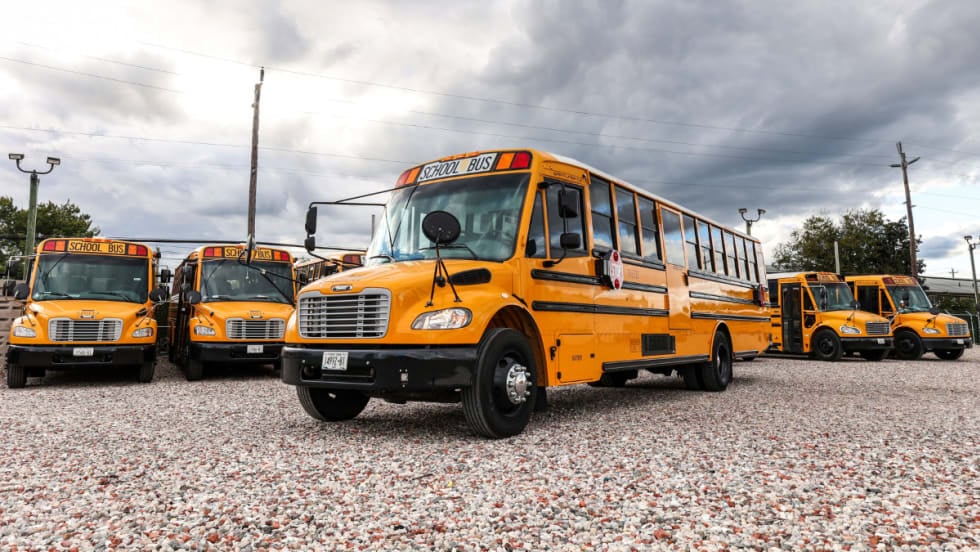
Logan Bus Company Rolls Out AI Phone System for NYC School Bus Families
A summer pilot found that AI agents could handle most routine calls, freeing up time for customer service staff to focus on emergencies and complex family concerns.
Read More →
From Intent to Impact: What I Learned About Leadership from TAPT
A Texas transportation supervisor shares lessons on self-awareness, accountability, managing stress and building trust — and why investing in leadership development matters at every stage of your career.
Read More →
NAPT Names 2026 Award Recipients, Hall of Fame Inductee
Who earned national recognition for their work in student transportation? This year, NAPT named five recipients of its 2026 awards for service, safety, and leadership, plus its newest Hall of Famer.
Read More →
2026 State of Student Transportation Report
Driver shortages. Rising costs. Growing safety expectations. More data, but not enough time to act on it. The 2026 State of Student Transportation Report reveals what transportation leaders say is putting the most pressure on their operations—and where they’re investing next. See how your priorities compare.
Read More →
How to De-Escalate an Angry Person: 5 Steps for Handling Workplace Conflict
What makes emotions run high, and how should you handle an angry colleague or parent? Follow these steps for staying calm, listening, showing empathy, and resolving conflict.
Read More →
What Readiness Looks Like This School Year
Learn about the challenges shaping the 2026–2027 school year, from persistent driver shortages and budget pressure to technology and readiness gaps. See how school districts are responding and adapting in Zonar’s 2026 Back-to-School Readiness Report.
Read More →