




Message Received: Best Practices for Effective Radio Communication
On the Air, Aboard the Bus
How school districts battle dead spots and service issues with improved communications technology.

Christy Grimes・Former Senior Editor

Communications systems for pupil transportation are more than just a way to stay connected; they can be lifesavers.
Photo: School Bus Fleet
6 min to read
The Cypress-Fairbanks Independent School District (CFISD) in Harris County near Houston had a communications problem.
According to a case study by JVCKENWOOD USA, the Texas school district’s two-way radios couldn’t keep up with the growth it was experiencing.
“As the school district grew, we had dead spots on campuses and were not able to communicate consistently with our campus police officers,” says Lt. Casey J. Davis, former director of emergency management for the CFISD Police Department.
Larger than the city of Denver at 186 square miles, CFISD relies heavily on two-way radios to ensure safety and security. The radios are crucial to transportation requirements for the 1,100 buses operating out of five transportation centers and to administration, engineering, and operations.
CFISD worked with Northwest Communications, a local Kenwood dealer, on a plan to deploy new communications technology, transitioning from conventional analog operation on seven UHF channels with a single 300-foot tower to NEXEDGE digital technology and multiple tower sites.
Don Cameron, president of Northwest Communications, explained that he met with the transportation department after the first tower was built, to address what they needed and got the department’s new communication system set up. He then constructed three additional towers.
“Once the infrastructure was installed and the transportation department radios were up and running, we converted the NEXEDGE radios from analog to digital during summer when schools were closed. Once that was complete, we flipped the switch, and everyone moved to digital,” he says.
By transitioning to digital communications, CFISD public safety personnel no longer must rely on industrial pool channels. The 32 channels on the towers are for district-wide communications on public safety frequencies in 450 MHz.
“These are exclusive, FB8 channels,” Cameron says. “Now, no one can talk over the police department, so that’s an extra layer of security.”
An FB8 channel is a repeater operating within a centralized trunked radio system, which provides exclusive use of the designated frequency within a geographical area, according to the Federal Communications Commission.
All CFISD buses are equipped with Kenwood NEXEDGE mobiles. Dispatch for each transportation center is set up so that when a bus driver keys up their radio, the vehicle is automatically identified. That allows campus police to immediately reroute buses if there is an emergency.
“Those incidents do occur, and we need to be able to keep the kids safe on their way to and from school, no matter what happens,” Davis says. The addition of Zonar Fleet Management further ensures accuracy in incident recording and response, according to the case study.
Communications systems for pupil transportation are more than just a way to stay connected; they can be lifesavers.
Because school bus drivers are prohibited from using mobile devices while behind the wheel, two-way radio systems remain the best form of communication. We’ve highlighted some communications systems on the market, and features that may come in handy in a life-threatening situation.
Kenwood Integrated System Solutions
Kenwood’s two-way radios help keep pupil transportation staff across the district informed of route changes, emergencies, and offer clear communication between buses and the base. Kenwood's trunking makes it possible to create a site that is ideal for managing school bus fleets. Kenwood offers integrated system solutions.
NEXEDGE NX-5300

The NX-5300 offers both mixed digital and FM analog operation, and has Bluetooth for hands-free operation.
Photo: Kenwood
The NX-5300 offers mixed digital and FM analog operation and can easily migrate with digital radios in other sites. It has a Bluetooth module built-in for hands-free operation.
Specs:
- 6 W (136-174 MHz) Models
- 5 W (380-470, 450-520 MHz) Models
- 3 W (700/800 MHz) Models
- Multi-Digital Operation in two of NXDN, DMR & P25 (Phase 1 & 2)
- NXDN Conventional and Type-C & Gen2 Trunking
- S-Trunking
- DMR Tier III Trunking
- Active Noise Reduction (ANR)
- Over-The Air Programming
NEXEDGE NX-3820

The NX-3820 adaptable mobile radio supports both NXDN and DMR digital protocols, as well as mixed digital and FM analog operation.
Photo: Kenwood
This adaptable mobile radio supports both NXDN and DMR digital protocols, as well as mixed digital and FM analog operation, enabling it to serve in a wide range of applications. It also offers Bluetooth for hands-free operation, and built-in GPS.
Specs:
- UHF:450-520 MHz, 400-470MHZ
- NXDN Conventional and Type-C & Gen2 trunking
- S-Trunking
- DMR Tier III trunking
- DMR Tier II conventional
- Active Noise Reduction (ANR)
Motorola Solutions' Maximum Coverage for Reliable Communications
Motorola Solutions’ two-way radios connect faculty, buses, and first responders to coordinate incident response and prevention. Radio systems offer maximum coverage, capacity, and control for reliable communications.
Motorola MOTOTRBO R7 Portable Two-Way Radio

The volume on the MOTOTRBO R7 handheld two-way radio adjusts automatically based on background noise, making it ideal for crowded school buses.
Photo: Motorola Solutions
The rugged MOTOTRBO R7 with the full keypad is a good handheld option for school bus drivers, according to Motorola Solutions. It works on the DMR standard and delivers sharp, clear speech. The volume adjusts automatically based on background noise, making it ideal for crowded school buses. Detailed information from school dispatchers can be displayed on the home screen. The device can be programmed and updated over the air via WiFi and is powered by a battery that lasts up to 28 hours.
Specs:
- VHF: 136-174 MHz, 5 W
- UHF: 400-527 MHz, 4 W
- Industrial-level noise cancellation
- Channel Capacity: 1,000
Motorola MOTOTRBO XPR 5550e Digital Mobile Two-Way Radio

Integrated Wi-Fi in the MOTOTRBO XPR 5550e enables remote software updates, as well as voice connectivity via WAVE OnCloud when you are out of range of your MOTOTRBO system (subscription required).>
Photo: Motorola Solutions
With high-performance integrated voice and data, and advanced features for efficient operation, these next-generation radios deliver connectivity to your department, according to Motorola. Bluetooth audio lets you talk without wires. Integrated Wi-Fi enables remote software updates, as well as voice connectivity via WAVE OnCloud when you are out of range of your MOTOTRBO system (service subscription required). The MOTOTRBO XPR 5000e Series is a family of DMR-standard digital radios. There is support for trunking, as well as legacy analog technology.
Specs:
- VHF: 136-174 MHz, 1-25 W
- UHF Band 1: 403-470MHz, 25-40 W
- UHF Band 2: 250-512 MHz, 1-40 W
- Channel Capacity: 1,000
Here are some basics on effective two-way radio communication, shared by Max Christensen, education program consultant for the Iowa Department of Education's Bureau of School Business Operations:
- Speak slowly and clearly and in a normal tone, and keep your message simple and easy to understand.
- Always release the mic switch when finished talking so the other person or persons can then talk.
- Keep all communications on a professional level as you are likely being monitored by others within the community via scanners.
- Never mention a student's name and/or address on the radio unless it's absolutely necessary, again because you are likely being monitored by others.
- Never mention any personal information about a student - such as their ethnic background, medical problems, or disciplinary action, again because of being monitored by others.
- Did I mention keep all communication on a professional level? Talking about what you did over the weekend is for time around the break table, not for the two-way radio.
- Learn some basic "radio talk" such as 10-4 for "message received" or "what's your 20" for "what's your location?" Also, "over" (I'm finished), "say again" (please repeat), "stand by" (I acknowledge your message but can't respond now), "go ahead" (I can respond now), "roger" (message received and understood), and "affirmative/negative" (yes/no).
Subscribe to Our Newsletter
More Management

5 Questions: How CharterUP Brought a Marketplace to Student Transportation
What does it take to bring a transportation marketplace into K-12? Hear firsthand what CharterUP has learned about the unique needs of schools and bus operators.
Read More →
EverDriven Expands TripCentral Transportation Management Platform to All Partner Districts
The platform provides school districts with real-time trip tracking, student transportation scheduling tools, and pickup and drop-off management capabilities.
Read More →
6 School Transportation Trends to Watch: 2026 District Survey Results
School bus buying is up, fuel choices are shifting, and driver shortages persist. This and more in the latest K-12 public school survey, plus the largest fleets in the U.S.
Read More →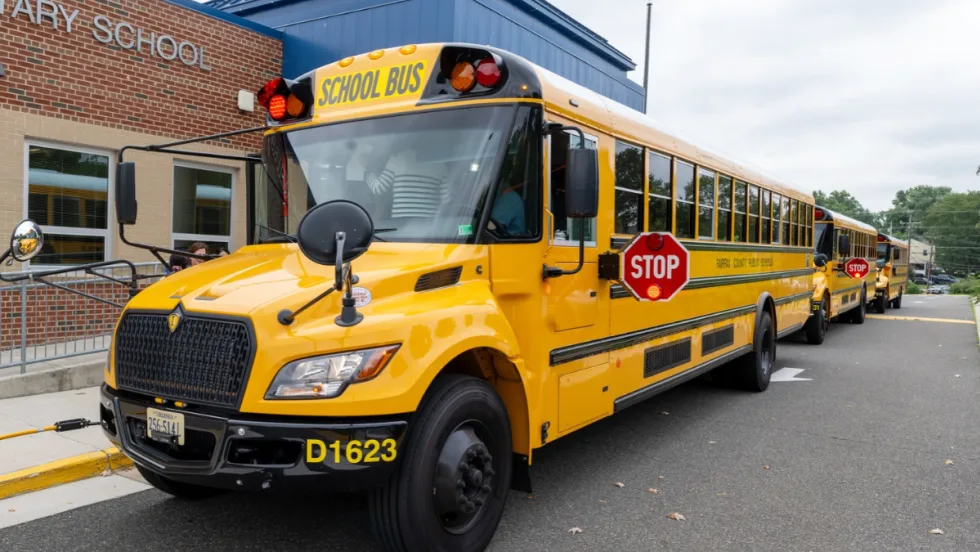
The 100 Largest School Bus Fleets in America: 2026 Rankings
Which public K-12 school districts are the largest in the nation in terms of bus fleet size? Here are the new standings of the top 100 district fleets.
Read More →
EverDriven Launches Route Consolidation Calculator to Estimate Diesel Savings
As diesel prices hit record highs, the largest alternative transportation provider says a 10% route consolidation could save a 120-route district more than $78,000 a year in fuel alone.
Read More →
Zum Secures Continued Financing Support for School Bus Expansion
Generate Private Credit has financed approximately $75 million in school bus deployments across three states, supporting more than 500 buses as Zum expands across the county.
Read More →
Beyond Discipline: A Different Approach to Student Behavior on the Bus
After implementing a dean of students program in Oregon, North Clackamas is seeing positive improvements. Here’s how it worked. The Route is brought to you by IC Bus.
Read More →
A Dean of Transportation's Different Approach to Student Behavior on the School Bus
After implementing a dean of students program in Oregon, North Clackamas is seeing positive improvements on the bus. Here’s how it worked.
Read More →
Inside NAPT ACTS 2026: Highlights from Louisville
From federal updates and student behavior strategies to new school bus technology and industry awards, see highlights from NAPT ACTS 2026 in Louisville.
Read More →
Meet the 2026 School Bus Driver Hero Winner: Annette Brown
We caught up with Wa-Nee Community Schools' Annette Brown on site at SBFX, where she was named the 2026 School Bus Driver Hero Award winner. Hear about her reaction, what she loves most about being a school bus driver, and more!
Read More →