





Check Out: 10 Things Mechanics Need to Know About School Bus Transmissions
Evolving the Yellow Bus While Keeping Faith with the Core Mission
The technology that goes into the school bus and makes it run may change, but the goal remains the same: safe and reliable transportation between home and school for children.
November 20, 2023
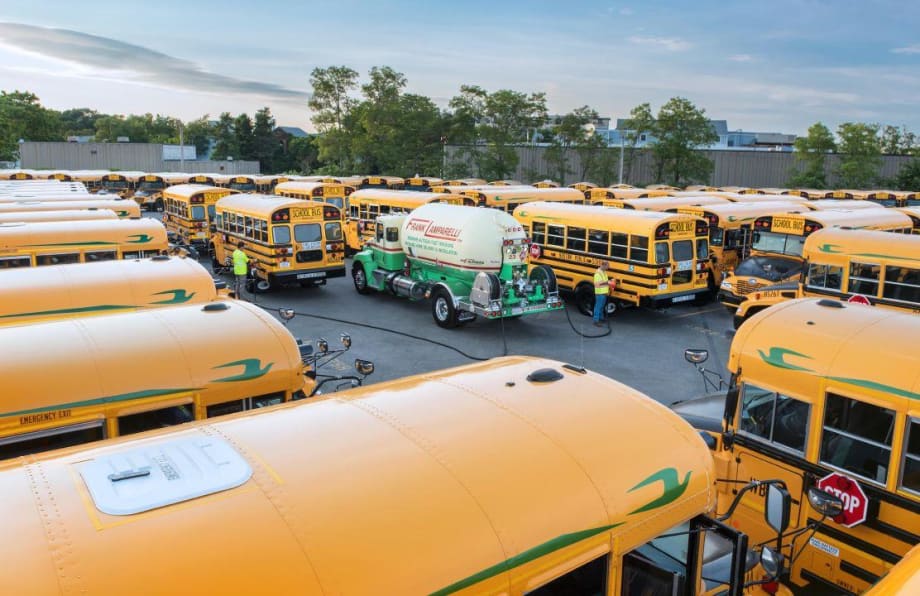
Renewable propane can be used as a drop-in fuel for standard propane-powered school buses, like these used by Boston Public Schools in Massachusetts.
Photo: ROUSH CleanTech
6 min to read
The fundamentals of the job of school transportation haven’t really changed much in more than a century: get those student passengers from home to school and back again, safely.
But, increasingly, how that process works, what goes into the buses that carry them, and the technologies that improve the experience for passengers and drivers alike, all see changes happening – sometimes faster than we might like.
This year, School Bus Fleet takes some time to recognize a few game changers, including:
Renewable propane as an alternative fuel.
A Texas school district’s innovative maintenance shop program.
A clean transportation technology pioneer exploring electric batteries and hydrogen fuel.
Pumping Up Renewable Propane
Propane doesn’t make up a large percentage of the United States school bus fleet, but that could start changing in 2024.
“Renewable propane is the next evolution in clean U.S. fleet vehicle fuel, and will undoubtedly be a game changer in 2024 for school bus fleets,” said Todd Mouw, executive vice president of sales and marketing for ROUSH CleanTech.
Renewable propane – or biopropane – is a non-fossil fuel created from raw materials such as animal fat, plants, wood waste, cooking oils, and feedstock that’s abundant and inexpensive.
“Renewable propane has the same great features as conventional propane, including reliability, power, and reduced emissions, but with even lower carbon emissions,” Mouw said.
The California Air Resources Board (CARB) reported that renewable propane made with domestic, non-rendered, used cooking oil has a carbon intensity score of 20.5, while conventional propane has a carbon intensity score of 79. The World LP Gas Association has stated that renewable propane could meet half the world’s propane demand by 2050.
Mouw also pointed out that several U.S. refineries in California, Texas, and Louisiana have existing capacity to produce renewable propane as part of their renewable diesel production systems. The fuel is more frequently being generated from the seed oil of the camelina plant, which isn’t a food crop and doesn’t compete with food production.
Currently, propane is used primarily in school bus fleets in the western United States – Texas has about 2,900, as an example. But the fuel stands to gain traction throughout the rest of the country.
The Propane Education and Research Council (PERC) has committed to testing renewable propane, including blends with conventional propane, Mouw said. The organization also has informed original equipment manufacturers of potential engine use while raising awareness of the fuel for producers, sellers, transporters, and end users.
Innovation in Fleet Maintenance Shop Management
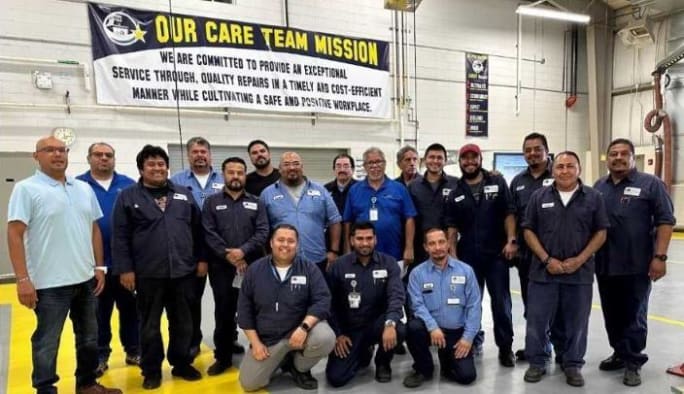
In March 2023, the El Paso Independent School District in Texas implemented its new CARES program for recognizing technicians and revamping the shop's approach to maintenance procedures.
Photo: El Paso (Texas) Independent School District
Sometimes, change is procedural.
This year, El Paso (Texas) Independent School District implemented a new approach for its maintenance team called the CARES Program.
Jesse Vasquez, transportation fleet director for EPISD, says the idea is to update and improve all auto shop operations and “provide insight and beliefs to achieve goals and promote a teamwork environment.”
The program’s mission: “We are committed to provide an exceptional service through quality repairs in a timely and cost-efficient manner while cultivating a safe and positive workplace.”
The CARES program aims to recognize technicians and reward them for their hard work. The letters in the acronym stand for:
Cultivate: Contribute to a positive work environment.
Accountability: Embrace safety and responsibility.
Respect: Treat everybody with dignity and compassion.
Excellence: Provide the highest quality of repairs.
Service: Exceed expectations every time.
Technicians can be nominated when they epitomize any of these values. They receive a CARES certificate, their photo’s taken, they get a pin and magnet of the letter for which they were nominated, and a gift.
“The goal is to receive all pins and become a CARES specialist and to have their certificates displayed on the shop wall to be recognized,” Vasquez said.
The program, started in March 2023, also saw the introduction of new shop initiatives, including:
Recruitment efforts: Making fliers, vehicle magnets, and large banners hung on buses to encourage applicants to fill auto shop vacancies.
WITTDTDTJR: “What it takes to do the job right.” The transportation department spent more than $40,000 updating diagnostic software and upgrading or replacing outdated equipment.
Revamped preventive maintenance: All regular and special education school buses now have their own individual PM programs following manufacturer recommendations with added detail inspections.
Tire and upholstery inspections: El Paso uses Bridgestone’s tire monitoring program, with yard checks each week focused on tire pressure, tread depth, and overall tire performance. Technicians also check bus interiors daily to remove graffiti and re-upholster seats that have been vandalized.
Fast Lane: A drive-up designated area created to assist drivers with minor service needs, such as fluid fill-ups, bulb replacements, mirror adjustments, or tire checks.
Shop Talk: This program encourages better communication with drivers via bulletin board placed at all drivers’ lounges, with safety tips, shop news, and other helpful information.
Training: The district works with vendors to provide the latest training programs.
“Since its inception in March of this year, the feedback has been positive from various district departments, and customer service has improved in all aspects,” Vasquez tells School Bus Fleet. “Auto shop technicians have aligned themselves with the CARES mission and taken a positive approach to the program. They were able to accomplish starting the new school year with every single bus, both active and spare, in working condition, earning praise from the director of transportation.”
Neighboring school districts also are hearing about the CARES program and are starting to adapt it for their operations, he says.
“In its short existence, our program has managed to change our shop moral and bring our shop values and work to a higher standard,” he says.
Accelera’s Ambitions for Parity
It’s no secret that the price tag for a new electric school bus – about $400,000 – can prove too daunting for school districts that can’t take advantage of state and federal funding opportunities to pursue cleaner fleets.
But the recent announcement of a joint venture between Daimler, PACCAR, and Accelera by Cummins could help change the equation, potentially bringing down the cost of one of the most expensive parts of an electric bus: the battery.
“We’re heavily invested in the school bus industry,” says John Bennett, general manager for ePowertrain systems at Accelera by Cummins. “Clearly, it’s an early adopter segment, perfectly suited for electrification. We see it as a beachhead. We want to develop it, mature it, move it outside to other segments for volume to drive down costs.”
Reining in those costs is critical to bringing electric school buses closer to price and total cost of ownership (TCO) parity with their diesel counterparts.
“Until we can get to TCO parity, we’re not getting to widespread adoption,” he says. While some original equipment manufacturers estimate it could take as long as 10 years to achieve parity, Bennett remains optimistic about a 5-year timeframe.
The partnership for battery production, expected to lead to a new U.S.-based battery plant within the next four years, is just one venture for Accelera, which is focused 100% on zero-emission technology.
Beyond electric school buses, Bennett’s team is exploring hydrogen as an important option in the long-haul trucking space.
“In most cases, school buses are better served by batteries than hydrogen,” Bennett says. “If you look at a school bus, routes are well defined, relatively lighter, routes are relatively short, and the energy required to power a school bus is relatively low.”
Hydrogen makes more sense for heavy-duty trucking, Bennett says, because those vehicles aren’t coming back to a central home base every night.
Topics:Management
Subscribe to Our Newsletter
More Management

How to Build a Better Driver Training Program
Ready to boost up your school bus instructor training? Here’s how to pick the right talent and improve recruitment, retention, and safety.
Read More →
CALSTART and Forth Combine to Form Catalyst Mobility
The new name represents a renewed vision for the nonprofit focused on advancing clean, equitable, and affordable transportation solutions that move people and goods.
Read More →
What Makes a Great School Bus Driver Trainer?
Choosing the right school bus driver trainer takes more than experience. Learn six keys to selecting and developing trainers and evaluating program effectiveness.
Read More →


School Bus Contractors Expand Through New Deals, Acquisitions & Partnerships
STA's Canadian division acquires Ontario-based G&L Stevenson Transport while Durham School Services adds a new district contract in California, First Student adds a New Jersey contract, and Minnesota Coaches acquires Halo Transportation.
Read More →
Logan Bus Company Rolls Out AI Phone System for NYC School Bus Families
A summer pilot found that AI agents could handle most routine calls, freeing up time for customer service staff to focus on emergencies and complex family concerns.
Read More →
From Intent to Impact: What I Learned About Leadership from TAPT
A Texas transportation supervisor shares lessons on self-awareness, accountability, managing stress and building trust — and why investing in leadership development matters at every stage of your career.
Read More →
NAPT Names 2026 Award Recipients, Hall of Fame Inductee
Who earned national recognition for their work in student transportation? This year, NAPT named five recipients of its 2026 awards for service, safety, and leadership, plus its newest Hall of Famer.
Read More →
Sponsored•September 2, 2026
2026 State of Student Transportation Report
Driver shortages. Rising costs. Growing safety expectations. More data, but not enough time to act on it. The 2026 State of Student Transportation Report reveals what transportation leaders say is putting the most pressure on their operations—and where they’re investing next. See how your priorities compare.
Read More →
How to De-Escalate an Angry Person: 5 Steps for Handling Workplace Conflict
What makes emotions run high, and how should you handle an angry colleague or parent? Follow these steps for staying calm, listening, showing empathy, and resolving conflict.
Read More →
Sponsored•September 1, 2026
What Readiness Looks Like This School Year
Learn about the challenges shaping the 2026–2027 school year, from persistent driver shortages and budget pressure to technology and readiness gaps. See how school districts are responding and adapting in Zonar’s 2026 Back-to-School Readiness Report.
Read More →