Alt-Fueling Equipment Tailored for School Bus Fleets
Customized fueling stations, fuel removal systems, and scheduled EV charging are some of the latest alt-fueling options dedicated to enhancing the efficiency and productivity of pupil transportation.
Sadiah Thompson・Assistant Editor
May 16, 2019
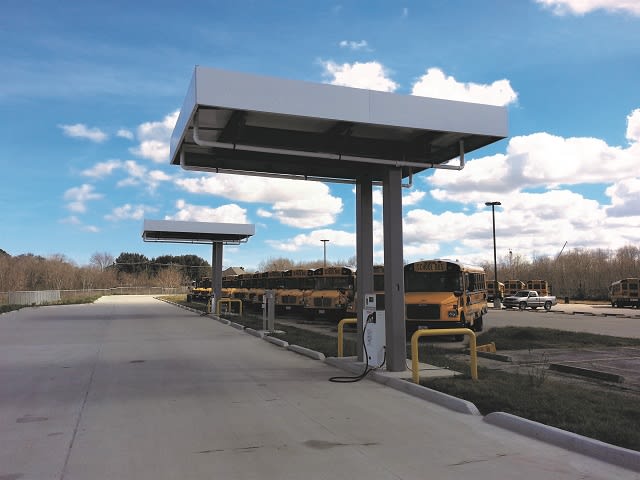
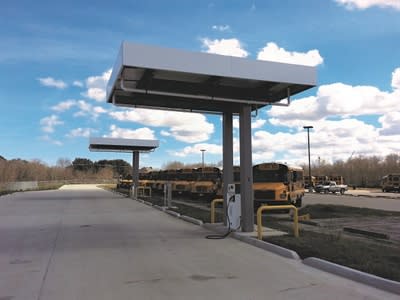
Propane fueling supplier Parafour Innovations often consults with school districts to customize their fleet’s fueling stations. Shown here is a mid-size station the company completed with a 18,000-gallon tank and two single hose dispensers.
3 min to read
Propane fueling supplier Parafour Innovations often consults with school districts to customize their fleet’s fueling stations. Shown here is a mid-size station the company completed with a 18,000-gallon tank and two single hose dispensers.
Alternative-fuel school buses are increasingly being used for pupil transportation. As a result, fueling and charging infrastructure suppliers are moving forward with equipment that has the potential to provide cost savings as well as reduce the consumption of power and fuel.
From propane buses to electric vehicles (EVs), student transportation providers need to assess which alternative-fueling equipment is the best fit for their operation. Here, propane fueling and EV infrastructure suppliers share insight on the various equipment options that are available, including customized fueling stations, fuel removal systems, and scheduled EV charging.
Ad Loading...
Customized Fueling
Most alternative-fueling equipment suppliers will provide school districts with the option to customize their fleet’s fueling and charging stations.
Propane autogas supplier Parafour Innovations offers fueling opportunities for both small and large school bus fleets.
“It really depends on where the district is going to locate the fueling station because some facilities don’t have enough room or space for multiple dispensers, so it would be more ideal for compact tank and dispenser packages,” says Robin Parsons, president of Parafour Innovations. “For newer facilities planning rapid fleet growth, dual-hose dispensers and 18,000 gallon tanks are a better option.”
For example, Parafour Innovations recently worked with Leander (Texas) Independent School District to install four new dual-hose dispensers to accommodate the district’s propane buses. The company also installed a leak detection system that sounds an alarm when the smell of gas reaches unsafe levels, typically 2% of the lower explosive limit, Parsons notes.
When specifying tank capacity for propane stations, he encourages school districts to order tanks that hold no less than about 2,000 gallons of propane, especially if the district has between five to 10 propane buses.
Ad Loading...
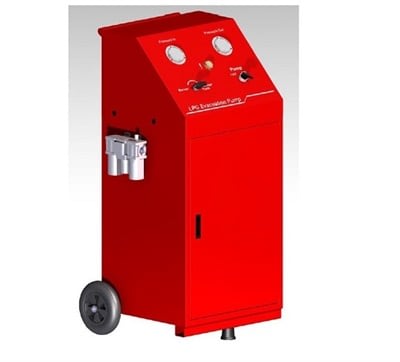
The Propane Evacuation Machine from Superior Energy Systems allows the propane that is removed from one vehicle tank to be transferred to that of another.
Propane Removal System
Propane fueling dispensers operate much like a gasoline pump, but with added safety features such as pull-away protection and heavy-duty steel construction.
Jim Bunsey, director of operations for Superior Energy Systems, says that “quick-connect” nozzles, which make the refueling process safer and easier, are now a standard offering, in which drivers are able to click in the nozzle, refuel, and go.
In addition to refueling equipment, if school districts are looking for more ways to service their propane-fueled vehicles, Superior Energy’s Propane Evacuation Machine helps fleets remove propane from buses for service and maintenance purposes.
The evacuation pump allows the propane that is removed from one vehicle tank to be transferred to that of another and/or to a separate propane storage tank. The unit, which is designed for use outside the school bus shop, also comes equipped with pneumatic wheels and a sight flow gauge that offers a visual of the propane transfer process.
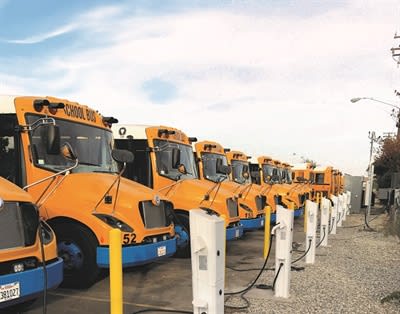
EV Connect offers both Level 2 and Level 3 charging options for school buses. Shown here are Level 2 charging stations for Twin Rivers Unified School District in McClellan Park, California.
Scheduled EV Charging
While propane and CNG suppliers offer time-fill or overnight fueling to optimize fleet costs, EV manufacturers are also providing scheduled charging services to compensate for the periods of time when school buses are inactive.
Ad Loading...
EV Connect, a supplier of EV charging infrastructure, offers both Level 2 (alternating current) and Level 3 (DC fast-charging) options for school buses.
David Hughes, the company’s vice president of government and sales, says Level 2 charging, which provides up to 16 kilowatt-hours of battery power, is the most common setup for school districts, along with scheduled charging to avoid utility demand charges.
Most electric school bus batteries can operate for about 120 miles, while the typical school bus route may be between 70 to 80 miles, Hughes says.
EV Connect uses a specific networked 70 amp charger that is designed for electric buses with routes of about 80 to 90 miles or less. Hughes says this type of charging infrastructure is relatively inexpensive compared to higher-powered DCFC chargers, and requires less complex electrical infrastructure.
New Power-Saving Approach to EV
Alternative-fuels systems and renewable natural gas (RNG) supplier Trillium is now offering its PowerUp program, which is designed to serve EV fleets using a variety of energy sources for production and storage.
“Drawing power from utilities, battery storage, solar panels, and on-site generation using RNG, PowerUp by Trillium allows school districts to take control of their power costs,” explains Bill Zobel, general manager of business development and marketing for Trillium.
In addition, the company offers a package that pulls from those sources of power and provides the district with low-cost and reliable power for their operation, he adds.
Trillium launched its PowerUp program at the Advanced Clean Transportation (ACT) Expo in April in Long Beach, California. Since then, Zobel says, the supplier has reached out to various school districts and its clients to educate them on the new offering.
The average PowerUp by Trillium solution is expected to take about nine months to install, according to the company.
See which fleets are adding electric and propane school buses as districts and operators invest in charging infrastructure, bidirectional technology, and alternative-fuel expansion.
With diesel prices surging, school bus fleets have new reason to stress-test fuel costs, consider diversification, and calculate what each route really costs to operate.
Gasoline is gaining ground in full-size school buses. See how today’s options stack up against diesel on cost, maintenance, emissions, performance, and more.
Batteries change throughout years of daily routes, but degradation doesn’t necessarily mean the end. Here’s what operators should know about performance, safety, and second life.
The new name represents a renewed vision for the nonprofit focused on advancing clean, equitable, and affordable transportation solutions that move people and goods.
Propane and electric school bus deployments continue to grow as districts add new vehicles, expand charging infrastructure, and gather more real-world operating data.
WRI’s latest buyer’s guide points to a consolidating electric school bus market, but fewer options may reflect a maturing industry rather than fewer meaningful choices for school bus operators.
Learn how propane autogas helps school districts manage fuel costs with predictable pricing, lower maintenance, and reduced emissions from former transportation director Joel Stutheit.